The Three Ways These Tools Charge Agencies
AI visibility tools charge agencies in one of three ways. Per client, where every new client domain or client workspace, a separate area of the tool for that client, adds a line to the bill. Per question, where you pay each time a tracked question, which vendors call a prompt, is checked on an assistant. Or one flat fee, sometimes with a shared pool of sites and prompts, that covers every client until the pool runs out.
The price on a vendor's pricing page tells you what one client costs. Its pricing model tells you what client twenty-five costs. That second number is the one that decides your margin, and it's the one this post works out.
The setup for every example is the same. An agency with 5, 10, or 25 clients, 20 tracked questions per client, each asked once a week on ChatGPT, Gemini, Claude, Perplexity, and Google AI. If you're still choosing tools by feature, our roundup of AI visibility tools built for agencies covers white-label and reporting. This post is only about how the bill grows.
Per-Client Pricing
Per-client pricing means every client you add costs the same amount again, so the bill is a straight line.
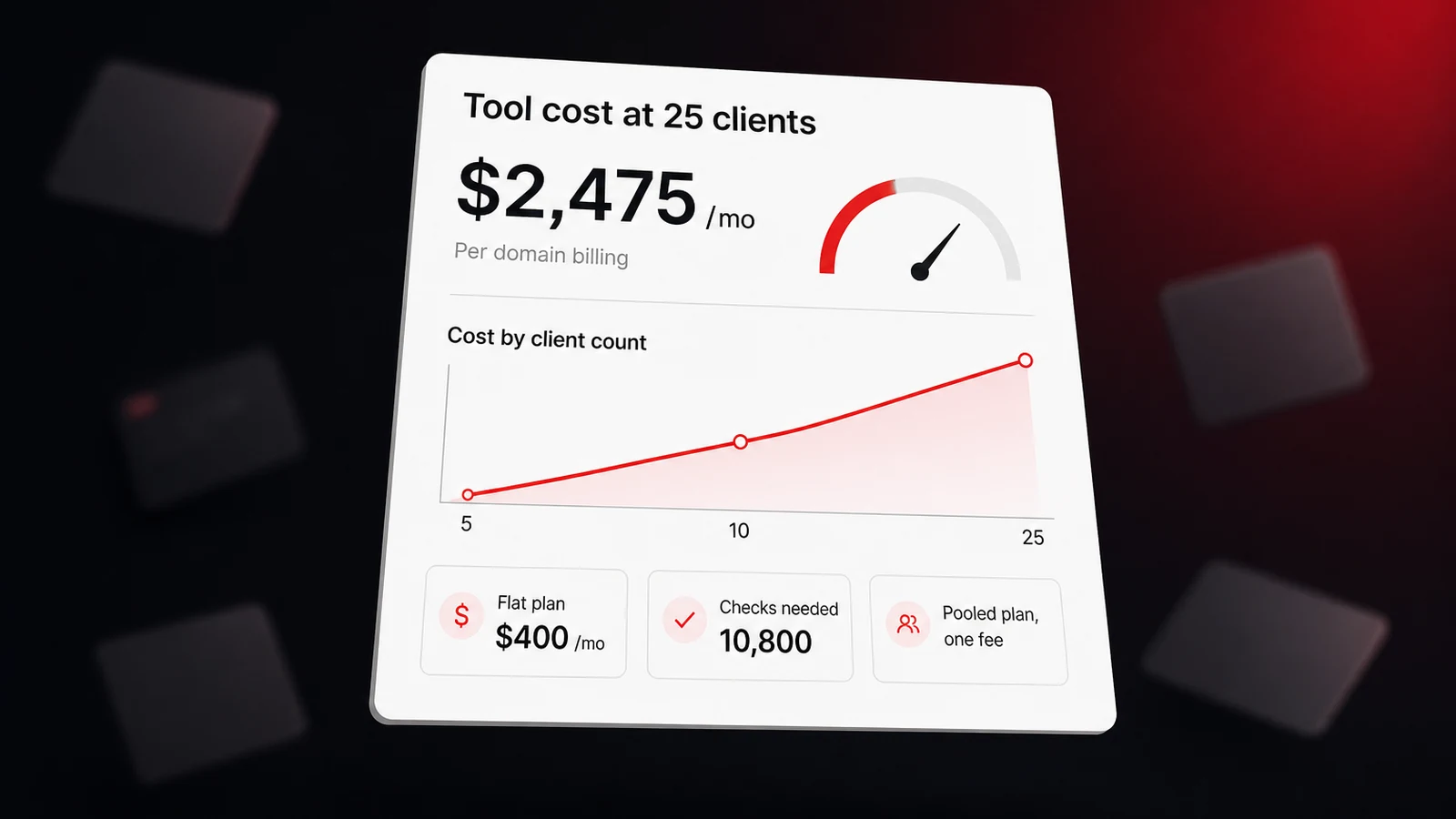
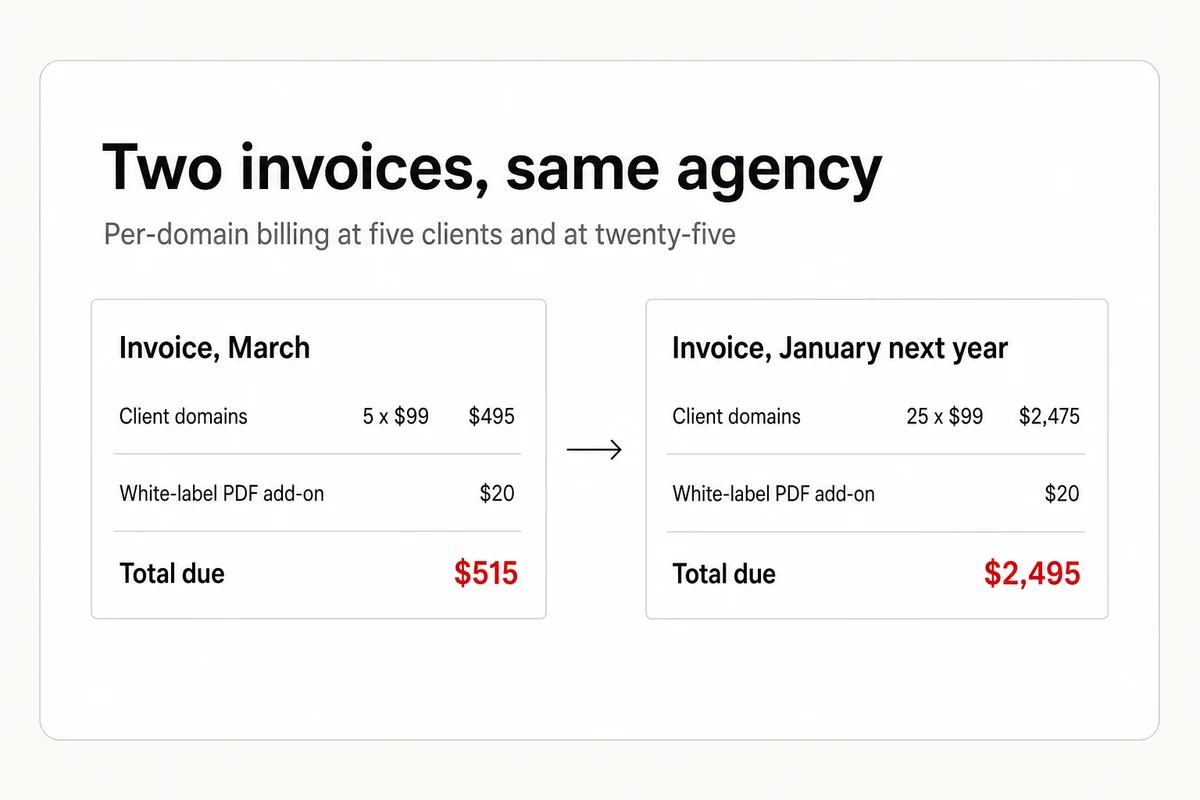
Semrush's AI Visibility Toolkit is the clearest example. Its own July 2026 guide to AI visibility tools for agencies prices the toolkit at $99 a month per domain, with white-label PDFs on a $20 a month add-on. Five clients cost $495 a month, ten cost $990, and twenty-five cost $2,475, before the add-on. With the $20 add-on the two invoices read $515 and $2,495. Each domain gets its own prompt allowance, which our Semrush AI Visibility Toolkit comparison lists, so one client's questions never crowd out another's.
Profound works the same way, with a bigger number. Its help center explains that each client gets a workspace with its own prompt set, competitors, and LLMs tracked, and the same Semrush guide lists Profound's Agency Growth plan at $99 a month plus $399 a month for each client workspace. That's $2,094 a month at five clients and $10,074 at twenty-five, the steepest line in this post.
Per-client pricing suits a small number of large clients. If each one pays you four figures a month, a $99 line beside it hardly registers. It hurts with a long tail of small local clients. At $300 a month per client, a $99 tool is a third of the fee before you've done an hour of work.
Pay-Per-Question Pricing
Pay-per-question pricing charges for what you ask, not how many clients you have. One question, on one assistant, on one day, is one check, and the client count is uncapped.
That makes the arithmetic the thing to get right. Twenty-five clients with 20 questions each, checked weekly across the five we track, is about 10,800 checks a month. Ten clients is about 4,300. Five is about 2,200.
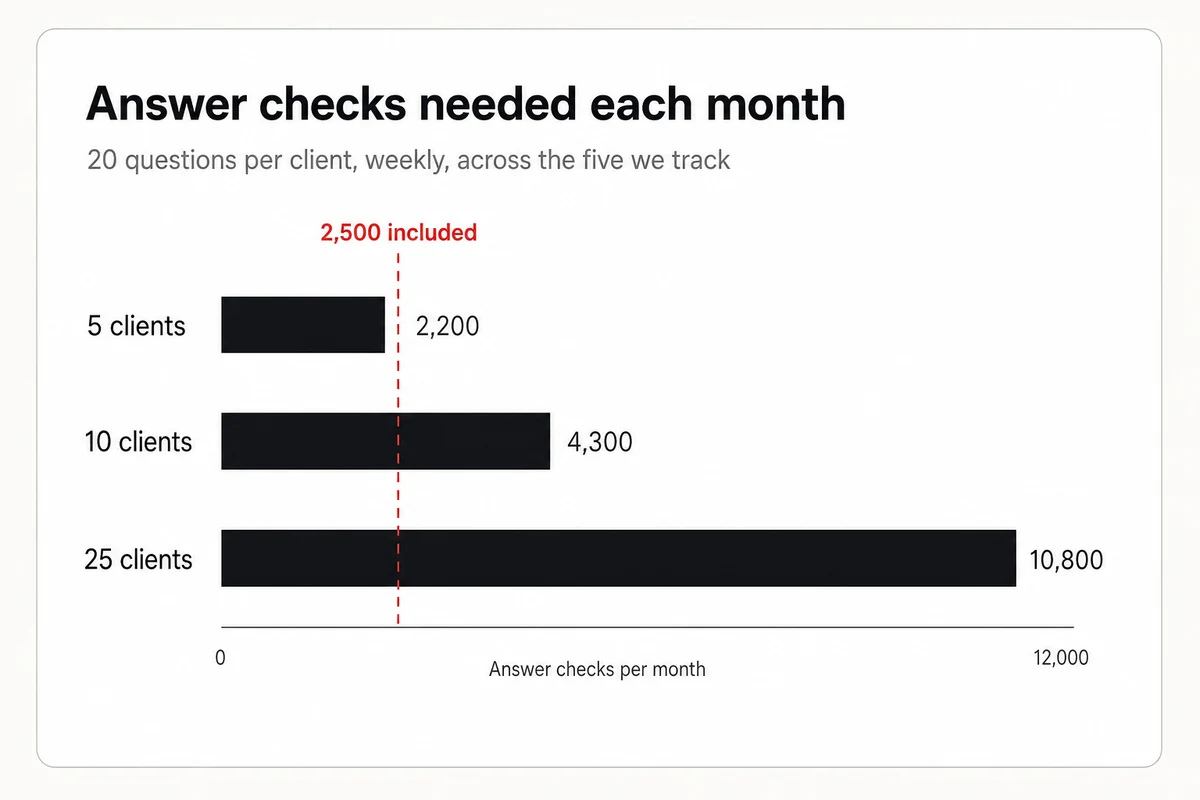
Ahrefs' Brand Radar is the example here. Its help center says there's no cap on the number of brands or domains you can analyze. What you pay for is checks. The all-platform plan is $699 a month with 2,500 checks included, which covers about five clients at our cadence. Past that, add-on tiers give you 2,500 more checks for $50, 7,000 for $100, or 25,000 for $250 a month. At ten clients that's $749 if the add-on stacks on the included checks and $799 if it replaces them. At twenty-five, only the 25,000 tier covers the month, so $949 either way. The page doesn't say whether a tier stacks on the included checks, so ask before you plan around it.
The trap in this model is the word unlimited. Unlimited brands on a plan with a fixed number of checks means every client shares that allowance, so client six gets fewer questions than client one unless you buy more. Divide the plan's checks by the questions you want per client. That's your real client capacity.
Pooled Pricing, How Lighthouse Local Charges Agencies
Pooled pricing is one monthly fee that covers a shared pool of client sites, tracked prompts, and competitors, and you decide how to split the pool across clients. It's the model Lighthouse Local for Agencies is built on, and it's the one that fits an agency with a long list of local clients.
Here's what that means on the bill. Adding a client doesn't add a line, it uses part of the pool you already pay for, so what each client costs you drops with every client you sign. Every client report is white-label on every agency tier, not a $20 add-on or a $399 workspace. A client's busy month doesn't raise the bill, because you move prompts between clients instead of buying more. And every agency plan starts with a 14-day free trial, so you can load real clients before you pay. The tiers and what each pool holds are on Lighthouse Local for Agencies.
A flat fee without a pool is the same idea with less control. Searchable's Scale plan with unlimited domains is $400 a month when billed annually, unlimited projects included, with a hard cap of 500 tracked prompts. That's exactly twenty-five clients at twenty questions each, and the twenty-sixth client takes questions away from someone. A pool has a ceiling too. The difference is that you choose how it's split.
What 25 Clients Cost Under Each Model
Here's the same agency under each model, using the vendor figures above. Treat it as a shape, not a quote. Prices change often, and the Ahrefs row depends on whether its add-on tiers stack with the included checks.
| Model | Example | 5 clients | 10 clients | 25 clients | What to watch |
|---|---|---|---|---|---|
| Per client | Semrush AI Visibility Toolkit, $99 a domain | $495 | $990 | $2,475 | $20 a month more for white-label PDFs |
| Per client | Profound Agency Growth, $99 base plus $399 a workspace | $2,094 | $4,089 | $10,074 | Pitch workspaces expire after about 30 days |
| Per question | Ahrefs Brand Radar, $699 with 2,500 checks | $699 | $749 to $799 | $949 | Clients are uncapped, checks are the bill |
| Flat | Searchable Scale, $400 | $400 | $400 | $400 | 500 tracked prompts is the cap |
| Flat, pooled | Lighthouse Local for Agencies | One monthly fee, a pool of client sites, prompts, and competitors you split yourself, white-label on every tier | Cost per client falls with every client you add | ||
Two things stand out. Per-client pricing is the only model where a client never competes with another for questions, and the only one that climbs in a straight line. It passes a $400 flat plan at the fifth client on Semrush, and from the first client on Profound. Flat and pooled plans hold their price and make prompts the thing you ration instead.
So the choice comes down to your mix. A few large clients who each need hundreds of questions are better served per client. Thirty small clients who each need fifteen are better served by a pool, which is why Lighthouse Local for Agencies is priced that way. Running all of them from one account, which our guide to tracking AI visibility for many clients walks through, is what makes the pooled math work.
Three Questions to Ask Before You Sign
What grows on the invoice when a client signs? Per client, it's one more line at list price. Per question, it's that client's questions times the assistants times the days. Pooled, it's nothing until the pool is full. Get the vendor to say it in writing, because pricing pages describe the first client and rarely the twentieth.
What does the client-facing version cost? The dashboard your client opens is often a separate line. Semrush sells white-label PDFs as a $20 add-on, for example. Price the plan you'd show a client, not the one you'd demo. If the readout is what you sell, our post on reselling AI visibility audits at a margin covers what to charge for it.
What happens in month two? Profound's pitch workspaces run about 30 days before a credit is needed to keep them, and add-on tiers start the first month you pass an allowance. None of that causes trouble if you know it in advance. All of it becomes a surprise invoice if you don't. None of it tells you whether the tracker's data is accurate, and evaluating AI visibility tracking tools for accuracy is the other test to run on the same trial.
Then set the tool against what you keep. Promethean Research's April 2026 study put the average digital agency's after-tax net margin at 13% in 2025, with studios under ten people at 19%. A tool whose cost grows in a straight line with clients eats into a margin that's already thin, and the agencies most exposed are the small ones adding local clients fastest.
Pick Your Pricing Model Before the Tool
Decide how you want to pay before you read a pricing page. Count the clients you expect in twelve months, decide how many questions each one deserves, and multiply by the assistants and the days you'll check. Then match the model to that shape. Per client for a few large accounts, per question for research-heavy work, a shared pool for a long tail of local businesses.
If that shape is a long tail of local clients, Lighthouse Local for Agencies was priced for exactly that, and Lighthouse Local's Beacon, a white-label audit sold on its own, is how you win the next client you'll track on it. Write the answer next to each vendor once, and a vendor's pricing page stops being the thing that decides.
Frequently asked questions
How do AI visibility tools charge agencies?
In one of three ways. Per client, where each domain or workspace is a new line at list price. Per question, where you pay for each prompt checked on each assistant on each day and the client count is uncapped. Or one flat fee, sometimes as a shared pool of sites, prompts, and competitors, that covers every client until the pool is used up.
Is per-client pricing bad for an agency?
Not by itself. It's the easiest model to forecast and the only one where a client never competes with another for questions. It gets expensive when your clients are many and small. At $99 a domain, each client adds $99 a month, which is a third of a $300 a month local client's fee and a rounding error against a four-figure one. Twenty-five of them is $2,475 a month before white-label add-ons.
What does unlimited clients mean on a flat plan?
That the cap moved somewhere else, usually to prompts, checks, or seats. A plan with unlimited brands and 100 prompts gives ten clients ten questions each. Divide the plan's prompt or check count by the questions you want per client to get your real client capacity.
How many AI answer checks does an agency need a month?
Multiply clients by questions per client by assistants by checks per month. Twenty-five clients, 20 questions each, once a week across ChatGPT, Gemini, Claude, Perplexity, and Google AI, is about 10,800 checks a month. Ten clients at the same cadence is about 4,300, and five is about 2,200.
Do white-label client reports cost extra?
Often, yes. Semrush, for example, sells branded PDFs as a $20 a month add-on. Lighthouse Local for Agencies includes white-label client reports on every agency tier, so the client-facing version costs the same as the plan.
Does Lighthouse Local charge agencies per client?
No. Every agency plan is one monthly fee with a pool of client sites, tracked prompts, and competitors that you split across clients yourself, white-label reports on every tier, and a 14-day free trial. Adding a client uses part of the pool rather than adding a line to the bill, so the cost per client falls as you grow.