What Agencies Need That Brand Tools Don't Offer
This guide picks the AI visibility tool that fits an agency reselling the service to clients, not the one that tracks the most engines. Most AI visibility tools were built for one brand watching itself. An agency runs the same job for twenty clients at once, under its own name, on a budget each client has to cover. That changes what a good tool means. In 2026, AgencyAnalytics surveyed 494 agency professionals and found that 66% report rising client demand for AI search optimization, the top new service request of the year. The same survey found 97% of agency leaders call accurate reporting important to keeping clients. Demand is up, and reporting is how you hold onto it.
So this comparison skips the feature race over which tool tracks the most engines. It scores twelve tools on five things that decide whether an agency can resell the service at a margin. White-label, so clients see your brand. Client reports, so the monthly proof writes itself. Share links, so a client can look without a screenshot deck. Ease of use, because you'll set this up twenty times. And the billing unit, because per-seat and per-domain bills scale very differently across a client list. If you're still deciding whether to offer the service at all, start with how agencies package AI visibility as a service, then come back for the tool.
White-Label Is a Tier, Not a Toggle
Ask a vendor whether they white-label and the honest answer is usually "on the right plan." Across the tools here, white-labeling shows up in three forms. Some include it on every plan. Some gate it behind a mid or top tier. Several don't mention it on their public pricing at all, which for a brand-side tool usually means it isn't a priority.
Nightwatch turns it on from its Professional plan up. Rankscale opens white-labeled dashboards on Growth and above. Writesonic saves it for its Agency Enterprise plan, and Peec AI, whose prices we couldn't confirm for the table below, lists white-label reporting only on its Comprehensive tier. Two rank-tracking suites sell it as an add-on. Semrush's AI Visibility Toolkit adds branding and white-labeling through its Pro Report add-on, and SE Ranking bundles white-label reporting into an Agency Pack. Profound, Ahrefs Brand Radar, AthenaHQ, and Scrunch AI don't address white-labeling on their pricing pages, and they're priced by seat, which tells you who they expect to log in. Lighthouse Local for Agencies puts white-label and a custom domain on every agency plan, so the tier you pick changes capacity, not whether your brand shows.
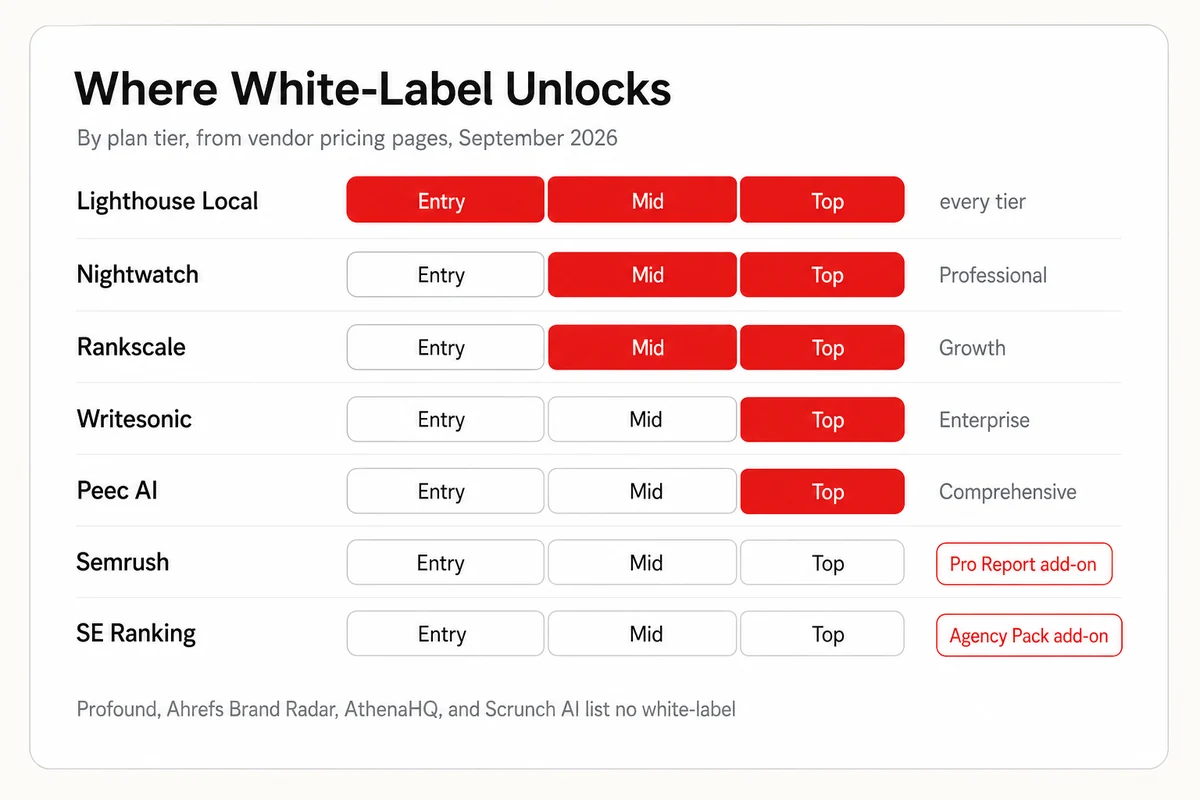
The practical test is a custom domain. A logo swap inside the vendor's own app still leaks the vendor the moment a client reads the address bar. If your clients will ever open a live dashboard, ask whether it can run at insights.youragency.com, not just carry your colors.
Client Reports Are Where Retention Is Won or Lost
A tracker only you can read is a research tool. A tracker that produces a report the client opens every month is a service. That's why reporting deserves more weight than engine count when you're choosing. Three questions sort the field. Does it export a PDF or send on a schedule? Does the report carry your brand? And does it show the actual answer an assistant gave, with the client named or missing, which is the one artifact a business owner understands without a legend?
Otterly.AI ships detailed reports with PDF export on every plan. Semrush sells scheduling and PDF export as a Base Report add-on, then branding as a second add-on on top. SE Ranking's Agency Pack includes unlimited scheduled reports with AI summaries. LLMrefs refreshes a weekly visibility report automatically, and Writesonic's Agency Starter pairs a dashboard with shareable audit reports. Nightwatch and Scrunch AI both list reporting, though neither spells out scheduling on its pricing page. Profound, Ahrefs Brand Radar, and AthenaHQ don't describe client reports at all, because their buyer is an in-house team that lives in the dashboard.
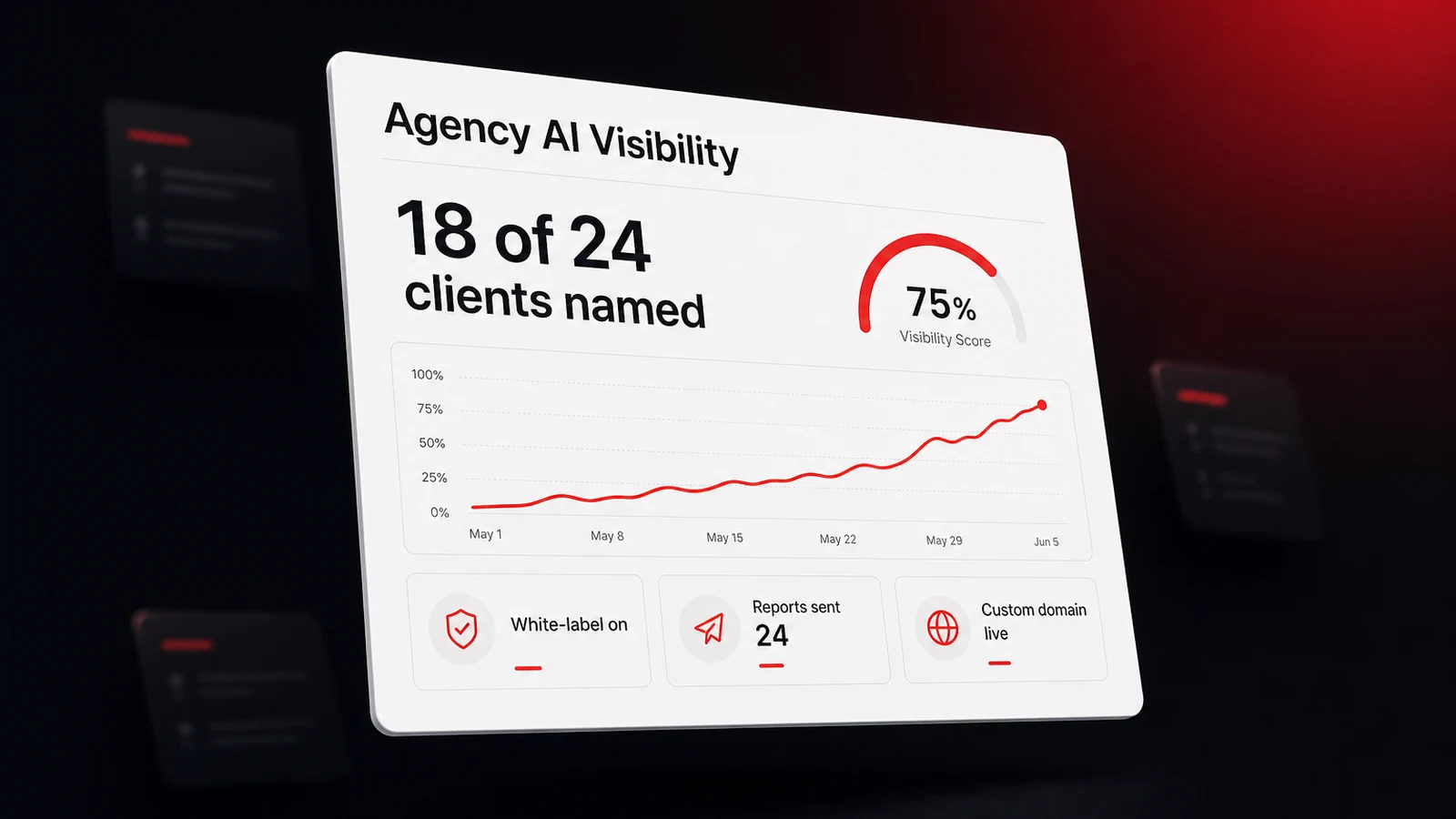
Lighthouse Local includes unlimited white-label client reports on each agency plan, built from the same per-assistant answers our AI visibility tracker records on a schedule. When the report shows the ChatGPT answer that named a competitor in March and the client in April, the renewal conversation is already written.
A Share Link Replaces the Monthly Screenshot Deck
Reports answer "how did we do." Share links answer "can I look right now," and they save your account managers from building a slide deck out of screenshots every month. The mechanics differ by tool. Some give a client a read-only login. Some generate a link to a live dashboard. Some only connect to a BI layer and leave the client-facing part to you.
SE Ranking offers guest links for view-only access. Rankscale includes shareable dashboard links across its tiers. Semrush adds sharing by link to the same Pro Report add-on that carries its white-labeling. Writesonic's shareable audit reports do a similar job for prospects. Otterly.AI routes through a Looker Studio connector on Standard and above, which works if you already build client dashboards there and is a second product to maintain if you don't. Profound, AthenaHQ, Ahrefs Brand Radar, LLMrefs, and Scrunch AI don't document a client-facing link on their pricing pages.
Lighthouse Local for Agencies hands you a white-labeled report for each client that you share from your own domain, at no extra cost on any tier. One caution applies to every row of the table below. A pricing page that says nothing about sharing isn't proof the feature is missing, so if a tool fits on every other axis, ask on the sales call before you rule it out.
Setup Time Should Be Measured in Minutes
You're going to onboard this tool once per client, so a setup that takes an afternoon for one brand takes a week across twenty. Three things drive the time. Whether there's a trial without a card, so you can test with a real client before committing. How prompts get created, since every tracker needs the questions a client's customers actually ask. And whether its pricing unit forces you to budget per client before you can even start.
Trials are common. SE Ranking and Nightwatch each offer 14 days without a card, and Lighthouse Local for Agencies runs a 14-day free trial with no setup fee. Scrunch AI, Rankscale, and LLMrefs run 7-day trials, and Scrunch says its onboarding takes about 30 minutes. Otterly.AI and Writesonic let you start without a card, and AthenaHQ's free tier comes with a small credit balance. Profound describes its setup as instant.
Prompts are the hidden cost. A local plumber's customers ask "who can fix a water heater in Mesa today," not "plumbing services Arizona," and a tracker only measures what it's told to ask. Tools that seed prompts from a database, like Ahrefs Brand Radar, save typing but skew generic. Tools that let you write prompts per client take longer up front and produce reports a client recognizes, and keeping every client's set in the same shape is what makes tracking AI visibility for many clients manageable. The fastest path is to take the questions customers actually type into an assistant and load ten of them per client on day one. Credit-based tools, Rankscale and AthenaHQ among them, add one more step, since you have to estimate how many credits each client's prompts will burn per month before you can promise a price.
Your Pricing Unit Decides Your Margin
Entry prices grab attention, but the unit you're billed in decides whether client number twenty costs the same as client number two. Five units show up across these tools. Per seat, where you pay for logins and clients share one prompt bundle. Per domain, where each client is a new bill. Per prompt or per check, where cost tracks the questions you ask times the engines you ask them on. Credits, a variable version of the same thing. And pooled capacity, where every client draws from one shared allowance.
Per domain is the easiest to forecast and the hardest on margin. Semrush's AI Visibility Toolkit runs $99 a month for one domain on annual billing and $99 for each additional domain, so ten clients cost $990 a month before the report add-ons that make it client-ready. Per seat suits an in-house team and fights an agency. Profound's Growth plan is $399 a month for three seats, and Scrunch AI's Starter is $250 a month for three, with prompt volume shared across whatever clients you load. Flat plans go the other way. LLMrefs charges $79 a month for unlimited projects up to 500 prompts, which is generous for a solo consultant and tight once ten clients each want fifty questions tracked. Nightwatch prices by keyword tier with unlimited seats, so its Agency plan at €399 a month behaves like a pool.
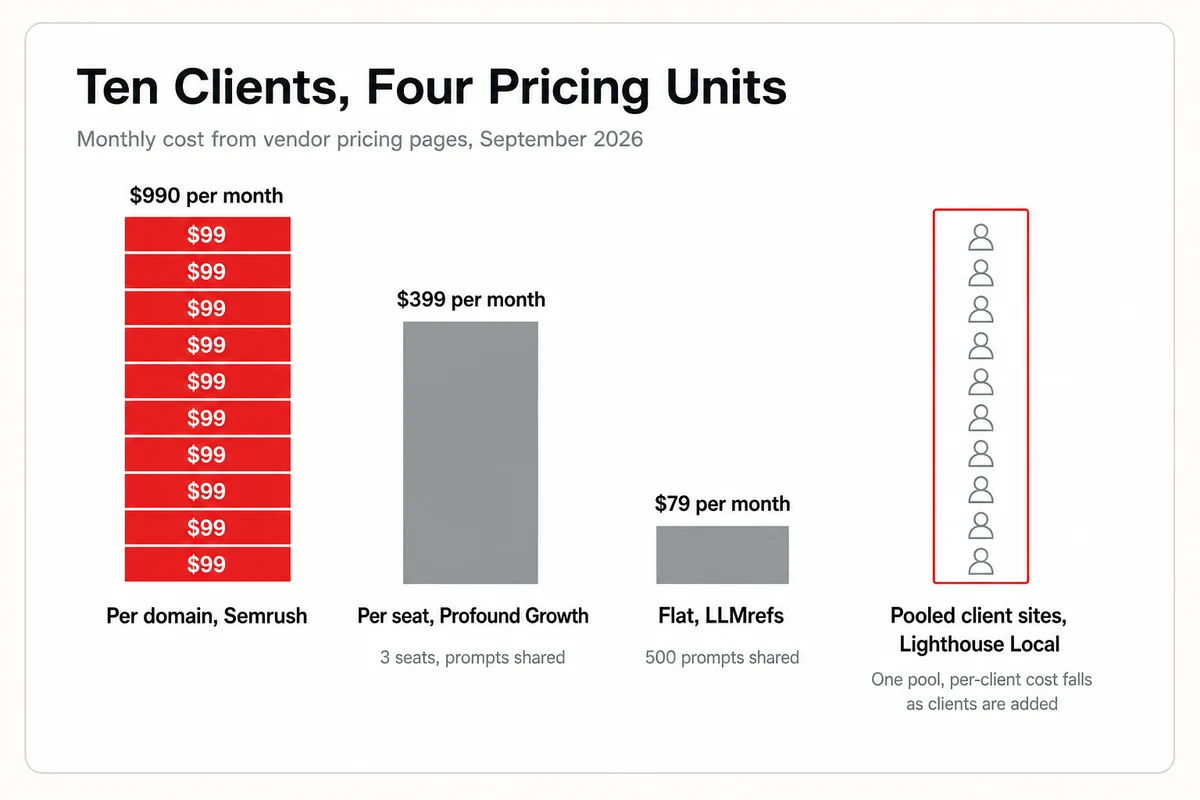
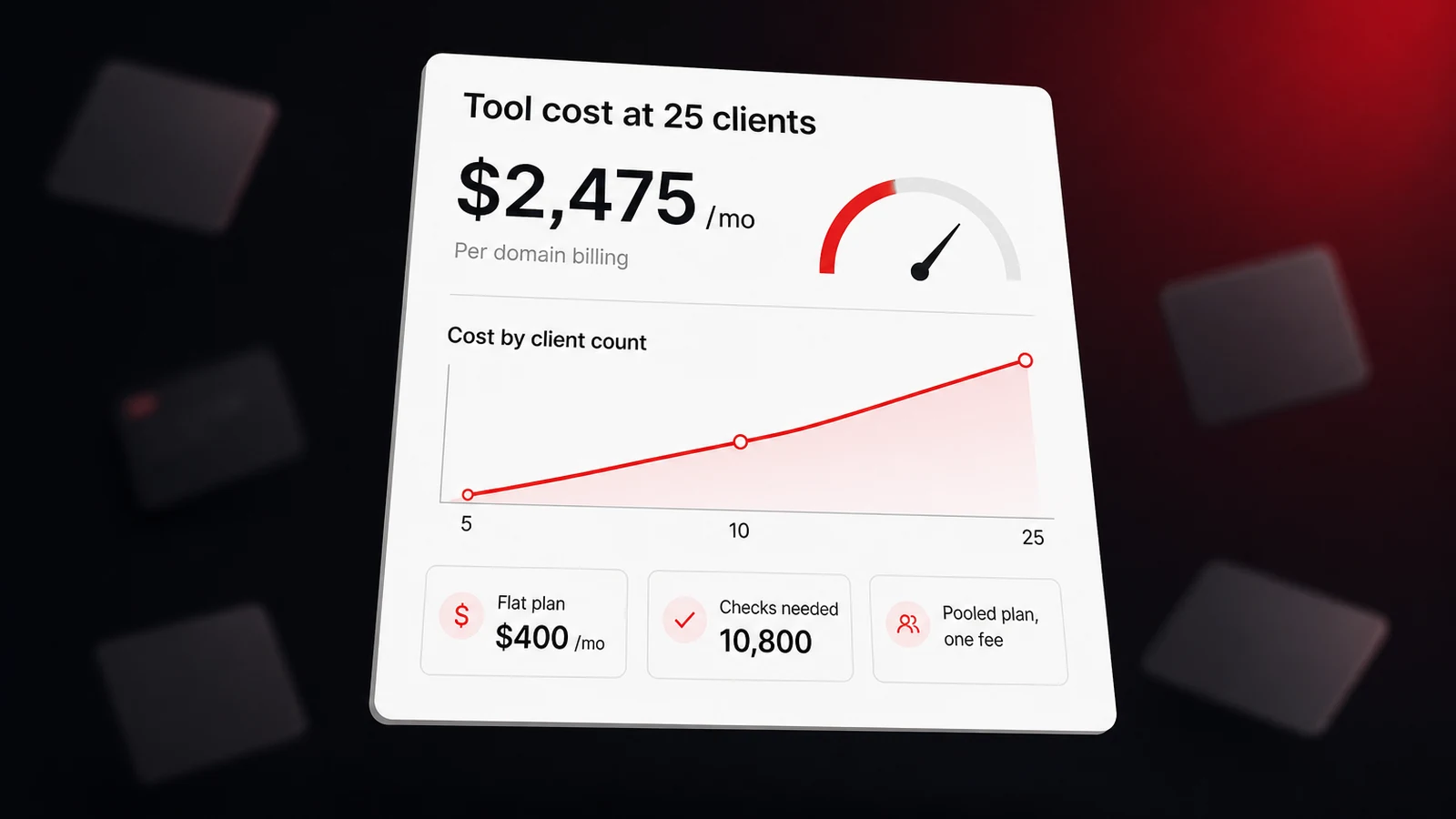
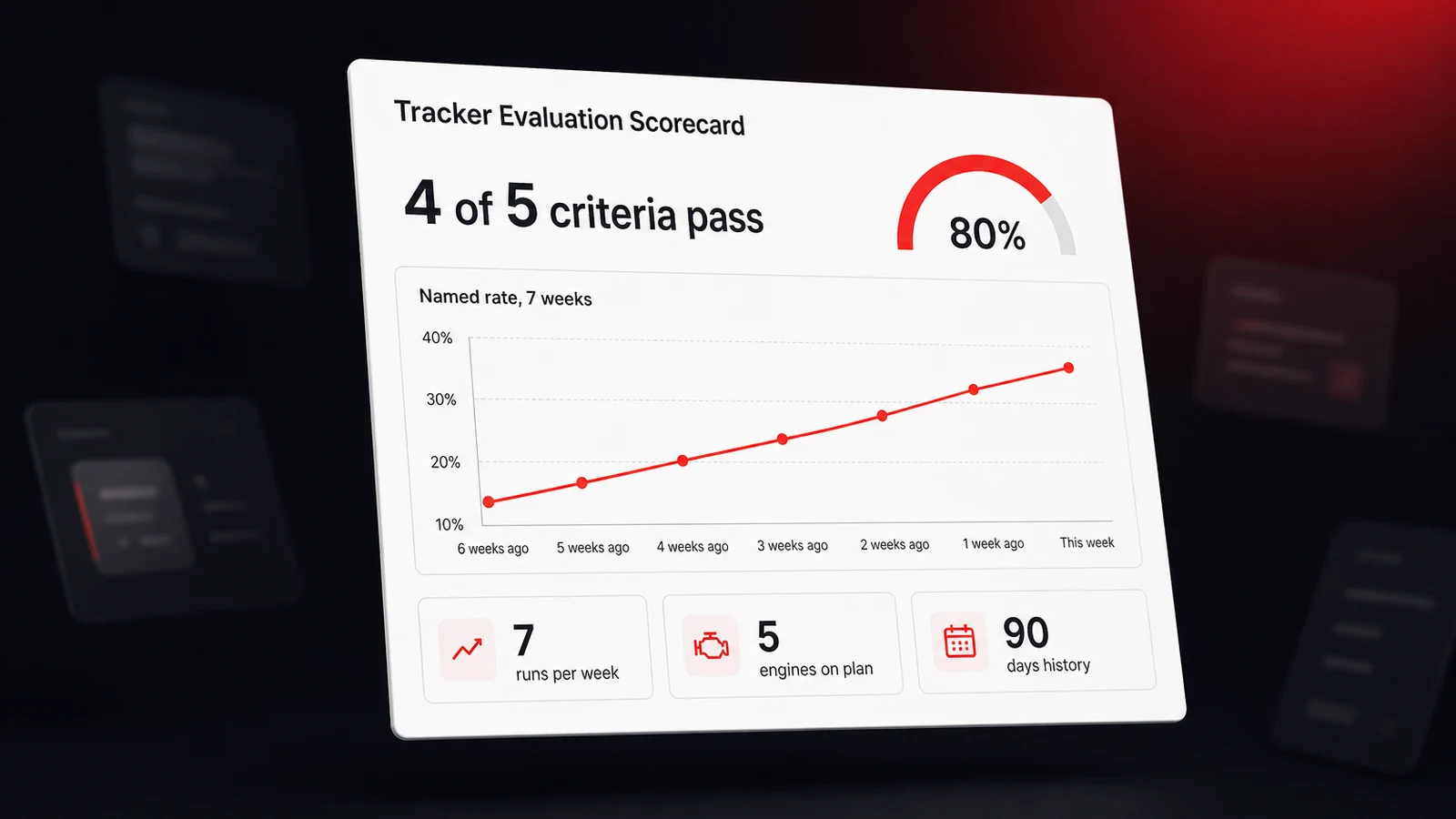
Lighthouse Local for Agencies prices by client site drawn from one shared pool of prompts and competitors that you allocate however you like, so per-client cost falls as you add clients instead of repeating. Whatever tool you pick, run the same arithmetic before you sign, once the tool has passed a trial scorecard for data accuracy. Take your realistic client count twelve months out, multiply by the unit the way our breakdown of how AI visibility tools charge agencies does at 5, 10, and 25 clients, add every add-on the client-facing version needs, and compare that number to what you'll bill per client per month. The tool's share of that bill is your margin, and it's the number this whole comparison exists to protect.
Twelve Tools on Five Axes
Every figure below comes from the vendor's own pricing page, opened in September 2026, on annual billing where the vendor offers it. Prices in this category change often, so treat the table as a shortlist filter and confirm the current number before you buy. A "not listed" on white-label or sharing means the vendor's pricing page doesn't mention it, not that it's confirmed absent. For current numbers, our dated comparisons of AI visibility tools re-check each vendor's pages and show the date we read each source.
| Tool | Entry price and tiers | Pricing unit | White-label | Client reports | Share links |
|---|---|---|---|---|---|
| Lighthouse Local for Agencies | Agency Starter, Agency Growth, and Agency Enterprise | Pooled client sites, prompts, and competitors | Every tier, with a custom domain | Unlimited white-label reports on every tier | Branded report per client on your own domain |
| Profound | Starter $99/mo, Growth $399/mo, Enterprise custom | Seats plus a prompt bundle | Not listed | Not listed | Not listed |
| Otterly.AI | Lite $29/mo, Standard $189/mo, Premium $489/mo | Prompt tiers, unlimited members | Not listed | Detailed reports with PDF export | Looker Studio connector on Standard and up |
| Semrush AI Visibility Toolkit | $99/mo per domain, $99 per extra domain, $45 per extra user | Per domain and per user | Pro Report add-on, $20/mo | Base Report add-on, $10/mo, PDF and scheduling | Sharing by link with Pro Report |
| Ahrefs Brand Radar | Included in core plans from $129/mo, standalone from $199/mo | Prompt checks, one per prompt per engine per location | Not listed | Not listed | Not listed |
| SE Ranking AI Search add-on | Core $103.20/mo plus the add-on at $71.20/mo | Checks plus seats | Agency Pack add-on, $69/mo | Unlimited scheduled reports with Agency Pack | Guest links, view only |
| Scrunch AI | Starter $250/mo, Growth $417/mo, Enterprise custom | Seats plus prompt volume | Not listed | Reporting dashboard on all plans | Not listed |
| Nightwatch | Starter €79/mo, Professional €159/mo, Agency €399/mo | Keyword and prompt tiers, unlimited seats | Professional and up | Included, white-label from Professional | Not listed |
| Rankscale | Essentials $20/mo, Pro $99/mo, Growth $385/mo, Enterprise $780/mo | Credits per engine query | Growth and up | Not listed | Shareable dashboard links |
| AthenaHQ | Essential free, Starter $295/mo, Enterprise custom | Credits, one response per credit | Not listed | Not listed | Not listed |
| Writesonic Agency | Agency Starter $200/mo, Agency Enterprise custom | Unlimited-seat workspace, capped by monthly answers | Agency Enterprise only | Shareable audit reports on Starter, white-label reports on Enterprise | Shareable audit reports |
| LLMrefs | $79/mo, one plan | Flat, unlimited seats and projects, 500 prompts | Not listed | Weekly automatic reports, CSV export | Not listed |
Match the Tool to the Agency You Run
No single tool wins on every axis, so pick by the agency you're actually running.
- You resell to local businesses at volume. You need white-label on the plan you can afford now, not the one you'll grow into, and a pricing unit that doesn't reprice every new client. Lighthouse Local for Agencies and Nightwatch's Agency plan are built around that shape. If winning those clients is the harder half, Lighthouse Local's Beacon lets prospects run a white-label AI visibility audit on themselves, on your own domain, and arrive as leads.
- You already pay for Semrush or SE Ranking. Their add-ons are the cheapest way in, and they sit inside a rank-tracking interface your team knows. The trade is that AI answers live one tab over from rankings, and ranking on page one doesn't guarantee an AI mention, so make sure the client report leads with the answer, not the position.
- You serve a few enterprise brands with in-house teams. Profound, AthenaHQ, and Scrunch AI are priced by seat and built for a brand team that lives in the dashboard, with single sign-on, executive dashboards, and engine counts that reach nine or more on the top tiers of Profound and AthenaHQ. White-label doesn't matter there, and neither does a pooled client list.
- You're a solo consultant with a handful of clients. LLMrefs, Otterly.AI's Lite plan, and Rankscale's Pro tier keep the bill under $100 a month. You'll do the branding by hand, and that's fine at five clients and painful at fifteen.
Two honest limits on our own row. Lighthouse Local tracks ChatGPT, Gemini, Claude, Perplexity, and Google AI, so if a client's customers live on Copilot or Grok, a nine-engine tool covers more ground. And it's built for agencies serving local and service businesses, not for an enterprise brand team that wants BI connectors and single sign-on.
Pick for the Client Meeting, Not the Demo
The demo is where every tool looks good, because every tool tracks something. The client meeting is where the differences show. Can the client see their own name in an answer, under your brand, at a link they can open without you, for a price that left you a margin? Score each shortlisted tool against that sentence and the field narrows to two or three fast.
If your shortlist needs white-label and a custom domain on the first tier, unlimited client reports, and a pool that gets cheaper per client as you grow, Lighthouse Local for Agencies was built to that spec, with a 14-day trial to test it on a real client before you commit. Choose the tool your client will see, not the one that impressed you.
Frequently asked questions
What is an AI visibility tool for agencies?
Software that asks ChatGPT, Gemini, Claude, Perplexity, and Google AI the questions a client's customers ask, records whether the client is named, and packages the result as a branded report. For an agency, white-label, client reporting, and pooled pricing matter as much as the tracking itself.
Which AI visibility tools offer white-label reporting?
On their September 2026 pricing pages, Nightwatch from its Professional plan, Rankscale from Growth, Writesonic on Agency Enterprise, Peec AI on Comprehensive, Semrush through its Pro Report add-on, SE Ranking through its Agency Pack, and Lighthouse Local for Agencies on every plan. Profound, Ahrefs Brand Radar, AthenaHQ, and Scrunch AI don't mention it.
How much do AI visibility tools cost for an agency?
In September 2026, entry plans for a single brand run from about $20 to $100 a month, and agency-grade plans with white-label land roughly between $150 and $500 a month. Your pricing unit matters more than the sticker, since per-domain tools multiply with every client while pooled plans don't.
Can clients view their AI visibility dashboard directly?
It depends on the tool. SE Ranking offers guest links, Rankscale offers shareable dashboards, and Semrush shares by link through its Pro Report add-on. Lighthouse Local for Agencies gives each client a white-labeled report on your own domain. Several brand-side tools don't document client access at all.
Do agencies need a tool, or can they check AI answers by hand?
Manual checks work for a first audit but don't scale. Answers change week to week and differ per assistant, so a tool that asks on a schedule and stores the history is what makes monthly client reporting possible across many clients.