One Sits on Top of the Results, the Other Replaces Them
Google AI Overviews and AI Mode are two layers of the same Google Search, and they treat a local business differently. An AI Overview is an AI-written summary that appears at the top of a normal results page, with the ads, the map pack, and the web results still underneath it. AI Mode is a separate tab where the AI answer is the whole page, you can ask follow-up questions, and the usual list of results is gone. The first is a box Google adds when it decides to. The second is a place a customer chooses to go.
Google has been pulling the two closer together. In December 2025, TechCrunch reported that Google was testing a merge of AI Overviews with AI Mode, describing the Overview as an AI-generated snapshot of key information above the results and AI Mode as a back-and-forth chat that, until then, had lived behind its own tab. By January 2026 that test had shipped. A reader can now ask a follow-up from inside an AI Overview and continue the conversation in AI Mode, and Gemini 3 became the default model behind Overviews worldwide. In its July 2026 earnings remarks, Google's CEO said AI Mode had crossed one billion monthly active users since Google took it global, and that the two surfaces had been brought together into one search experience.
So the honest framing isn't two products. It's one experience with two doors, and a local business is picked, described, and cited differently depending on which door the customer walked through. Both run on the same retrieval idea, a question split into several searches at once, which our post comparing how AI answer engines source content explains in full. What differs is what sits around the answer and what each surface leans on to build it.
The Same Boise Plumber Search, Run Both Ways
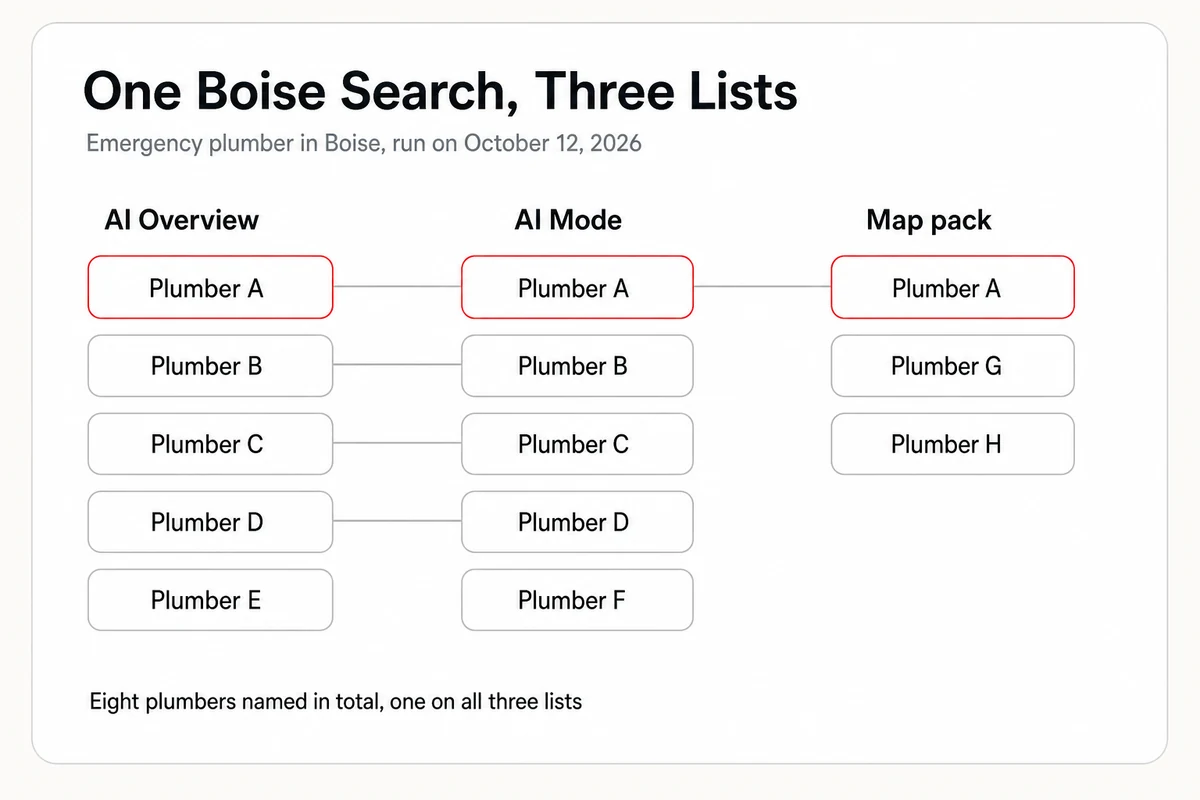
On October 12, 2026, we searched Google for an emergency plumber in Boise, Idaho, signed out, with the location set to Boise, and then ran the identical question in AI Mode. Here's what each page held, top to bottom.
The regular results page opened with two sponsored plumbers, then the AI Overview. Its first sentence named two plumbers with their phone numbers. Under that sat a list of five business cards, each with a star rating, review count, address, hours, and a line of services, then three bullets on what to do while waiting, then two follow-up questions. The sources were tucked into small chips at the side. Below the Overview came the three-business map pack, a button offering to have AI get prices, four related questions, and the ten web results.
AI Mode was a different page. No ads, no map pack, no list of links. One sentence, then five business cards, each with a Highlights line that summarized what reviewers said, for instance that customers reported fast weekend response for a burst main line. Then a comparison table with ratings and a one-line note per plumber, an embedded map, two follow-up questions, and a sources panel showing one plumber's website and two Google Business Profile entries.
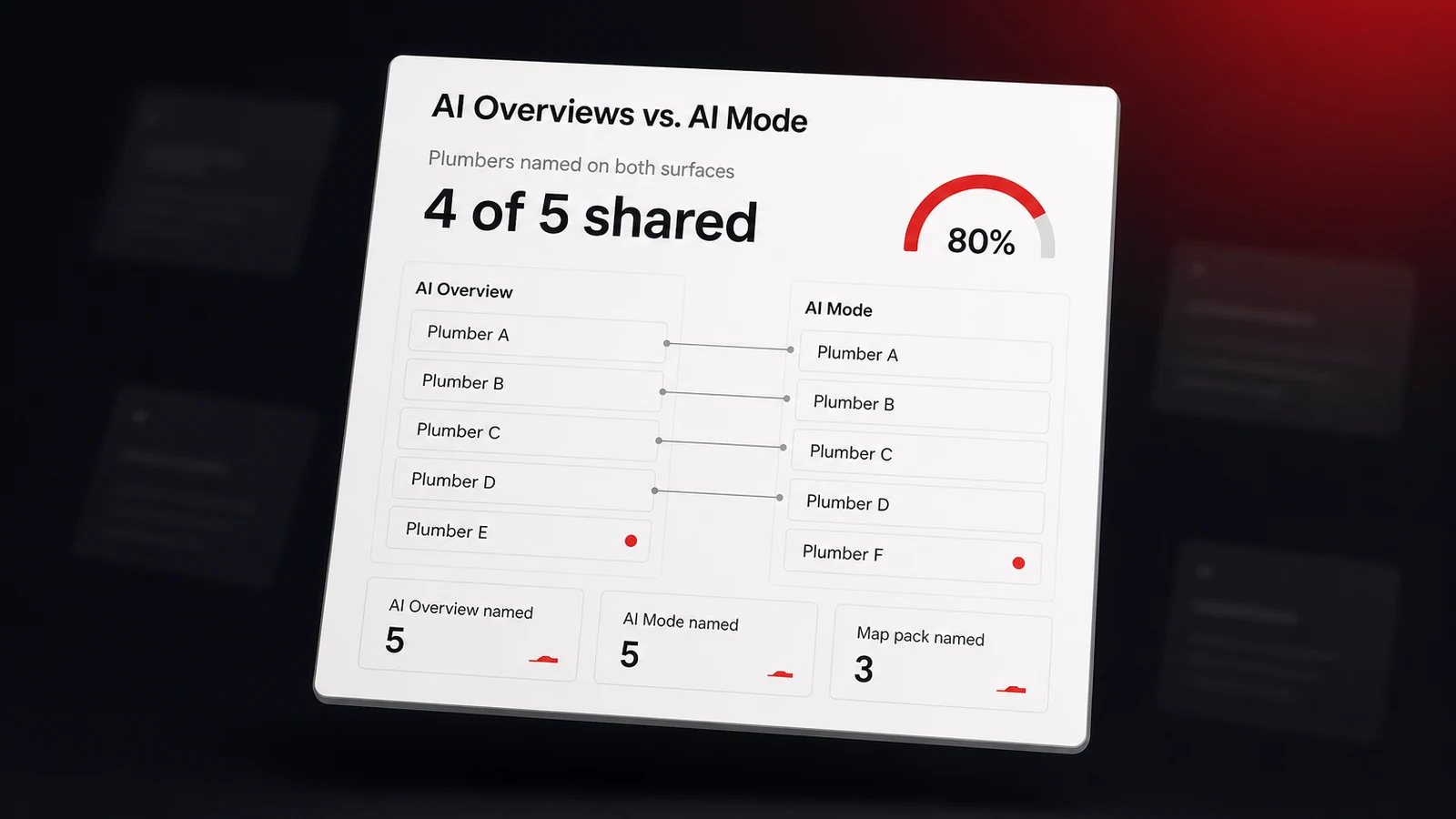
The lists overlapped, but not the way you'd guess. Of the Overview's five plumbers, four also appeared in AI Mode's five. Each surface had one plumber the other skipped. The map pack of three, the list most owners obsess over, shared only one business with either AI list. Across the three lists, eight different plumbers were named, and exactly one appeared in all three.
| List on the page | Businesses shown | Shared with the AI Overview | Shared with AI Mode |
|---|---|---|---|
| AI Overview cards | 5 | 4 | |
| AI Mode cards | 5 | 4 | |
| Map pack | 3 | 1 | 1 |
One more thing happened. We loaded the regular results page a second time a few minutes later, and the Overview had shrunk to a single recommended plumber with a Show more button. Same question, same location, different Overview. Keep that in mind for the checking routine later in this post.
Where the Two Surfaces Differ, Side by Side
Here's the comparison a local business owner needs, with the sourced numbers behind the last three rows in the sections that follow.
| Question | AI Overview | AI Mode |
|---|---|---|
| Where it appears | Top of a normal results page, only when Google decides to add one | Its own tab, every time someone asks there |
| What surrounds it | Ads above, map pack and web results below | Nothing. The answer is the page |
| How a customer reaches it | Automatically, by searching | By choosing the tab, or by asking a follow-up inside an Overview |
| Local business cards | Yes, Business Profile cards with rating, hours, services | Yes, plus review-based highlights, a comparison table, and a map |
| Follow-up questions | Offered, and they open AI Mode | The whole point of the page |
| How often a local search gets one | A minority of local searches, depending on wording and trade | Always, once the customer is in AI Mode |
| What it cites | Mostly web pages, with little overlap with AI Mode | Web pages plus a large share of Google's own pages and Business Profiles |
| What happens to the click | Fewer clicks than a plain results page | Fewer still, and the session runs longer |
| Where you measure it | Search Console, combined with AI Mode, impressions only | The same report, same limits |
Two of those rows decide most of the strategy. A business can be invisible to the Overview and still never lose a customer to it, because the Overview often doesn't appear. The same business can't opt out of AI Mode, because a customer who goes there gets an AI answer every time.
How Often a Local Search Even Gets an AI Overview
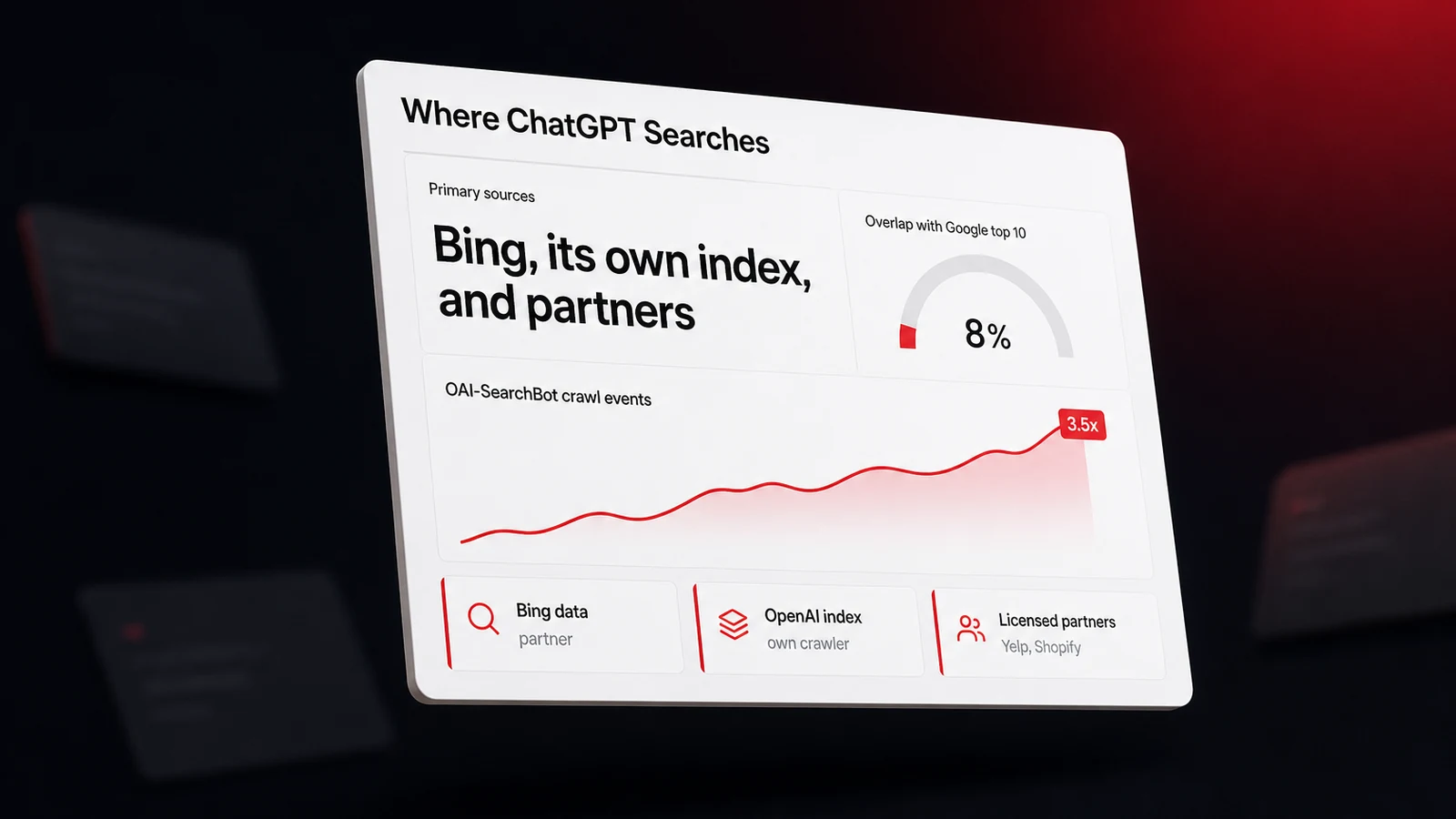
An AI Overview appears on a minority of local searches, and the exact share depends on how you count. In November 2025, Ahrefs analyzed about 146 million desktop results pages from September 2025 and found that AI Overviews appeared on 20.5 percent of all results pages but only 7.9 percent of local searches. That counts every query Ahrefs classes as local, however it's phrased. Hand-run service-plus-city questions, the kind a customer with a leak types, see Overviews far more often. In May 2025, Whitespark ran 540 of them across three cities and six trades and found an Overview on 68 percent, a study we covered in our post on the divide between branded and unbranded AI visibility.
Vertical matters too. In September 2026, Local Falcon ran 84,204 searches for 998 US hotels and recorded that Google showed no AI Overview on about 47.8 percent of its hotel searches. In the same study, AI Mode named the hotel being searched for in 64.5 percent of searches, Google Maps in 56.4 percent, and AI Overviews in just 10.4 percent. That's one vertical and a vendor's own data, so treat it as a reading, not a law. But the shape of it matches what we saw in Boise. The Overview is a sometimes. AI Mode, once a customer is there, answers every time, and it names businesses more freely than the Overview does.
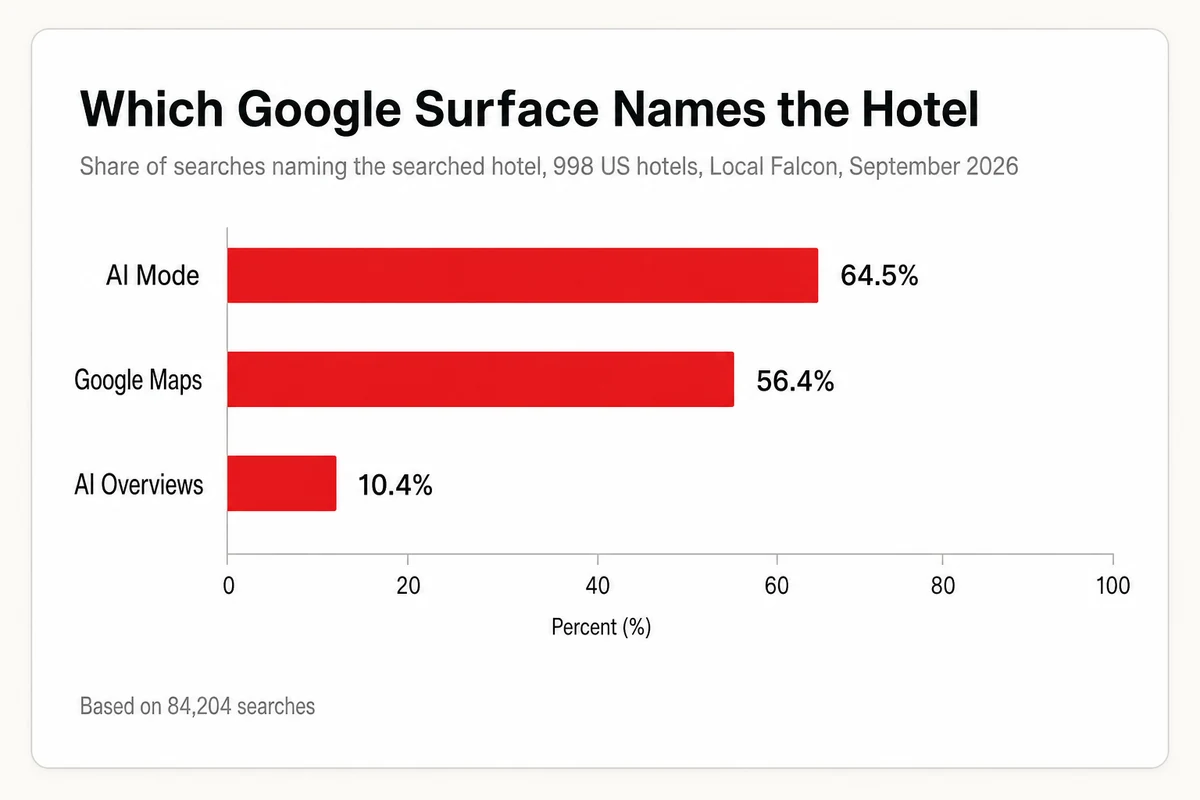
For a local business, the practical reading is this. Your map pack and your Overview presence are the surfaces for the customer who searches the old way. AI Mode is the surface for the customer who has started asking Google questions the way they'd ask a friend, and that group passed a billion people this year.
Where Each Surface Gets Its Facts About You
AI Overviews and AI Mode give similar answers from different sources, and for a local business the difference is which of your records each one reads. In December 2025, Ahrefs compared 540,000 pairs of AI Overview and AI Mode responses to the same queries and found that the two cited the same URLs only 13.7 percent of the time, while a separate 730,000-pair comparison found the answers themselves about 86 percent similar in meaning. Same conclusion, different footnotes.
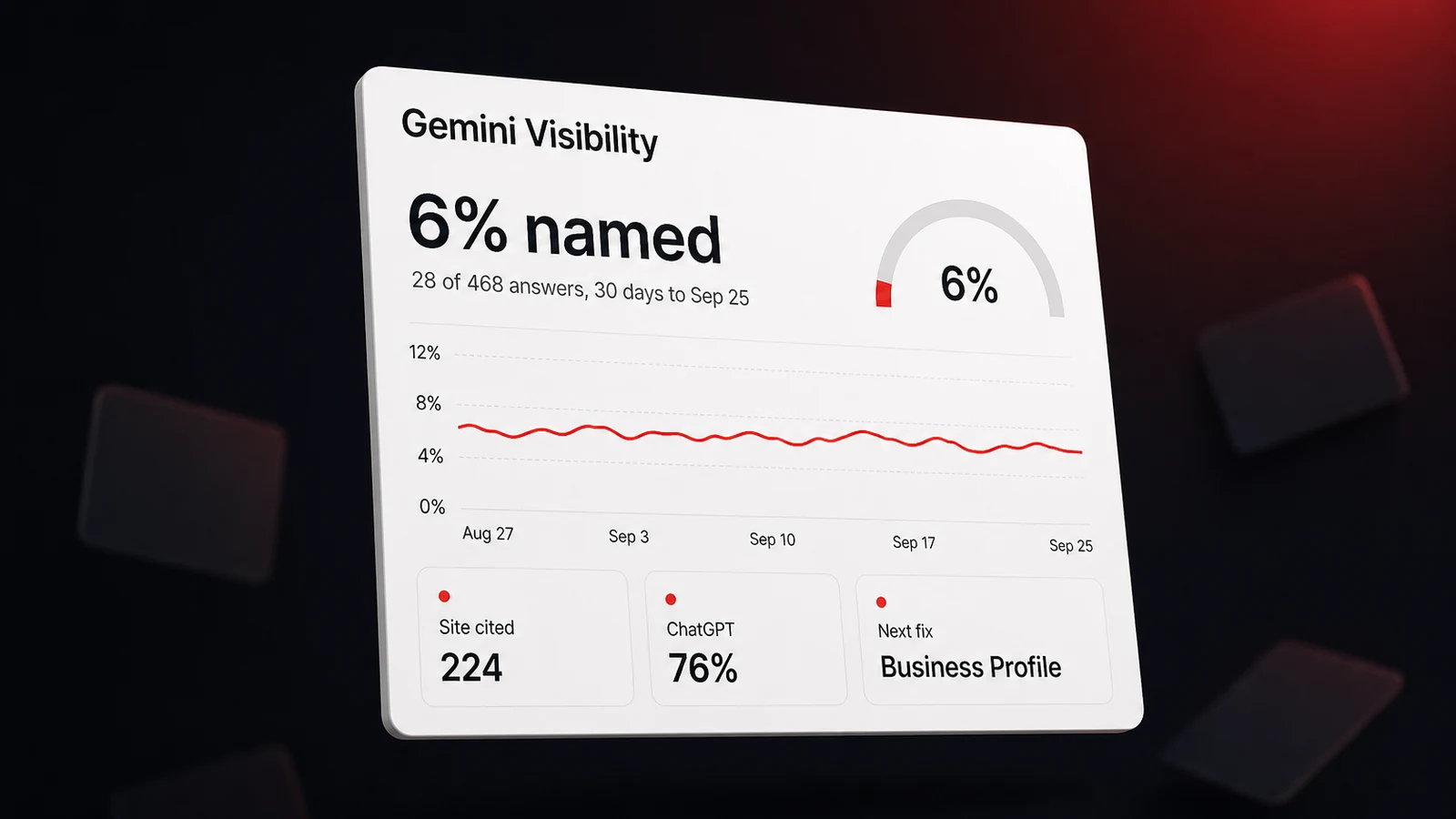
Where AI Mode's footnotes point is the part that matters locally. In a study run in February 2026 across 68,313 keywords and 1,321,398 citations, SE Ranking found that google.com made up 17.42 percent of all AI Mode citations, and of those Google links, 36.1 percent went to Business Profiles and 59 percent to Google's own results pages. Eight months earlier, in June 2025, 97.9 percent of those Google links had pointed at Business Profiles. So roughly one AI Mode citation in six points back at Google itself, measured across 20 niches, and at launch nearly all of those Google links were Business Profiles. For local questions specifically, Steady Demand's data showed AI Mode leaning on Maps and Business Profile records while the Overview leaned on business websites, a split we covered in our post on getting recommended by Gemini.
Whitespark's May 2026 guide to AI Mode for local businesses describes the mechanics the same way. AI Mode shows ratings, review counts, pricing, and hours pulled from Business Profiles, with citations in a side column, and the guide is blunt that there's no practical way to see what each individual customer is being shown. In Boise, the Highlights line under each plumber was built from review text, which is a Business Profile artifact, not a website one. If your reviews say nothing specific, AI Mode has nothing specific to say about you.
Why the Click Changes Shape in AI Mode
Both surfaces send fewer people to websites than a plain results page, and AI Mode sends fewer still. The cleanest evidence is a preregistered experiment, not a traffic report. In August 2026, researchers at the University of Pennsylvania and Northeastern published a field study of 1,100 Google users in which being assigned to AI Mode cut external click-through by 18.8 percentage points, while removing Google's AI features altogether raised it by 8.8 points. Sessions in AI Mode also ran longer, with fewer searches per day. The customer stays in the conversation and leaves it later, with a decision already made.
Google's own numbers run the other direction, without a denominator. In July 2026, Google said its AI features send billions of clicks to websites every week, and Search Engine Journal pointed out that the claim came with no baseline and that the new generative AI reports in Search Console don't include click data. So you can't check it against your own site.
What you can see in analytics has improved. When AI Mode launched, its links carried a no-referrer tag, so visits from it landed in Google Analytics as Direct traffic. In May 2025, Google's John Mueller called it a bug on Google's side and it was fixed, so an AI Mode click now arrives looking like any other Google search visit. That's the catch. It looks like ordinary Google traffic, so your analytics can't tell you which door it came through.
For a local business the click matters less than it does for a publisher. A plumber doesn't need the visit if the card in the answer carries the phone number, the hours, and a Call button, and in Boise every card did. What a plumber needs is to be one of those five cards, and then to be reachable the moment someone taps.
Check Both for Your Own Business Without Signing In
You can read both surfaces for your own business in ten minutes, and the routine is the same one we ran in Boise.
- Open a private browser window so your own history doesn't shape the answer, and set the location to the city you serve.
- Type the question a customer types, with the service and the city, never your business name. Note whether an AI Overview appears at all, how many businesses it names, and whether you're one of them. Click Show more and look at the source chips.
- Click the AI Mode tab and ask the identical question. Note the cards, read the Highlights line under each, and open the sources panel to see whether it's citing websites or Business Profiles.
- Ask the same question a second way. Local Falcon's hotel study found that AI Mode named the searched hotel in 75.7 percent of searches for a best hotel near me, but only 53.3 percent for best hotels near me. One letter changed the list by more than twenty points.
- Write the three lists down, the Overview, AI Mode, and the map pack, and mark who's in all three. Then do it again next week, because the Overview you saw today may not be the one a customer sees tomorrow. Ours changed between two loads.
For the numbers behind the routine, Search Console's generative AI report shows how many times your pages showed up in AI Overviews and AI Mode, and Search Engine Journal's August 2026 walkthrough notes it reports impressions from AI Overviews and AI Mode together, with no clicks, queries, or positions. It tells you that you appeared. It can't tell you what the answer said or who was named beside you. For that, Lighthouse Local's AI visibility tracker reads the AI Overview off a live Google results page for your business's location, on a schedule, and logs which businesses were named each time, so the weekly check happens without you.
What to Fix for Each, and in What Order
Because the two surfaces read different records, the fix list splits in two. Start with the Business Profile, because it's the record the cards on both surfaces are built from.
For AI Mode, fix the Business Profile. AI Mode's local cards are Business Profile cards, so start where the data comes from. Fill every field, keep hours exact, and choose categories that match the service a customer would type. Why your Google Business Profile shapes AI visibility is a post of its own, and the short version is that it's the fact sheet every Google AI answer reads first. Then look at your reviews as source material rather than a score. The Highlights line is written from what reviewers say, so a review that mentions a Sunday callout or a 45-minute arrival gives AI Mode a sentence to quote. How reviews shape AI recommendations covers how to earn that kind of review without scripting it.
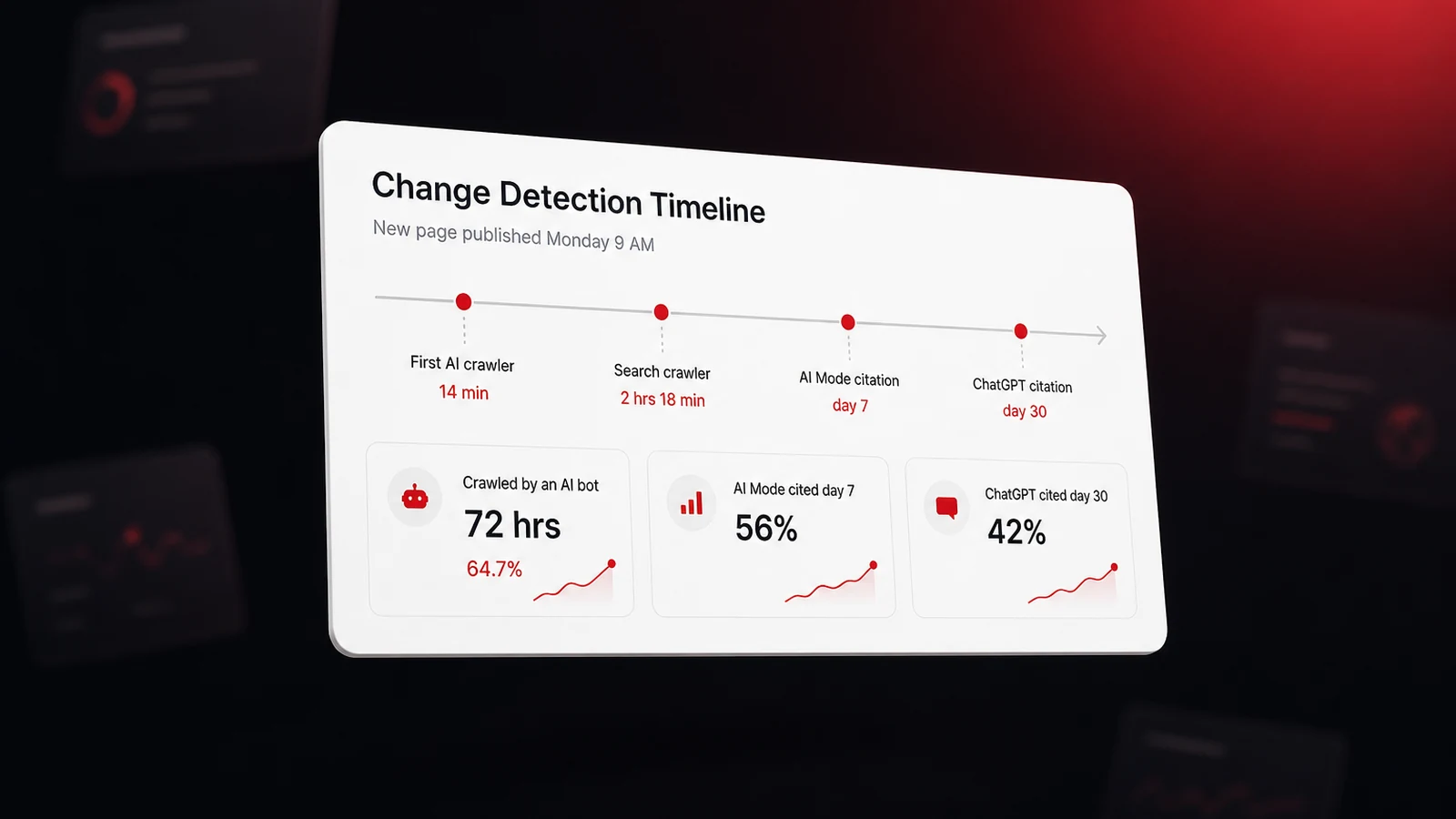
For the AI Overview, fix the service page. The Overview leans on web pages, so the page that answers the customer's question has to exist, be indexed, and say the answer plainly near the top. One page per service, with the city in the heading, a direct answer to what it costs and how fast you come, and a phone number in text, not an image. The Overview's source chips in Boise pointed at exactly that kind of page. Google can cite a fresh page within the week, but how long it takes AI to notice website changes varies by assistant, so give an edit a week or two before you judge it.
For both, answer the phone. Google has been adding agentic features to AI Mode. In July 2025, Google rolled out a feature that lets its AI call local businesses to check pricing and availability on a searcher's behalf, each call opening by saying an automated system is calling for a user. In August 2025, AI Mode expanded to 180 new countries and began finding restaurant reservations, and in November 2025 it started booking beauty and wellness appointments for users in Google's test program. The Boise results page carried a button offering to have AI get prices. A business that lets calls ring out, or whose booking link is broken, is failing a test it never sees. If you'd rather hand the profile, review, and service-page work to specialists, Lighthouse Local for Business does that work for you, with you approving each change.
Two Surfaces, Two Records, One Weekly Check
An AI Overview is Google summarizing the web on top of your results. AI Mode is Google answering the customer in a conversation, with its own Business Profile records doing more of the work. Being named in one doesn't mean being named in the other, and in Boise the map pack agreed with neither. For the page-side half of the work, run a free Lighthouse Local audit of your site and get back a ranked fix list of the on-site signals it scores. For the profile-side half, run the ten-minute check above. Fix the Business Profile because that's the record the cards are built from, fix the service page because that's what the Overview reads, and check both lists every week until your name stops moving.
Frequently asked questions
What is the difference between Google AI Overviews and AI Mode?
An AI Overview is an AI-written summary at the top of a normal Google results page, with ads, the map pack, and web results still below it. AI Mode is a separate conversational tab where the AI answer is the whole page and you can ask follow-up questions. Google now lets a follow-up asked inside an Overview continue in AI Mode.
Does AI Mode show local businesses?
Yes. For a local question, AI Mode shows business cards built from Google Business Profiles, with ratings, review counts, hours, a Call button, a highlights line summarized from reviews, often a comparison table, and a map. In a February 2026 study, 36.1 percent of the Google links AI Mode cited went to Business Profiles.
How often do AI Overviews appear on local searches?
It depends on the query. Across about 146 million desktop results pages in late 2025, Ahrefs found an AI Overview on 20.5 percent of all pages but only 7.9 percent of local searches. Hand-run service-plus-city questions see them far more often, and a 2026 hotel study found no Overview on about 48 percent of searches. AI Mode answers every time once a customer is there.
Do AI Overviews and AI Mode cite the same sources?
Rarely. In a December 2025 Ahrefs study, the two surfaces cited the same URLs 13.7 percent of the time across 540,000 query pairs, while a separate 730,000-pair comparison found the answers about 86 percent similar in meaning. AI Mode leans heavily on Google's own pages and Business Profiles, while Overviews lean on web pages.
How do I check whether AI Mode names my business?
In a private browser window with your city set, ask the question a customer would type with the service and city but not your name, first on the normal results page and then in the AI Mode tab. Note who's named on each, open the sources, ask it a second way, and repeat weekly, because the lists change between loads. A tracker can run the Overview check on a schedule for you.