
One Question, Two Machines
AI answer engines source content by fanning one question into several sub-searches, reading passages rather than whole pages, and citing only a handful of what they retrieve, a different pipeline from Google's crawl, index, rank, click model. A homeowner in Tacoma types "emergency electrician Tacoma" into two boxes. In Google, the words come back as a ranked list, a map pack, and ten links to choose from. In an AI answer engine, the same words come back as three paragraphs naming two or three companies, with a few small source markers at the end. Same intent, same web, and a completely different machine deciding who gets named.
Google's own engineers describe the gap plainly. In March 2026, Dounia Berrada, a senior engineering director on Search, explained that AI Mode is "basically doing a dozen searches for you in the time it takes to do one." That single sentence is the whole story of this post. Traditional search runs one query and ranks whole pages. An answer engine runs many queries, reads passages, and writes one answer.
The volume behind this is no longer small. In 2026, Similarweb measured AI platforms sending an average of 770.7 million referral visits a month worldwide between June 2025 and May 2026, more than double the year before, with every industry category it tracks at least doubling. Our comparison of SEO vs. AEO and why you need both makes the strategic case. This post is about the mechanics underneath, stage by stage, and what each difference means for a page you'd like to see cited.
Crawl, Index, Rank, Click
Traditional search is a four-stage pipeline, and every stage treats the page as the unit. A crawler fetches your URL. An indexer stores what it found, page by page. A ranker takes the query as typed, scores every indexed page against it, and produces one ordered list. A person scans that list and clicks. The contest ends at the click, and the search engine's job is finished the moment you land on the page.
That model has three properties worth naming, because the answer engine breaks all three. The query is handled as the person wrote it. The page competes as a whole, so a strong page with a weak paragraph still ranks. And the payoff is a visit you can count in analytics.
The click is still there, but it's getting thinner when an AI answer sits above it. In 2026, Seer Interactive tracked 53 brands across 5.47 million queries and found organic click-through with an AI Overview present was 2.36 percent in February 2026, against 3.82 percent when no AI Overview appeared. That's the traditional pipeline still working, and still paying out less per query than it used to.
Retrieve, Fan Out, Read, Cite
An answer engine also runs four stages, and none of them line up with the old ones. The bots are different, the query is different, the unit of selection is different, and the output is a paragraph instead of a list.
Fetch with separate bots. Most engines split crawling into at least two jobs. Perplexity's crawler docs are a clean example. PerplexityBot is "designed to surface and link websites in search results on Perplexity" and isn't used to train models, and it honors robots.txt. Perplexity-User is a different agent that visits a page at the moment a person asks a question, and because a human triggered the request, it generally ignores robots.txt. Blocking one doesn't block the other, and blocking a training crawler doesn't remove you from search answers.
Fan the question out. Google's support doc on AI Mode's query fan-out describes a technique that divides your question into subtopics and searches for each one at the same time across multiple data sources. The Tacoma homeowner's one query becomes several. Who does 24-hour electrical calls in Tacoma. What an emergency visit costs. Which companies have recent reviews. Whether a permit is needed. A page that only answers the original phrasing competes for one of those searches, not all of them. The same page also notes that when Google isn't confident in the quality of an AI response, AI Mode falls back to a plain set of web links, which is the old pipeline showing through.
Read many, cite few. OpenAI's web search documentation separates two lists. Citations are the references shown in the answer, and sources are "the complete list of URLs the model consulted when forming its response," which it notes is often the larger of the two. In April 2026, Ahrefs measured that gap across 1.4 million ChatGPT prompts. Only 49.98 percent of the URLs ChatGPT retrieved ended up cited, about 16.57 cited URLs per prompt, and 88.46 percent of citations came from its general search index rather than a specialty source. Cited pages had titles that matched the prompt more closely than uncited ones, 0.602 against 0.484 on a similarity scale, and matched the fan-out queries closer still at 0.656.

Write one answer. The model then composes a response from the passages it kept, names the businesses it found in them, and attaches its citations. There's no list for the reader to scan. The selection already happened, before the person saw anything.
The Passage Replaced the Page
The biggest shift hides inside the third stage. A ranker scores a page. A retriever scores a passage, the paragraph or list item that answers a fan-out query on its own, and it pulls that passage out of whatever page holds it. So a page can be cited for one strong paragraph and ignored for everything else, and a long, authoritative page can lose to a short one that states the answer plainly near the top.
Citation audits from 2026 show what the retrievers keep. In its first-quarter citation source audit, 5W found that of 2,170 URLs cited by Claude, 56 percent sat under a /blog/ path, 47 percent used a listicle structure, and 24 percent carried a year in the URL itself. Its broader finding was that pages built as "collections of citable atomic claims" outperform continuous narrative. Evertune looked at more than 40,000 URLs ChatGPT cited heavily over 60 days and found half were listicles, 58 percent of those were ranked lists, and the typical cited page ran 941 words with four H2s and two H3s. The pattern is consistent. Short sections, each with its own heading, each stating a complete fact.
| Dimension | Traditional search | AI answer engine |
|---|---|---|
| Unit of selection | The whole page (URL) | A passage inside a page |
| The query | Matched as typed | Fanned out into subtopics, each searched separately |
| What the person sees | An ordered list of links | One written answer with a few citations |
| Who chooses | The person, by clicking | The model, before anyone reads |
| The payoff | A visit | A mention, sometimes with a link, often without |
| How you measure it | Rank position and click-through | Mention rate and citation rate across engines |
You can restructure an existing page for the retriever without rewriting your business. Paste your page into an assistant with this prompt and it will hand back a version built from standalone claims.
Here is a page from my website, pasted below. Rewrite it so an AI answer engine can lift passages from it.

1. Under each heading, open with a 40 to 60 word paragraph that directly answers the question the heading asks, stating the specific facts (service, area, hours, price range, timeline) in full sentences.
2. Turn every list of features into a list where each item is one complete, standalone claim that makes sense with no surrounding context.
3. Give each distinct subtopic its own H2 or H3, phrased the way a customer would ask it.
4. Keep every fact I gave you. Add nothing you cannot find in my text, and mark anything I should verify with [CHECK].
5. At the end, list five questions a customer might ask that this page still does not answer.

My page:
[paste page text]
Page One and the Answer Rarely Agree
If the two pipelines select differently, their outputs should overlap only partly, and that's what the 2026 measurements show. In February 2026, BrightEdge reported that 17 percent of sources cited in AI Overviews also rank in Google's organic top 10, a share that stayed flat over its entire tracking period. Roughly half of AI Overview citations rank somewhere in the top 100, and the top-10 overlap ranges from 11 percent in finance to 24 percent in healthcare. Studies disagree on the exact share, and our post on AI search as a revenue channel cites an Ahrefs count of 38 percent on a different keyword set, but every 2026 measurement lands well under half. Ranking first still helps, since it puts your page in the candidate pool. It doesn't decide the citation.

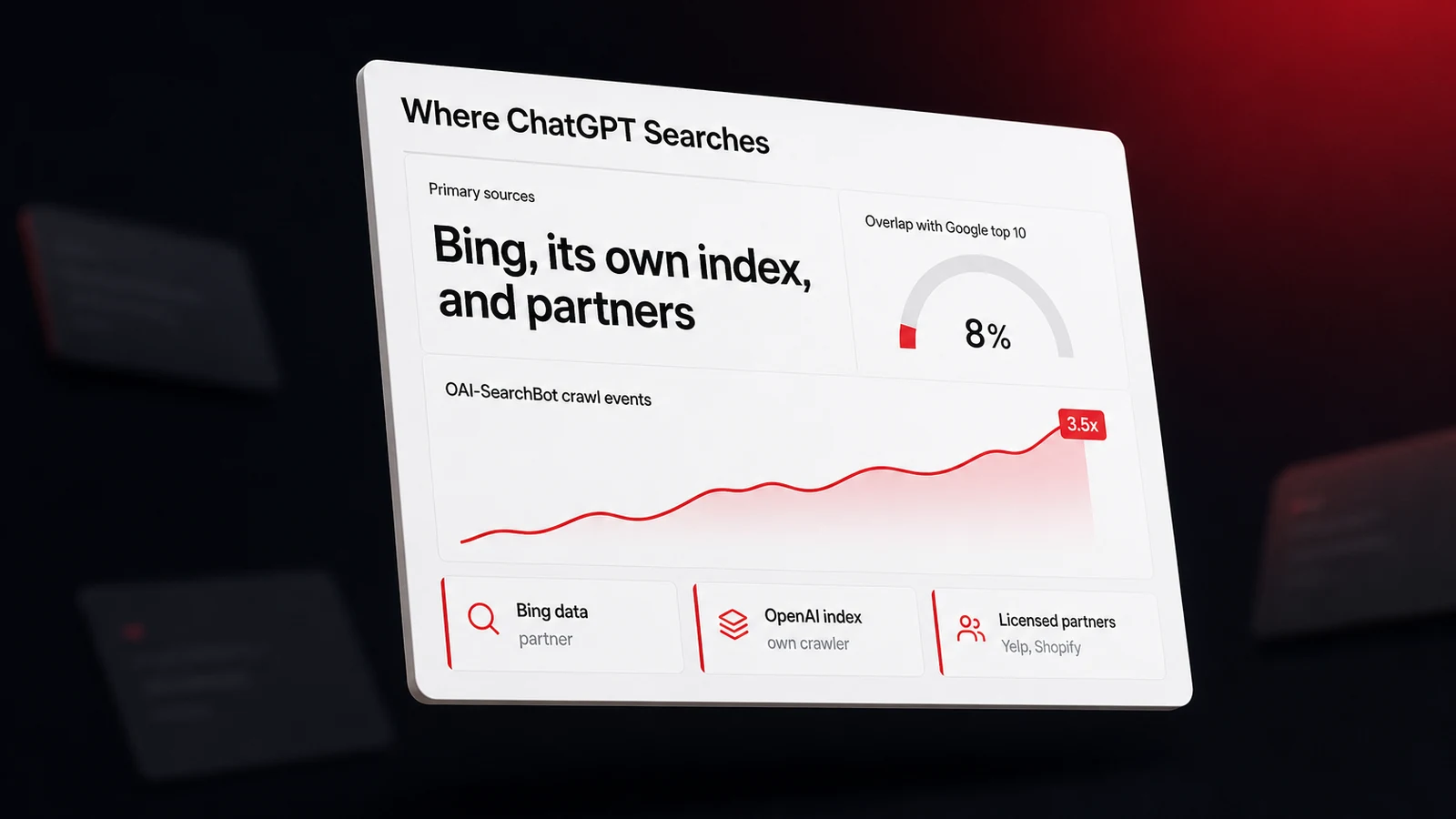
The engines don't agree with each other either. In May 2026, Kevin Indig's Growth Memo analyzed 3.7 million URL citations across 20,000 prompts on three engines and found that only 2.37 percent of cited URLs appeared on all three for the same prompt, while 91.07 percent appeared on just one. There's no single ladder anymore, and not even one shared web index, since ChatGPT draws on Bing data and its own crawled index while Google's engines search Google's. Each engine runs its own retrieval, keeps its own passages, and names its own shortlist, which is why tracking your visibility in AI search has to sample each assistant separately instead of assuming one result speaks for the rest.
Freshness Is a Selection Signal Now
In traditional search, an old page with strong links can hold a ranking for years. Retrievers behave differently, because a passage that reads stale is a passage the model trusts less. In July 2026, Seer Interactive studied 7,683 pages carrying 47,097 citations across three engines between March and June 2026. Seventy-five percent of the cited pages had been updated within the past year and 88 percent within two. By engine, Gemini ran highest at 78 percent updated within a year, ChatGPT at 73 percent, and Perplexity at 65 percent.
The detail that matters for a small site is that updates count, not birthdays. Measured by last update, 72 percent of cited pages looked fresh. Measured by original publish date, only 42 percent did, and more than a quarter of the fresh-looking pages were first published two or more years earlier. A page you refresh keeps working. In April 2026, Gander put a rate on the decay across 194,077 cited URLs, finding each year of age cut a page's AI visibility by roughly 40 to 60 percent, with content at about a third of its starting visibility by age two.
The engines are telling you this directly. When Bing launched its AI Performance report in February 2026, showing citation counts per URL across Copilot and Bing's AI-generated summaries, it paired the announcement with a plain note that IndexNow "helps ensure that AI systems reference the most current version of a page when generating answers." Push your changes, keep the dates honest, and let the retriever see a page that moved this year.
The Answer Names You, the Link Goes Elsewhere
Here's the difference owners feel most. In traditional search, your listing links to you by definition. In an answer engine, the model can name your business from what it read on a review site or a directory, and cite that site instead of yours. In 2026, Foundation Marketing and AirOps analyzed 5.1 million AI responses and 57.2 million citations across 50 brands and found only 10.15 percent of citations linked to a brand-owned domain. On unbranded discovery questions, the ones a new customer asks, that fell to 2.2 percent. Reddit alone took 20.8 percent of external citations, YouTube 13 percent, and LinkedIn 11 percent.
Local answers follow the same shape with different names. In a study of more than 28 million AI responses to local business questions in late 2025, Foundation counted 512,680 citations of Yelp in three months, 3.4 times its nearest local-discovery rival, with Yelp taking a 72.5 percent share of that competitive set in Google AI Mode and 62.1 percent in Perplexity. So the passage that gets your Tacoma electrician named is as likely to live on a review profile as on your own site, and the retriever doesn't care which. Our full breakdown of which local directories AI actually cites shows which platforms matter for each trade.
This is the part rank tracking can't see. A mention with no link produces no session in your analytics, no impression in Search Console, and no line in a rank report, yet it's the sentence the customer reads before deciding whom to call.
Write for the Retriever, Not the Ranker
Everything above points at the same short list of changes. None of them hurts your Google rankings, and most of them help, because a page that states its facts plainly is easier for both machines to read.
- Check both kinds of bot. Read your robots.txt and confirm you're not blocking the search crawlers while trying to block the training ones. The names differ by engine, and each publishes its own list.
- Open every section with the answer. A 40 to 60 word paragraph under each heading that states the fact completely, with the service, the area, and the number, so the passage stands alone when it's pulled out.
- Give each subtopic its own heading. Fan-out queries land on headings that match them. A page with one heading competes for one sub-search.
- Update the content, then the date. Revise a page's facts, then let the modified date change. Stamping a new date on old text is the shortcut the engines discount, a point our guide to what an XML sitemap does covers for the lastmod field.
- Feed the third-party passages too. Recent reviews, complete directory profiles, and consistent details across them, since nine in ten citations point away from brand sites.
- Measure mentions, not only rank. Bing's AI Performance report gives you citation counts for free. Lighthouse Local's AI visibility tracker runs your customers' questions through ChatGPT, Gemini, Claude, Perplexity, and Google AI on a schedule, records whether each one names you and which page it cites, and keeps the history so a change shows up as a trend rather than a surprise.
If you'd rather not do the page rewrites and listing work yourself, Lighthouse Local for Business pairs the tracker with specialists who handle the on-page and listings changes, each one approved by you before it ships.
Build for the Reader Who Never Clicks
Traditional search rewarded a page that earned the click. Answer engines reward a passage that earns the quote, on a page fetched by a different bot, found through a search you never typed, refreshed this year, and often sitting on someone else's site. The habits that got you to page one still form the base, and the retriever asks for a few more. To see which of those signals your own site is missing, our free AI audit scans the crawl access, structure, and freshness markers the engines read and returns a ranked list of fixes, no signup required. The pipeline changed from ranking pages to reading paragraphs. Write the paragraph worth reading.
Frequently asked questions
How do AI answer engines choose which sources to cite?
They split the question into several sub-searches, retrieve pages for each, score individual passages against those searches, and keep the ones that answer directly. Only part of what's retrieved gets cited. Ahrefs measured that about half of the URLs ChatGPT retrieved in 2026 ended up cited, with closer title matches and fresher pages winning.
What is query fan-out?
Query fan-out is the technique Google's AI Mode uses to divide one question into subtopics and search each one at the same time across multiple data sources, then combine the results into a single answer. Google describes it as doing a dozen searches in the time a person does one.
Do AI answer engines use Google rankings?
Only partly. BrightEdge found in 2026 that just 17 percent of sources cited in AI Overviews also rank in Google's organic top 10, and about half rank somewhere in the top 100. Ranking puts a page in the candidate pool, but the citation is decided passage by passage.
Does fresh content get cited more by AI?
Yes. Seer Interactive's 2026 study found 75 percent of pages cited by AI engines had been updated within the past year, and that updating an older page counts as much as publishing a new one. Gander measured visibility falling roughly 40 to 60 percent per year of page age.
Why does AI mention my business without linking to my website?
Because the passage it read about you often lives on a review site or directory, and the engine cites the page it read. In 2026, Foundation and AirOps found only 10.15 percent of AI citations pointed to brand-owned domains, and only 2.2 percent on unbranded discovery questions.