What "Getting Recommended by AI" Means
You get your business recommended by AI chatbots by making your facts consistent everywhere, your pages easy to quote, and your reputation visible, then checking where you actually stand across AI assistants and fixing whatever gap the check turns up. More of your customers are skipping the list of blue links. They open ChatGPT, Gemini, Claude, Perplexity, or Google AI and ask a plain question. "Who's the best plumber near me?" The assistant answers with a short list of names, and most people go with one of them.
Getting recommended by AI means your business is one of those named answers. It's different from ranking on a results page. A search engine ranks your pages so a person can click. An AI engine decides which businesses to name out loud based on what it can find and trust about you across the whole web. You can sit near the top of Google and still go unnamed when someone asks AI.
How Fast Customers Switched to AI
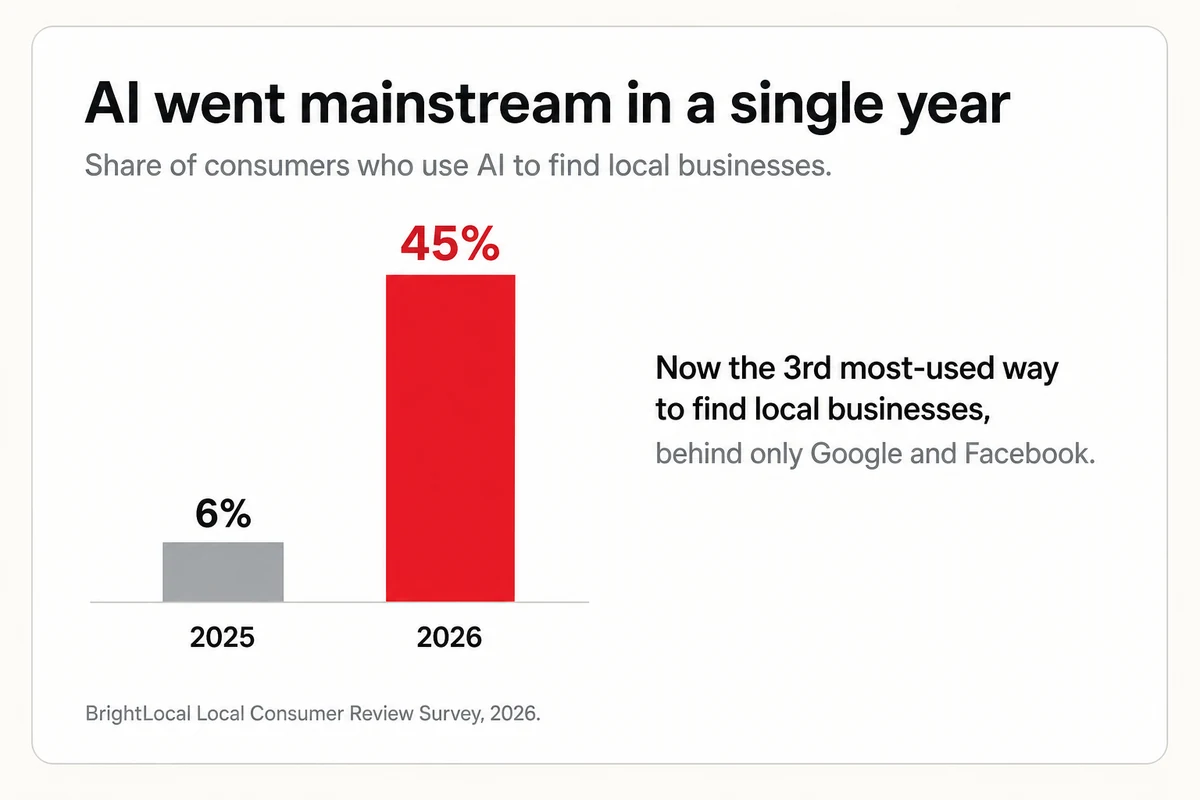
This isn't a fringe habit. In BrightLocal's 2026 Local Consumer Review Survey, the share of consumers who used AI to get local business recommendations jumped from 6% to 45% in a single year, which makes AI the third most-used way people find local businesses, behind only Google and Facebook.
When AI names a business, that pick arrives pre-vetted. The customer treats it as a shortlist someone already vetted for them, so they rarely check a second source. If the assistant names a competitor and not you, you didn't lose a click. You lost the job before you were ever in the running.
Three things make the gap easy to miss.
- It happens inside private chats, so you never see it. A customer asks, gets a few names, books one, and you never knew you were a candidate.
- Every assistant answers differently. You might be the top pick on ChatGPT and missing on Gemini, and never know which.
- The answers move. Models update, and the businesses they name shift week to week. Checking once tells you nothing durable.
How ChatGPT Picks Which Businesses to Name
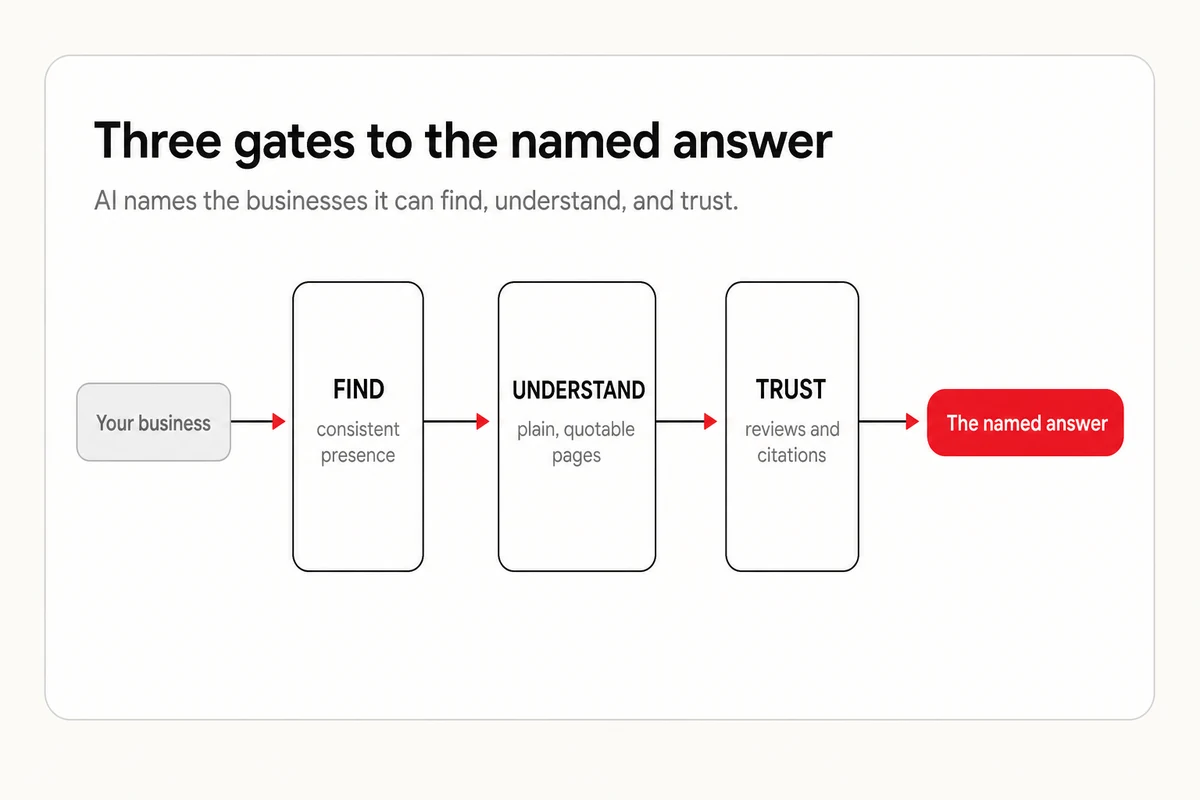
No assistant publishes its exact recipe, and the details differ by platform. Across all of them, the pattern holds. AI names businesses it can find, understand, and trust.
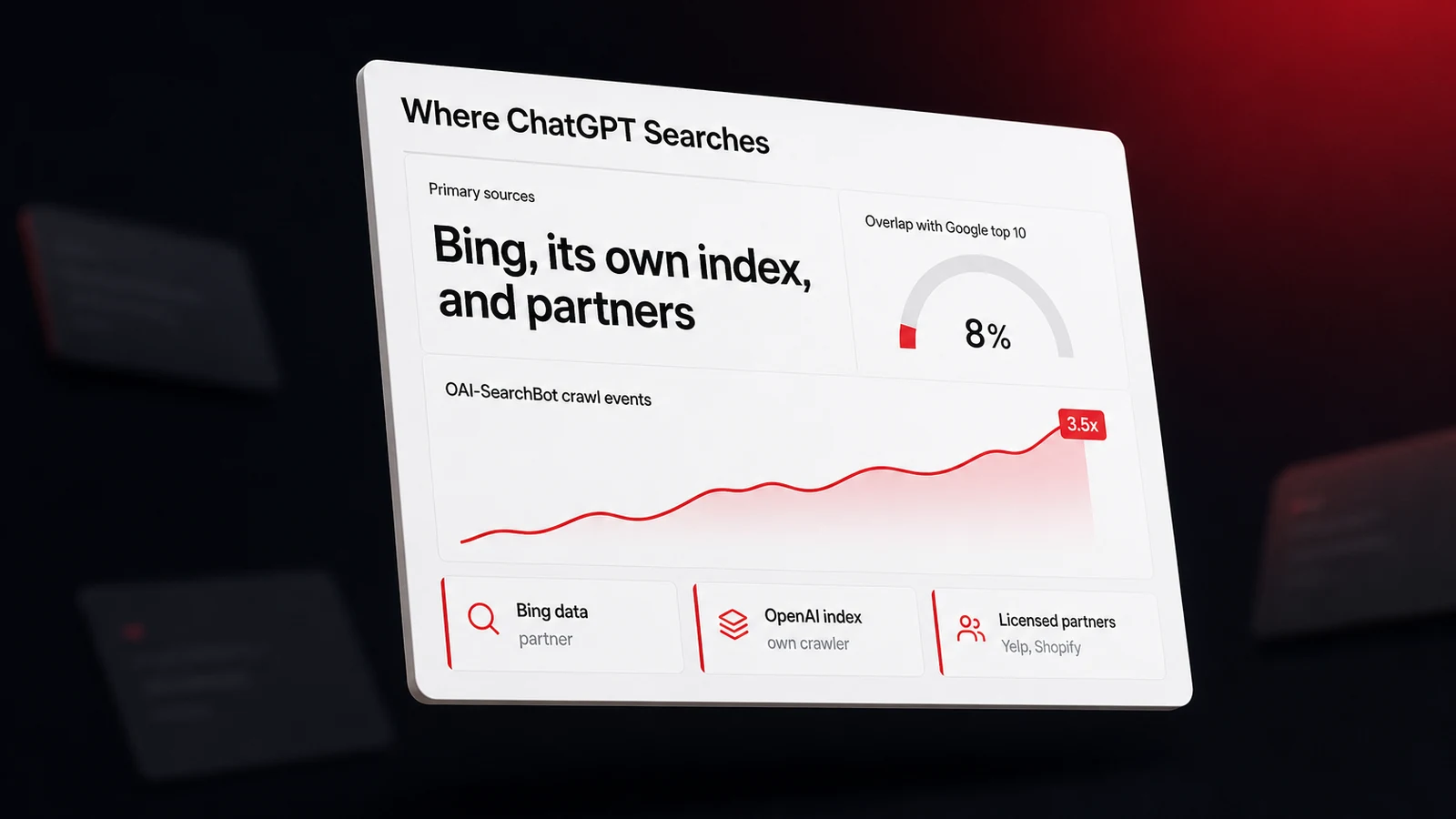
ChatGPT's answers lean on live search results, not just what it learned during training. OpenAI's own guide to searching the web with ChatGPT says search pulls the latest information from the internet into the conversation, beyond what was in its training data. That means a local business shows up by being crawlable and clearly written, not by being picked from a list.
For your business, this means the fundamentals that get you found in a normal search engine still carry weight here. A crawlable site with clear service pages and consistent facts gives ChatGPT something solid to search and quote. A thin or hard-to-find site gives it less to work with, so there's less chance you're the name it settles on. For ChatGPT on its own, our guide to getting recommended by ChatGPT walks through the three records it reads and the fixes in the order it reads them.
How Gemini Picks Which Businesses to Name
Gemini can answer with real places, not just described ones. Google's Gemini Apps help article on finding places says the app uses public information from Google Maps to help you, and it can return a place's address, description, website, ratings, and opening hours. Those fields are what your Google Business Profile fills in, so keep them complete and current.
That makes your Google Business Profile the single most valuable listing to keep accurate for Gemini specifically. Hours, address, categories, and photos should match what's true today, and reviews should stay current. For Gemini alone, our breakdown of getting recommended by Gemini lists what it reads and the fixes in order.
How Claude Picks Which Businesses to Name
When Claude answers using something it found on the web, it shows its work. Anthropic's announcement of Claude's web search says that when Claude brings information from the web into a response, it gives direct citations so you can check the sources yourself. When Claude uses the web for an answer, it cites the pages it used, so a business it names can come with a link to where it found the name.
That citation habit rewards a page written so a model can lift a clean, quotable sentence, the kind of page that states what you do, where, and for whom in plain language. A page buried behind vague copy or a slideshow gives Claude nothing clean to cite, so it's easy to skip over even when your business is a fine fit.
How Perplexity Picks Which Businesses to Name
Perplexity works by searching, not by recalling. Its help center article on how Perplexity works says it searches the internet, gathering information from authoritative sources like articles, websites, and journals, then cites what it used. A business gets named when its own pages, or the pages that write about it, are the ones that search turns up.
That puts the same weight on being crawlable and clearly written as it does on being written about elsewhere. A service page that states what you do in plain language gives Perplexity something to find directly, and a mention on a site Perplexity already treats as authoritative, a local publication, an industry directory, gives it another path to the same name. Our guide to getting recommended by Perplexity sorts the ten sources under four real answers and shows which of those paths won each question.
How Google AI Overviews and AI Mode Pick Which Businesses to Name
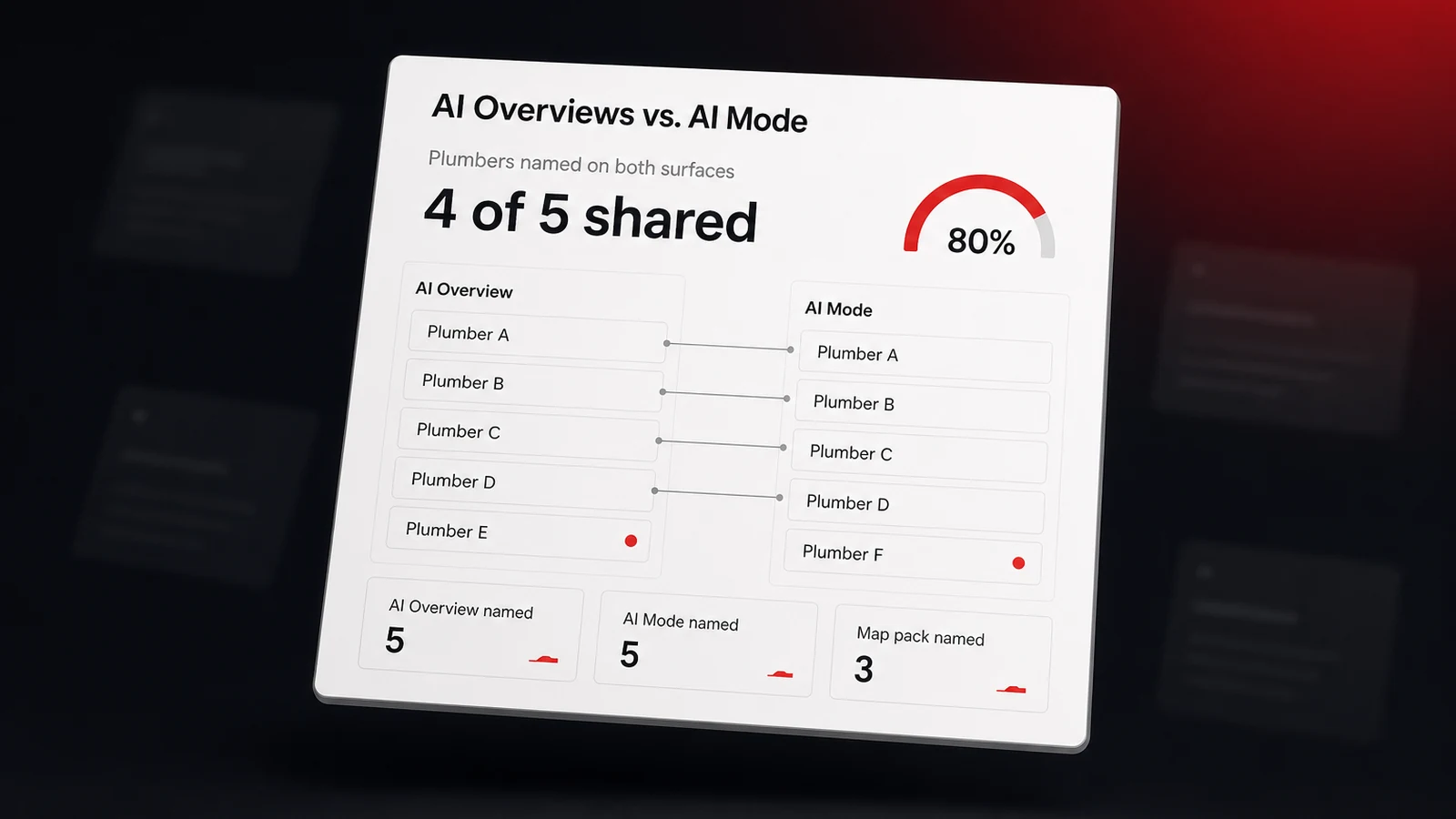
AI Overviews and AI Mode summarize the web instead of sending someone straight to a list of links. Google's own help page on AI Overviews describes an AI-generated snapshot built from web pages, with key information and links to dig deeper into the sources behind it. A business named in that snapshot is one Google's model found enough evidence for, in a page it was confident enough to summarize.
Getting picked here still starts with the basics of being indexed and easy to read, a crawlable site, a clear service page, current reviews. Lighthouse Local for Business watches the five we track at once and tells you which gap to close first, rather than leaving you to guess which one dropped you from an answer.
How to Check Where You Stand Today
Start by asking the way your customers do. Open each assistant and ask the real questions a buyer would type in your city, such as "best roofer in Austin," "who should I hire to fix a leaking roof near me," "top-rated family dentist near me." Note three things each time. Whether you're named, who's named instead, and what the assistant says about them.
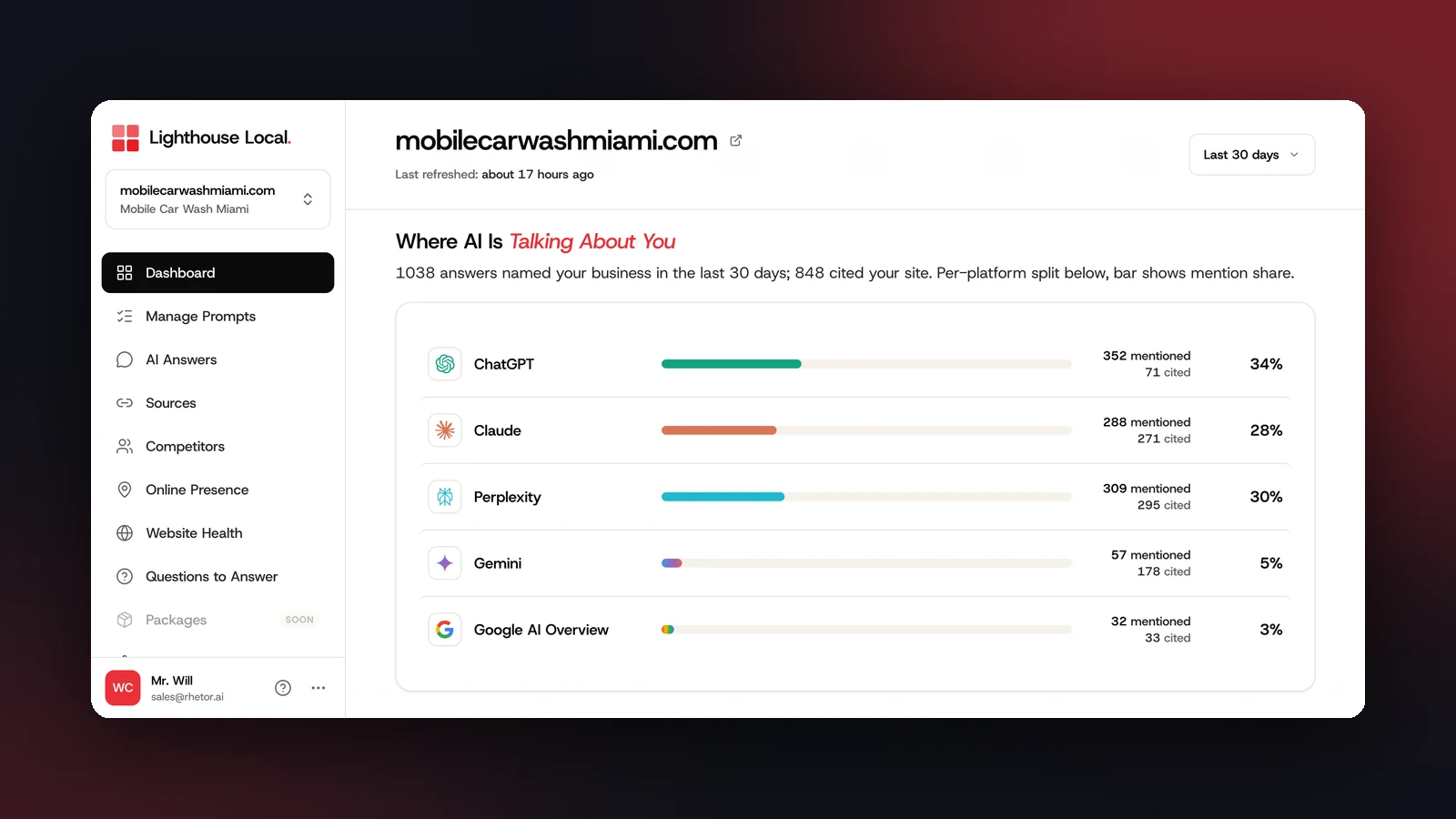
Do this on each of the major assistants, because the answers rarely match. The catch is that one round of manual checks is a snapshot, and the results change. To know where you actually stand, you have to watch it over time, the way you watch your reviews. That's where Lighthouse Local's AI visibility tracker comes in. It runs your questions across ChatGPT, Gemini, Claude, Perplexity, and Google AI on a schedule and records exactly what each one says, so you see movement instead of a single guess, the way you watch your reviews.
What One Local Business's Numbers Look Like
Here's what a check looks like once someone has run it. Take a mobile car wash in Miami that Lighthouse Local tracked across the 30-day window closing September 25, 2026. Its named rate, the share of answers that name the business, came out very different from one assistant to the next.
| Assistant | Answers checked | Named rate |
|---|---|---|
| ChatGPT | 505 | 76% |
| Gemini | 468 | 6% |
| Claude | 502 | 71% |
| Perplexity | 505 | 72% |
| Google AI | 115 | 26% |
Three of the five we track name it in about three answers out of four. Gemini names it about once in sixteen. The odd part is that Gemini isn't ignoring the site. Of its 468 answers, 224 used the business's own pages as a source, and only 28 named the business. Being read and being named are two different results, and the gap between them is what the fixes that follow close. The full breakdown is in our write-up on AI visibility for local business.
What to Fix to Get Named More Often
Once you know where you're missing, the fixes are concrete. Work them in order of impact.
- Make your core facts identical everywhere. Same business name, address, phone, and hours on your site, your Google Business Profile, and every major directory. Fix contradictions first.
- State what you do in plain sentences. On each service page, say the service, the area, and who it's for in a line a model can quote. Add a short FAQ that answers the real questions buyers ask.
- Earn and keep reviews current. Ask happy customers, reply to what comes in, and keep the flow steady rather than a one-time push, because reviews shape which businesses AI recommends.
- Get named by sources AI trusts. Local press, industry directories, and partners that already list businesses like yours.
- Close the specific gaps AI shows. If Gemini recommends a competitor for "emergency service" and not you, make that offering unmistakable on the matching page.
Every one of these is a page or a profile you already control. The value of tracking is knowing which one to fix first, and an assistant connected to your tracking data can rank those fixes for you. And if you'd rather not work the list yourself, Lighthouse Local's specialists can do the fixes for you, from the citations to the content to the backlinks.
AI Visibility vs. Traditional Local SEO
These overlap, and the same groundwork helps both, but they're not the same game. It's worth knowing where they differ so you don't assume good rankings mean AI names you.
| Traditional local SEO | AI visibility | |
|---|---|---|
| The goal | Rank your pages in the results | Get your business named in the answer |
| The output | A list of links to choose from | A short, pre-vetted shortlist |
| Where it's decided | One results page | Many assistants, each different |
| How you check | Rank trackers, Search Console | Ask each assistant, on a schedule |
The takeaway is simple. Keep doing the local SEO work, but don't assume it's enough, because local AI SEO adds a few jobs that ranking never asked of you. You can rank well and still be the business AI leaves out.
Track It, Don't Guess
You can't fix what you can't see, and AI recommendations happen where you can't watch them. The businesses that win here are the ones that treat AI visibility like reviews. They check it regularly, catch a drop the week it happens, and fix the specific gap the answer reveals.
If you'd rather not check whether AI recommends you by hand every week, Lighthouse Local tracks every assistant it covers for you, shows who's getting named instead, and turns each gap into a plain-English fix. Start with our free AI audit, a one-minute scan that scores your pages and shows the highest-impact things to improve. The businesses AI recommends aren't guessing whether it does. They track it, and so should you.
Frequently asked questions
How do I get recommended by AI?
Fix the facts first, then the proof, then measure. Keep your name, address, phone, and hours accurate and identical on your site, your Google Business Profile, and the major directories. Keep reviews recent. Write service pages in the words customers use, so a model can quote them. Then check how often each assistant names you, your named rate, once a month, and work on whichever assistant lags.
Which AI platforms actually recommend businesses?
The major ones that name businesses today are ChatGPT, Gemini, Claude, Perplexity, and Google AI, and they're the ones Lighthouse Local tracks. Each answers differently, so you can be named on one and missing on another. Check them all, not just the one you use.
Is AI visibility the same as SEO?
No, though they overlap. SEO ranks your pages so a person can click a link. AI visibility is whether an assistant names your business in its answer. The groundwork is similar, but you can rank well on Google and still be left out when someone asks AI.
How often do AI recommendations change?
Often enough that a one-time check tells you little. Models update and the businesses they name shift week to week, which is why it helps to watch your visibility over time instead of checking once.