One Car Wash, Two Thousand Answers, Five Verdicts
AI visibility for a local business is the share of AI answers to local questions that name your business, measured across the assistants your customers use and the neighborhoods you serve. It's a rate, not a rank. There's no number one slot to hold. When someone asks ChatGPT for a mobile car wash in Kendall, the answer is a shortlist of three to eight names, and you're either on it or you're not.
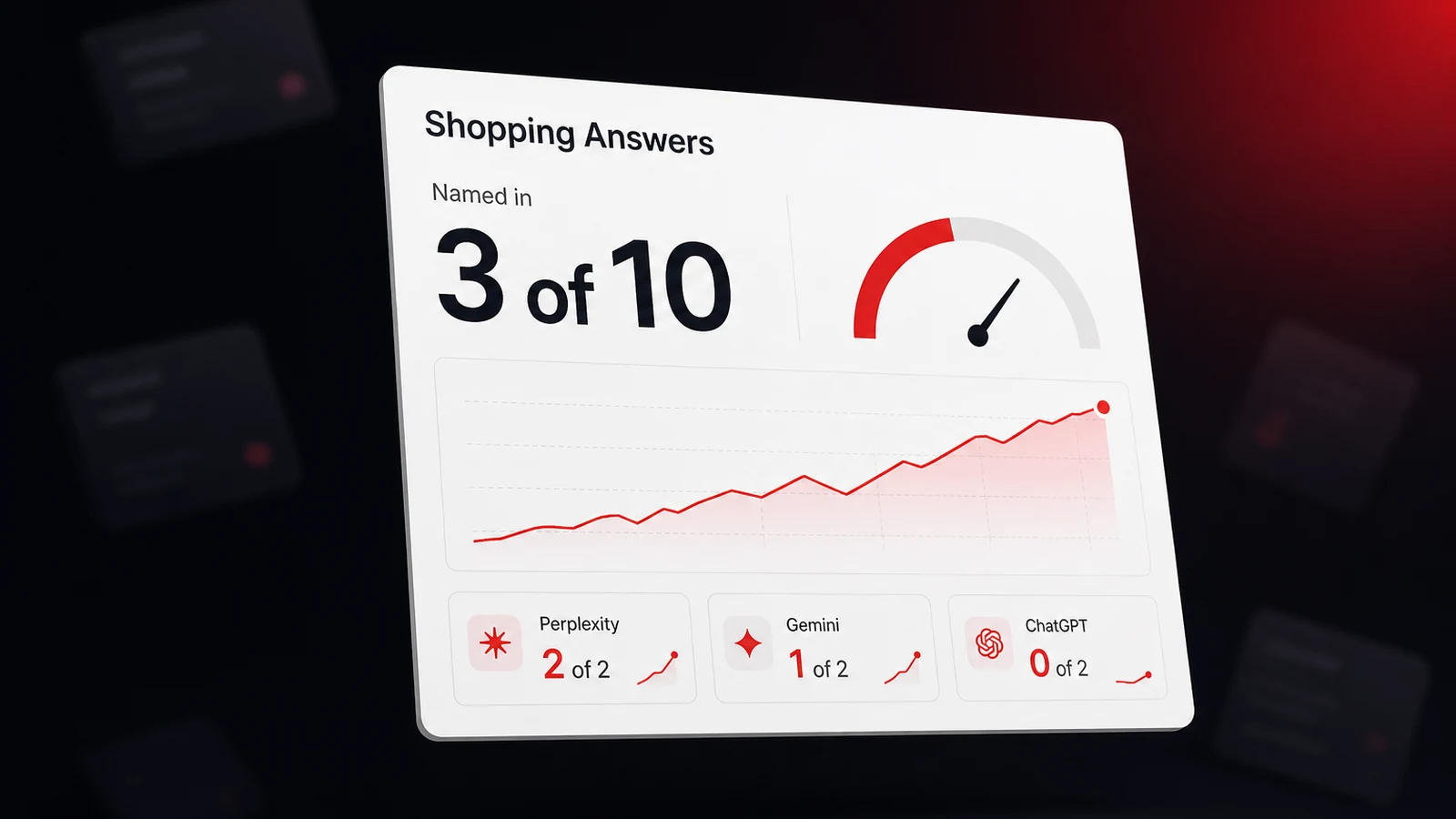
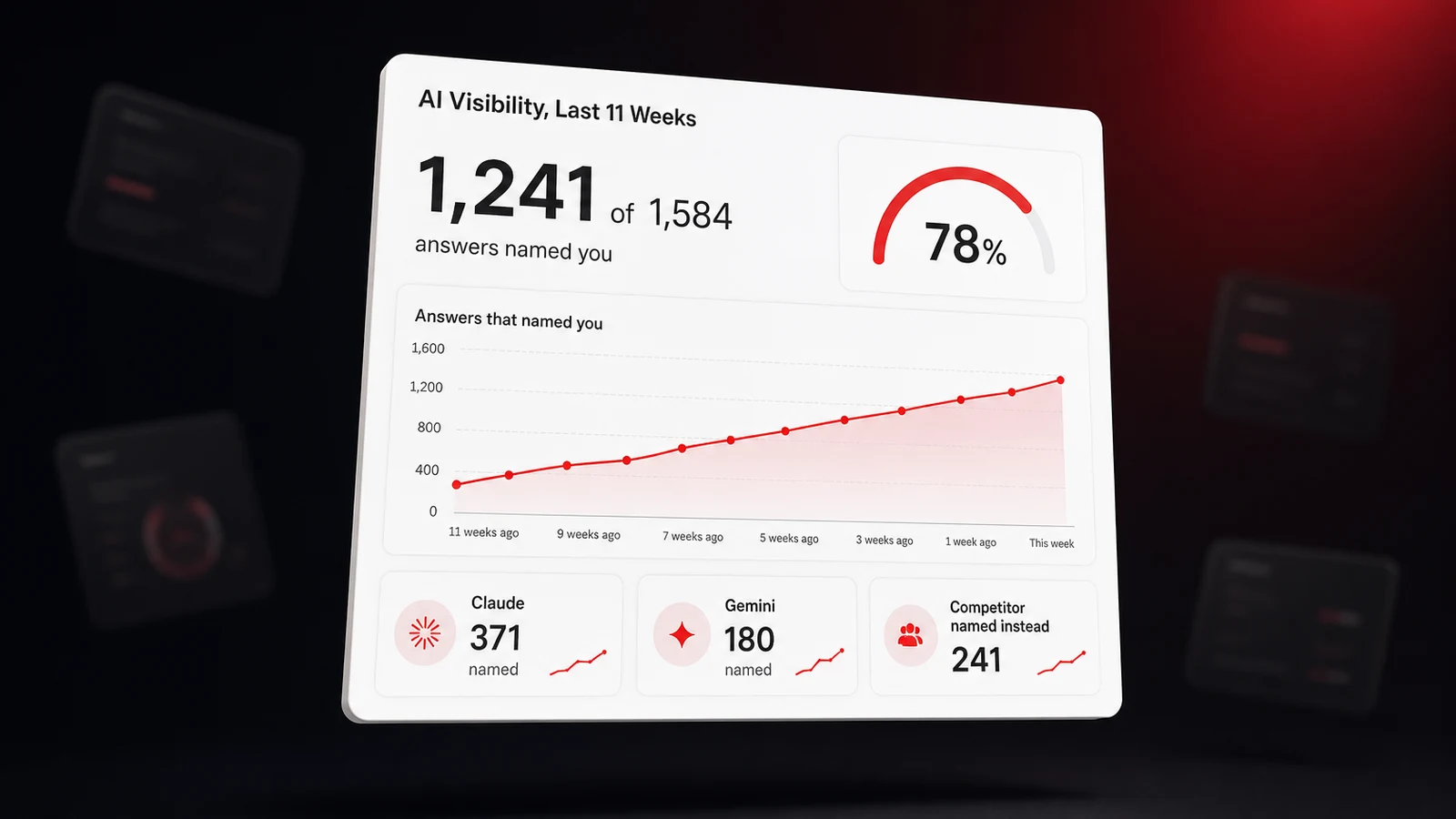
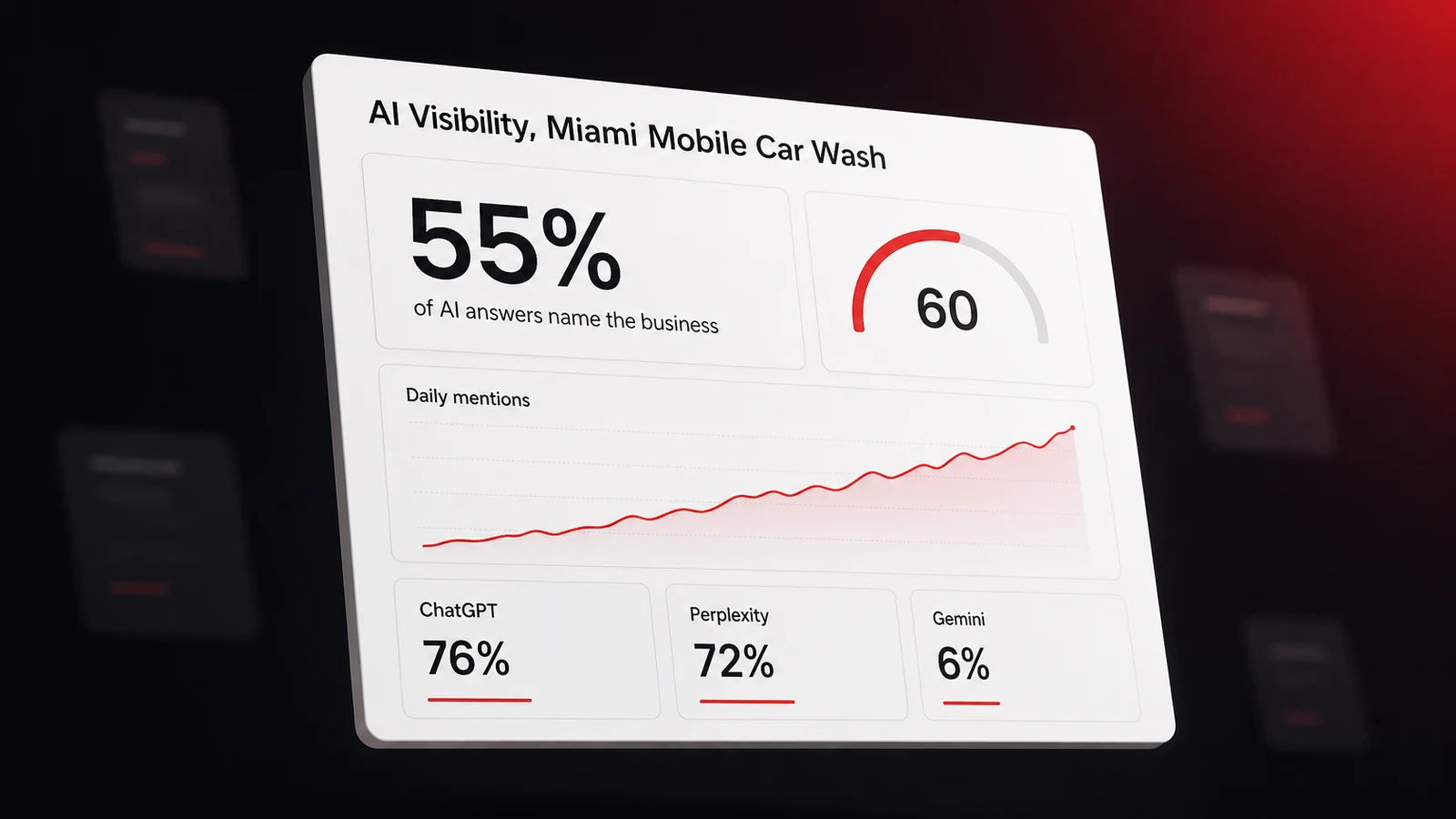
Here's what that looks like for one real business. A mobile car wash in Miami has tracked 21 prompts in Lighthouse Local's AI visibility tracker since June. Over the 30 days ending September 25, 2026, the tracker captured 2,095 answers to those prompts across ChatGPT, Gemini, Claude, Perplexity, and Google AI. The car wash was named in 1,163 of them, 55 percent. That single number hides the real story, which is how differently each assistant treats the same business.
| Assistant | Answers captured | Named the car wash | Named a rival instead |
|---|---|---|---|
| ChatGPT | 505 | 76% | 1 answer |
| Gemini | 468 | 6% | 319 answers |
| Claude | 502 | 71% | 63 answers |
| Perplexity | 505 | 72% | 82 answers |
| Google AI | 115 | 26% | 10 answers |
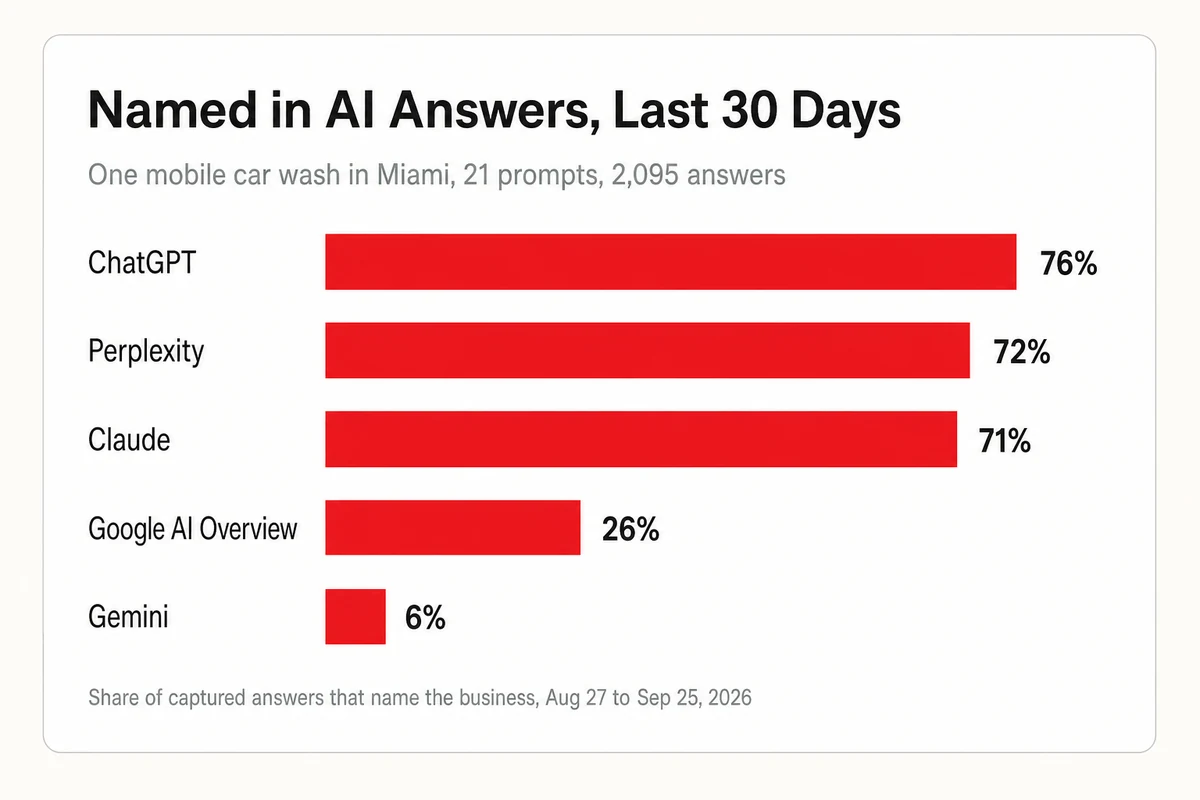
Three assistants name this business in about three of every four answers. One names it in one of every sixteen. Same business, same website, same 21 questions. If the owner had only ever asked ChatGPT, they'd think they were done. If they'd only asked Gemini, they'd think they were invisible. Both would be wrong, and neither would know what to fix. The rest of this post is what those numbers taught us about how local AI visibility works, and what moved when the business changed something.
A Place in the Prompt Changes Who Gets Named
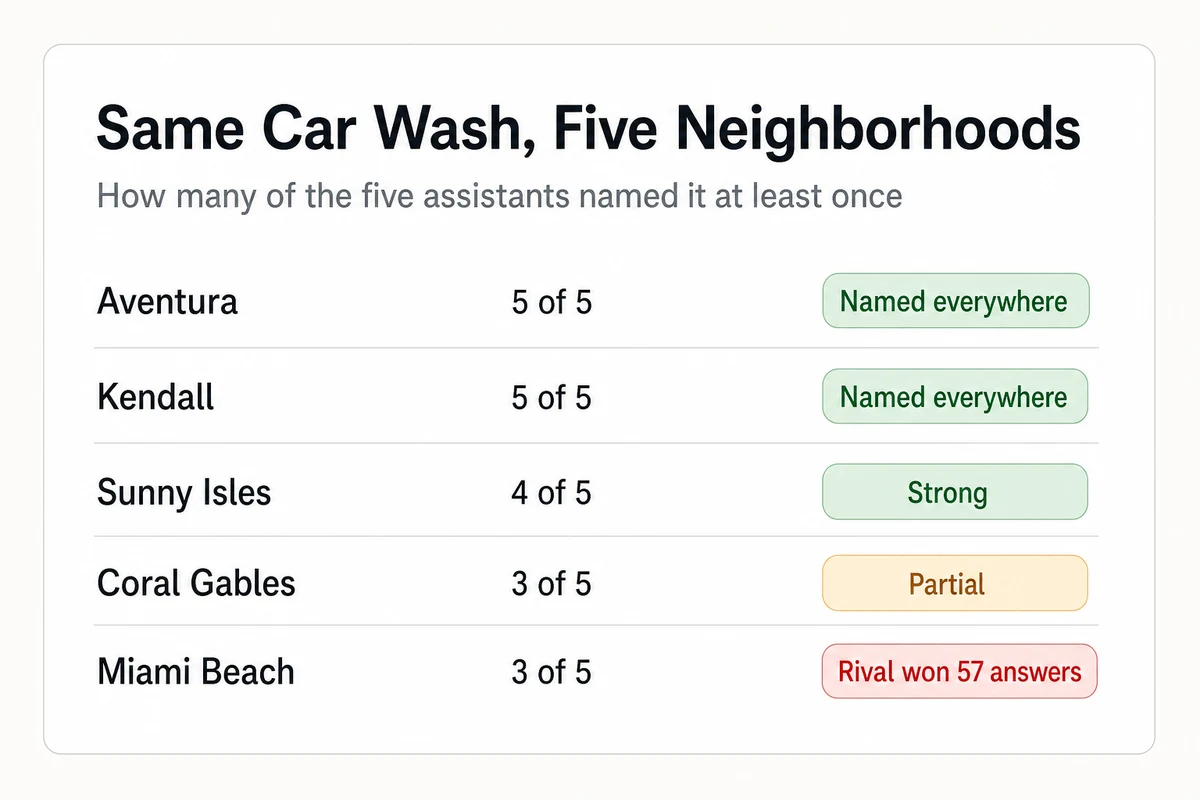
A national brand's AI visibility is one question asked one way. A local business's visibility is the same question asked in every neighborhood it serves, and the answers don't travel. The car wash tracks the same service across five Miami neighborhoods. In Aventura and Kendall, every one of the five we track named it at least once in the window. In Sunny Isles, four did. In Coral Gables and Miami Beach, three. And in Miami Beach a competitor with the beach in its name won 57 answers outright, named while the car wash wasn't, the most of any rival on any prompt.
The neighborhood in the prompt isn't decoration. It decides which sources the assistant reads, and it shrinks the answer. In June 2026, Sterling Sky's study of local search across 322 markets found Google's AI local packs surfaced 5,943 unique businesses where the traditional three-packs surfaced 18,330, about 32 percent as many, and 88 percent of markets had fewer businesses in the AI version. A separate May 2026 test by Local SEO Data, reported on PRWeb, ran 1,120 local queries across seven trades in 13 US cities and found 28.5 percent of local pack businesses missing from AI Mode for the identical query. When we opened the September 25 capture for the Miami Beach prompt, ChatGPT's answer listed eight businesses and every single link pointed at a Google Maps search, not a website. Claude's answer named five businesses and cited their own sites. Perplexity named five from a list of twenty sources that included a parking directory and the Better Business Bureau. Three assistants, three different maps of the same eight square miles.
The pattern holds well beyond one car wash. MentionedOn's running dataset of AI answers covers 21 local service trades across 40 US cities, 34,740 answers as of September 25, 2026, and finds the assistants spread their recommendations across roughly nine businesses per question set, with the leading business in an average market taking about 25 percent of mentions. That's why the first thing to understand about local AI visibility is that it's plural. You don't have a score. You have one per neighborhood per assistant, and the weakest one is where your next customer is being sent somewhere else. Two people asking the same assistant from two addresses can get different shortlists, which is the mechanism behind why AI recommendations differ by user.
Gemini Read the Site 224 Times and Named It 28
The Gemini column is the one worth studying, because it's not a case of the assistant never finding the business. Gemini cited the car wash's own website in 224 of its 468 answers, 48 percent. It named the business in 28. So in roughly 200 answers, Gemini pulled a page from the site, used it as a source, and then recommended someone else. Being cited without being named is a real pattern in AI answers, and here it's the whole Gemini story.
The likeliest reason sits in the tracker's open fix list. Since July 7 it has carried one health item at the top, claim and verify the Google Business Profile. Google's own developer documentation for grounding Gemini with Google Maps, updated September 23, 2026, describes answers backed by Maps data on over 250 million places, and Google's help page on AI Mode for local services says it researches available home services such as electricians and exterior cleaning and can check pricing and availability for you. An assistant that answers local questions from the map will name the businesses on the map. A business that isn't verified there can have a fine website, get cited for its content, and still lose the recommendation to four rivals who are pinned. That's consistent with what happened here, where Gemini handed 319 answers to competitors while ChatGPT handed over exactly one.
We've written before about whether a Google Business Profile matters for AI visibility, and this is the clearest demonstration we've logged. It's also the honest caveat on the 55 percent headline. A local business can be doing well on the assistants that read the open web and be nearly absent on the one that reads the map, and an average hides that split completely.
The 326 Domains Behind the Names
Every AI answer is built from sources, and the tracker logs which domains those are. For this one car wash's 21 prompts, the assistants cited 326 different domains in 30 days. The business's own site was cited most, 4,174 times, which is the good news. It means the assistants that read the open web, Claude above all, are quoting the service pages. After that the list turns into the local web everyone already knows.
| Source domain | Citations | ChatGPT | Gemini | Claude | Perplexity | Google AI |
|---|---|---|---|---|---|---|
| The car wash's own site | 4,174 | Yes | Yes | Yes | Yes | Yes |
| Yelp | 1,421 | Yes | Yes | Yes | ||
| Google (Maps and Search) | 1,178 | Yes | Yes | |||
| 647 | Yes | Yes | Yes | |||
| Way.com (a car care directory) | 558 | Yes | Yes | Yes | ||
| 484 | Yes | Yes | Yes | Yes | ||
| Yellow Pages | 305 | Yes |
Two things stand out. First, google.com appears in ChatGPT answers and in Google AI answers, nowhere else, and inside ChatGPT it appears as Maps links. Second, four of the car wash's tracked competitors each drew between 560 and 1,549 citations of their own sites, so the assistants aren't short of candidates. The reason directories weigh so heavily in local answers is covered in the domains AI actually leans on for local facts. What this table adds is the split by assistant. Yelp never shows up in a ChatGPT answer for this business, and Yellow Pages only ever shows up in Perplexity. If you fix one directory, you move one or two assistants, not all of them.
How Owners Phrase the Question, in Our Own Search Console
We can also see how people arrive at this topic, because Google Search Console shows us the exact queries that surfaced our own pages. In the 28 days ending September 22, 2026, our site appeared for 266 distinct non-brand queries. Ninety-four of them ran seven words or longer, and those long queries took 29 percent of all the impressions. People aren't typing keywords at this problem. They're typing the question they'd ask a person.
The local ones are specific. "AI visibility for local business" was the single most common phrasing, ahead of "local AI visibility," "local business AI visibility," and "local AI SEO." Then come the full sentences. "How do I know if AI assistants are recommending competitors in my local markets?" "How to track local SEO performance across AI and traditional search engines?" And one query that showed up exactly once and says the whole thing. "I want my business recommended when people ask AI for local services."
That last sentence is the definition from the customer's side. AI visibility for a local business is the answer to it, made measurable. The car wash owner's version of that question is the 21 prompts in the tracker, and the answers above are what "recommended" currently looks like for them, neighborhood by neighborhood.
Six Levers, in the Order This Data Ranks Them
Everything above points at a short list of things a local business controls, the same six levers our guide on how to get your business recommended by AI walks through. Ranked by the car wash's own numbers, most impact first, they look like this.
- Claim and verify your Google Business Profile. It's the gate to the map, and the map is what Gemini's and ChatGPT's local answers are built from. For this business it's the one open health item, and it lines up with a 6 percent Gemini rate against 76 percent on ChatGPT. Birdeye's report on the state of Google Business Profiles, updated April 2026, puts verified profiles at up to four times the website visits of unverified ones. Do this before anything on this list.
- Be on the directories each assistant actually reads. For this business that's Yelp, which three of the five we track cited. Facebook, which four cited. Yellow Pages, which only Perplexity cited. Way.com for car care specifically, and whatever the equivalent directory is in your trade. Check the source table for your own prompts, not a generic list.
- Give every neighborhood you serve its own page. Aventura and Kendall are named everywhere. Miami Beach lost 57 answers to a rival named after the beach. The car wash has a Miami Beach service page that Perplexity already cites, so the gap there isn't the page, it's the map and the reviews behind it. But a neighborhood with no page at all can't be cited for it by anyone.
- Answer the money questions on your site. Prompts like "how much should I pay to have my car washed" got the site cited by each of the five we track and named by two. The tip and price questions got cited and named nowhere. The tracker attaches about 16,000 monthly Google searches to the tipping question alone. A plain page that answers it in the first two lines is the cheapest citation this business hasn't earned yet.
- Earn reviews where the assistants look. Steady Demand's research index of AI and profile statistics, updated September 25, 2026, puts 90 percent of AI-recommended local businesses at 4.5 stars or higher and 35 percent of them at 500 or more reviews. Reviews are how AI decides which local businesses to recommend when several candidates all have a website and a listing, which in a city like Miami is every candidate.
- Keep the site itself readable. This business scores 89 on website health in the tracker, which is why its own site leads the citation table. A slow or blocked site drops off that table first. Our free AI visibility audit scores those on-site signals and returns the fix list, no signup needed.
Is the traffic worth the work? In March 2026, Ahrefs measured AI chatbot referrals across 74,752 sites at 0.28 percent of all visits, and on its own site the AI-search visitors, half a percent of traffic, produced 12.1 percent of signups. The visitors are few and they arrive decided, which for a local service is the whole point. Either way, the order above is the order the data ranks them, and the first one is free.
Watch the Rate for a Month Before You Judge It
One more thing the car wash taught us. Its visibility score read 79 at the end of June, when it tracked four prompts. In mid July the owner added the neighborhood and price prompts, seventeen more, and the score dropped into the mid 50s and has hovered there since, reading 60 on September 25. Daily mentions went the other way, from 13 a day to between 44 and 51. Nothing about the business got worse. The question set got harder and more honest, and the number followed.
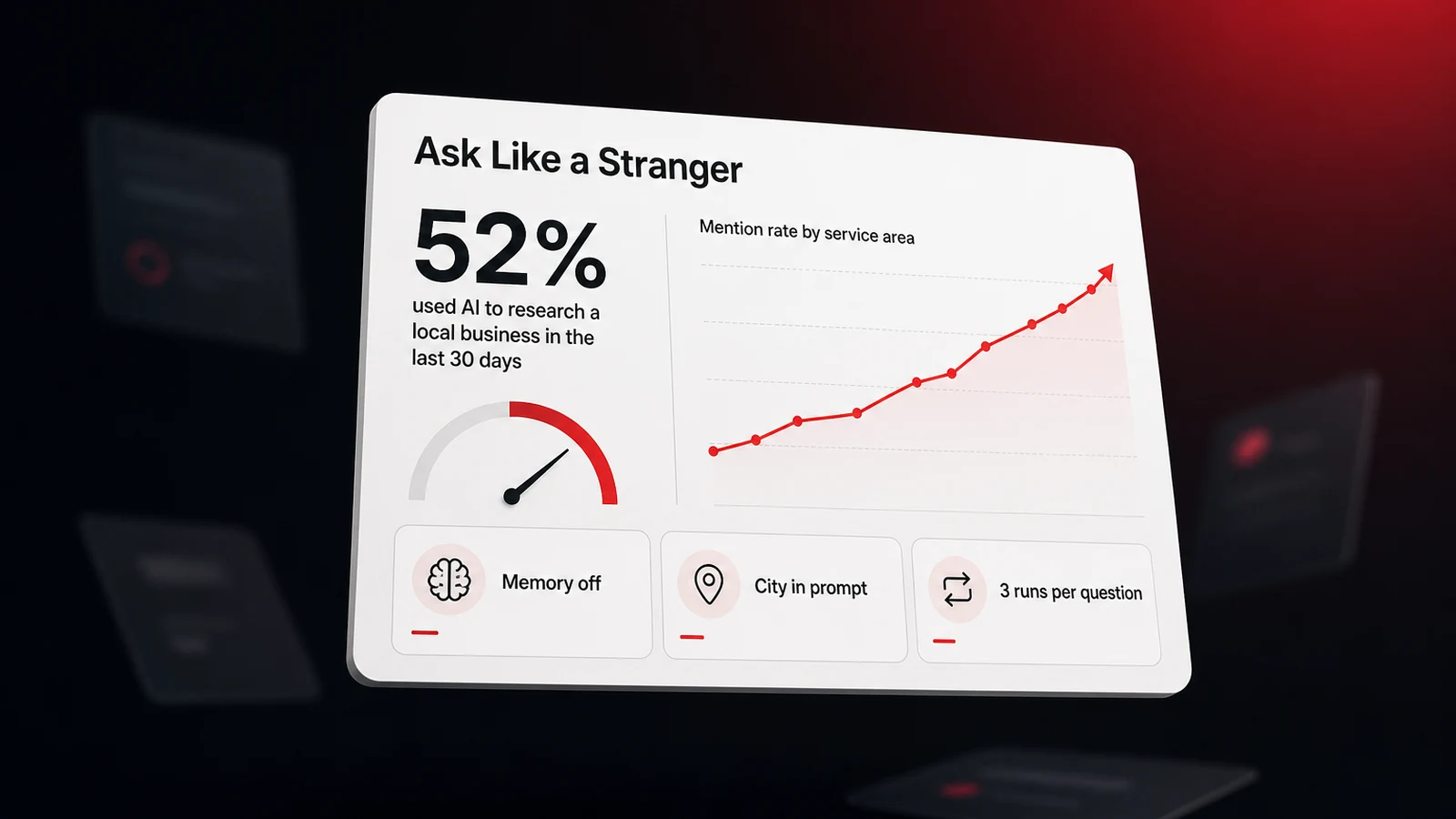
That's the trap in a one-time check. Ask three questions on one afternoon and you'll get a score that means nothing next week. The car wash's Gemini rate is 6 percent over 468 answers, which is a real measurement. A single Gemini answer that happened to name it would be a coincidence. The MentionedOn dataset makes the same point at scale. When it re-measured markets about 76 days later, only half of the top three businesses had kept their spot, and 55 percent of markets had a different leader. If you're building your own scorecard, the method for choosing prompts and sampling enough answers is in our guide to tracking brand visibility in AI search, and it works in a spreadsheet before it works in a tracker.
AI visibility for a local business, then, is a set of rates, one per assistant and one per neighborhood, that tells you which of your customers' questions currently get your name in the answer. The Miami car wash has 76 percent of ChatGPT and 6 percent of Gemini, one open profile fix, and a clear next page to write. If you'd rather hand the fixing to someone, Lighthouse Local for Business can take it off your plate, with specialists handling the profile, directory, and content fixes while the tracker keeps measuring the result. Get your own numbers first, and the next fix picks itself.
Frequently asked questions
What is AI visibility for a local business?
It's the share of AI answers to local questions that name your business, measured per assistant and per neighborhood. When someone asks ChatGPT, Gemini, Claude, Perplexity, or Google AI for a plumber in your town, the answer is a shortlist. Your AI visibility is how often you're on it.
How is AI visibility different from local SEO?
Local SEO earns a position in a ranked list on Google. AI visibility earns a mention in a written answer that names a few businesses and no positions. The inputs overlap, your Google Business Profile, reviews, directories, and site, but the assistants weigh them differently, and each assistant reads different sources.
Which AI assistant matters most for a local business?
The one your customers use, and it varies by assistant. In the car wash example, ChatGPT built its local answers from Google Maps, Claude from business websites, and Perplexity from a mix of sites and directories. Track all of the major assistants and fix the weakest rate first, because that's where customers are being sent elsewhere.
How long does it take to improve AI visibility?
Profile and directory fixes can show up in answers within weeks. Content and review changes take longer. Measure over at least 30 days and a few hundred answers before calling a change real, because single answers vary from day to day even when nothing about your business changed.
Can I check my AI visibility for free?
You can ask each assistant your customers' questions by hand and log whether you're named. Our free audit scores the on-site signals that decide whether AI can read your site, but it can't tell you whether the assistants themselves are naming you. Seeing that over time is what the tracker is for.