The Short Answer Is Yes, With One Real Exception
Google Business Profile feeds AI visibility because every major assistant reads its data somewhere in its answer pipeline, so a complete profile hands an assistant more evidence to recommend you on. No rule forces you to have one, but if you serve customers in person, treat it as required and spend your energy making it complete.
The exception is real, though. Google doesn't let every business have a profile, and if you run an online-only company you're locked out by rule, not by neglect. There's a section below on what those businesses should do instead.
The stakes moved fast. In 2026, BrightLocal's Local Consumer Review Survey found AI tools are now the third most-used source for local business recommendations, behind only Google and Facebook, and 40% of consumers say they trust the business recommendations AI gives them.
Where Each Assistant Gets Its Local Facts
ChatGPT, Gemini, Claude, Perplexity, and Google AI, the five we track, don't share one directory. Each pulls local facts from its own mix of sources, which is why the same question can get you named in one answer and skipped in the next.
Google's side is the clearest. In 2026, Google announced Ask Maps, a Gemini-powered layer that answers local questions by analyzing information from more than 300 million places and reviews from over 500 million contributors. That pool is Business Profile data. Gemini reads that same pool when it fields a near-me question, and so does Google AI, since both sit on top of the same Google Maps records you edit when you update your profile.
| Assistant | Where its local facts tend to come from |
|---|---|
| ChatGPT | Google-sourced business data reached through search, plus partners like Yelp |
| Gemini | Google Maps and Business Profile records, directly |
| Claude | Web search across your site, your profiles, and coverage of your business |
| Perplexity | Web search plus the map and review sources it cites inline |
| Google AI | Google Maps and Business Profile records, directly |
Notice what repeats down that column. Whether the assistant belongs to Google or not, profile data keeps showing up as the raw material.
Even ChatGPT Answers From Google's Records
You might expect profile data to matter only inside Google's own products. The measured reality says otherwise. In 2026, Formative Digital scraped 1,732 local AI citations across nine cities and five service verticals and found ChatGPT cited google.com 130 times, more than 60 times as often as the next domain. The same study caught ChatGPT rendering Business Profile card fields, hours, ratings, review counts, addresses, and categories, directly inside its answers.
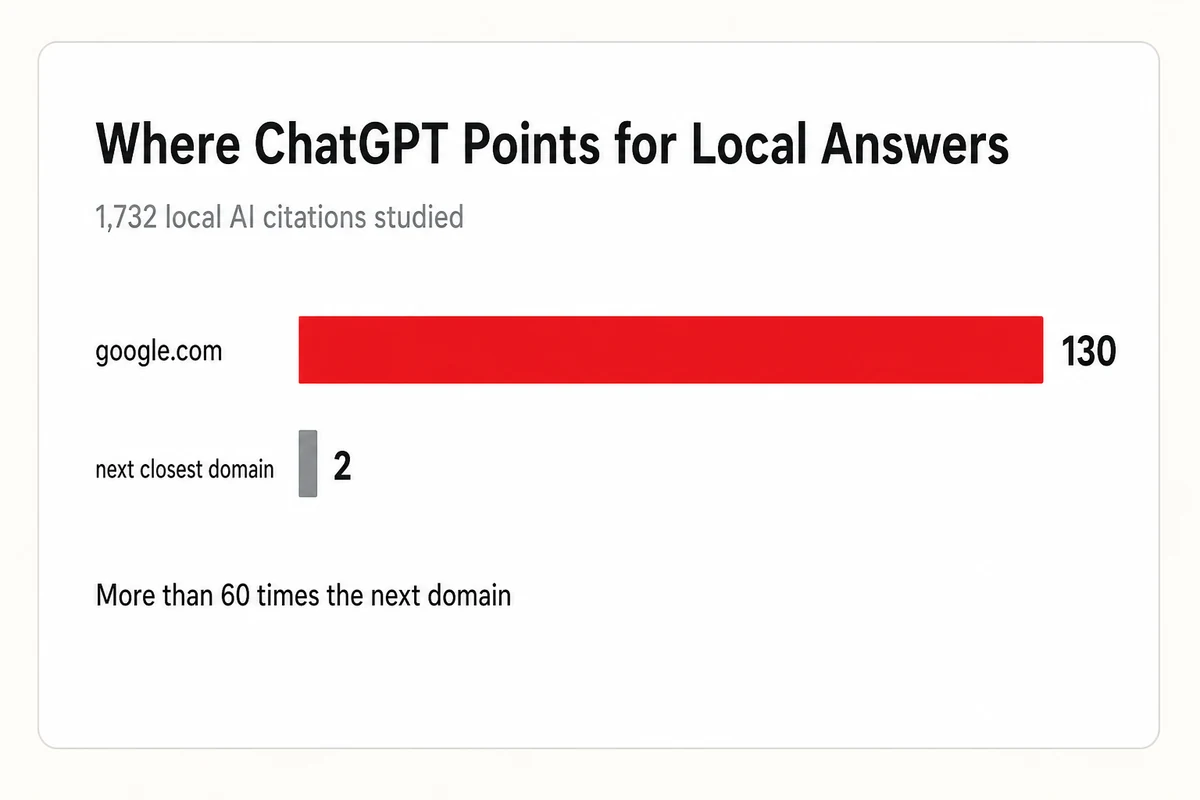
That's the practical case in one number. The assistant with no Google allegiance still treats Google's business records as its heaviest local source, so a thin or unclaimed profile costs you visibility even with customers who never open Google at all.
Your Profile Is a Fact Sheet, Not a Listing
It helps to stop thinking of the profile as a directory entry and start treating it as the structured fact sheet an assistant reads before deciding whether to say your name. A handful of fields do most of the work.
- Category and services. The match an assistant makes first. A vague category loses questions your real work should win.
- Hours. Assistants answer questions like open now literally, so wrong hours quietly remove you from every after-hours answer, and ChatGPT can keep repeating old ones from a months-old snapshot or a stale listing.
- Rating and review count. The quickest signal of whether you're worth the risk. The words inside them count too, because reviews steer AI recommendations with the exact phrases your customers wrote.
- Address or service area. How the assistant decides you fit a near-me question at all.
- Photos and attributes. Wheelchair access, parking, emergency service. Attributes are answers waiting for the right question.
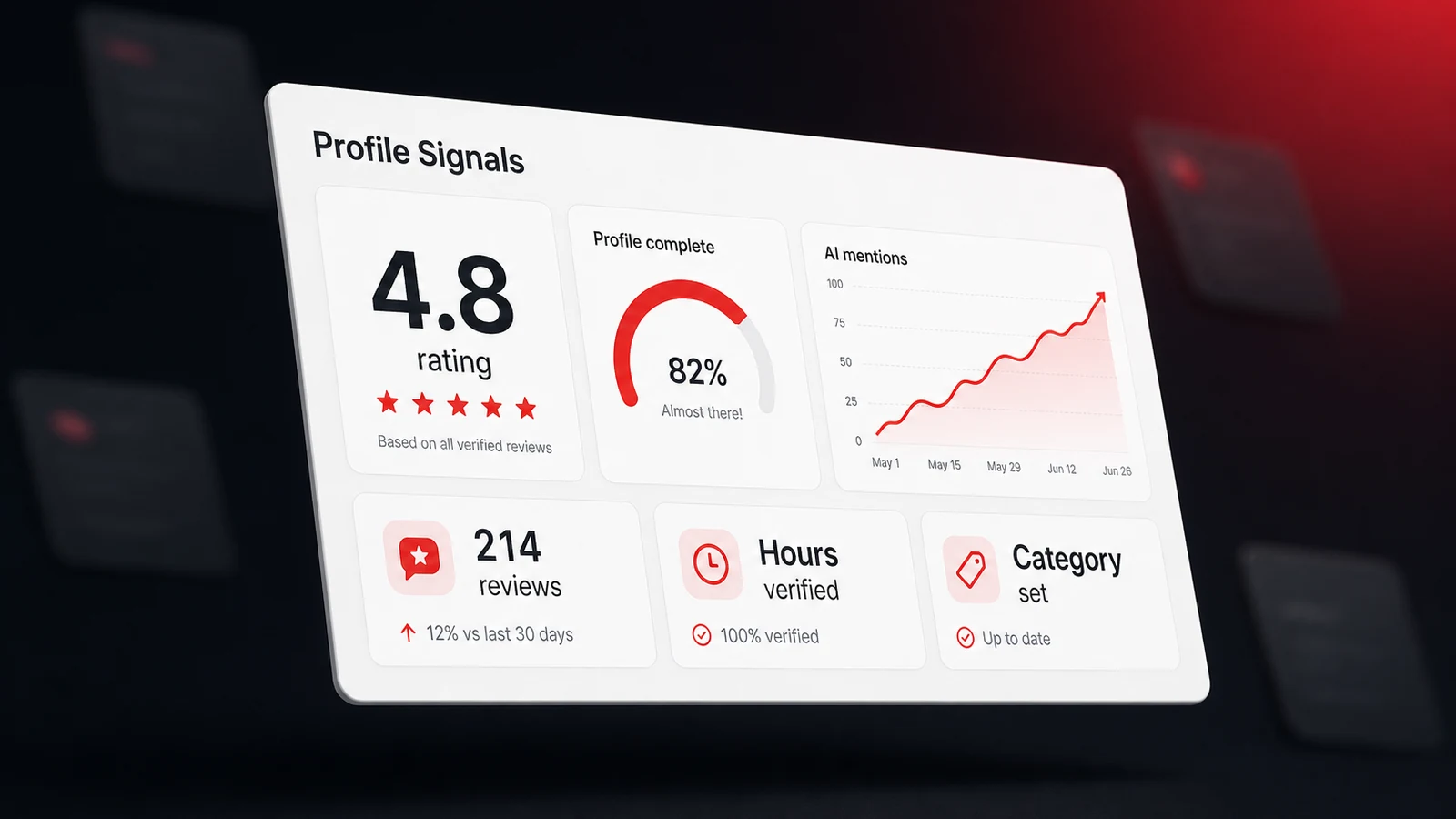
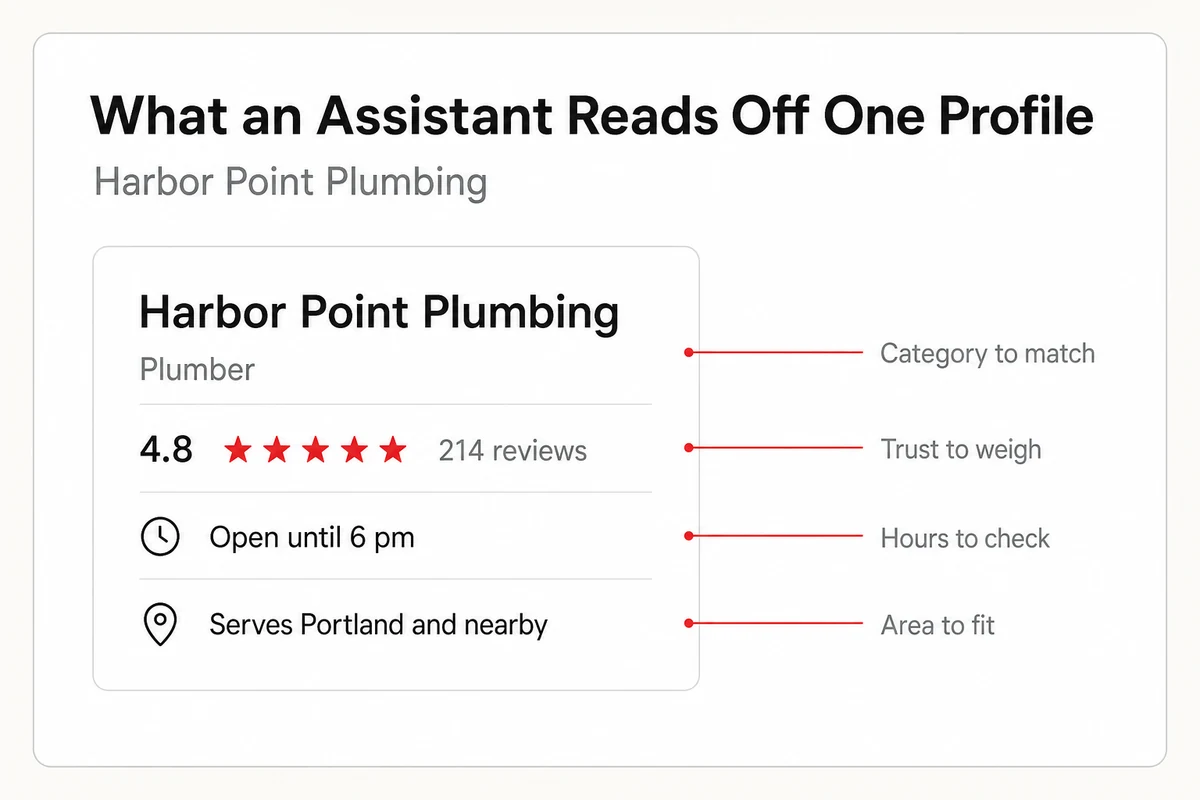
Here's how that reads on a real card. Take Harbor Point Plumbing, a service-area plumber. Its profile hands an assistant a category to match, hours to check, a 4.8 rating across 214 reviews to weigh, and a service area to fit the customer's location.
Who Can't Get One, and What Works Instead
Google's Business Profile eligibility guidelines require in-person contact with customers during your stated hours. Online-only businesses, lead-generation companies, rental or for-sale property listings, and businesses run from a P.O. box don't qualify. Service-area businesses do. Plumbers, cleaners, and mobile services can hide their address and list the areas they serve instead.
If you're in the ineligible group, you're not invisible. You just need other machine-readable sources to carry the same facts. Put local schema markup on your site so your name, category, and area read as labeled data instead of prose an assistant has to guess at. And build out the profiles you do qualify for, starting with the few directories assistants actually read. Yelp, for one, surfaces its reviews, ratings, and business details inside ChatGPT, so a strong presence there reaches AI answers through its own door.
Claimed Is Not the Same as Complete
Most businesses this post applies to already have a profile. The real gap is between claimed and complete. An assistant reading a profile with no hours, three photos, and a category picked years ago gets almost nothing to quote, and quotability is the whole game.
- Verify the profile so you control what it says.
- Pick the most specific primary category your work honestly fits, and the best one differs by trade, as our guides for specific trades show.
- Keep hours current, holidays included.
- List services with plain-language descriptions.
- Add recent photos and answer the questions customers post.
- Keep your name, phone, and address identical to your website's.
None of this is hard, and none of it stays done. Profiles drift as hours change and photos age. If you'd rather not babysit it, Lighthouse Local for Business pairs the tracking with specialists who handle profile upkeep for you, alongside reviews and on-page work.
Required in Practice, Whatever the Rules Say
So nothing forces you to have a Google Business Profile. The answer engines just behave as if one exists, and when it doesn't they fill the gap with whatever they can find, or with a competitor who gave them more to work with. Once yours is claimed and filled in, spend twenty minutes to see where you stand with each assistant, then let our AI visibility tracker watch whether the profile work changes those answers over the following weeks.
Your website carries the other half of the signals. Our free AI audit scans it and ranks what to fix first, no signup needed. Claim the profile, complete it, fix the site, and let the answers themselves tell you whether it worked.
Frequently asked questions
Is a Google Business Profile required to show up in AI answers?
No rule requires it, but every major assistant reads profile data somewhere in its pipeline. If your business qualifies for one, going without it leaves AI with far less evidence to recommend you on.
Which AI assistants use Google Business Profile data?
Gemini reads it directly through Google Maps, and Google AI does too. Independent research also caught ChatGPT citing google.com far more than any other domain for local answers, so profile data reaches assistants Google doesn't own.
What if my business isn't eligible for a Google Business Profile?
Online-only and lead-generation businesses don't qualify under Google's guidelines. Add local schema markup to your site and build out the profiles you do qualify for on platforms AI reads, like Yelp.
Does completing my profile improve AI visibility?
A complete profile gives assistants more facts to quote, exact hours, precise categories, services, and photos. The way to know it's paying off is to track how each assistant answers over time, not to assume.