Listings Feed the Answer, They Don't Earn the Name
Directory listings affect AI visibility in one narrow way. They supply the facts an assistant reads about you, and a few of them are the sources it quotes, but no 2025 or 2026 study shows that adding more listings makes ChatGPT, Gemini, Claude, Perplexity, or Google AI more likely to name your business. The research we read for this post points the other direction. A few directories carry most of the directory citations, each assistant reads a different handful, and in the largest listings study a business with a complete profile on every one of them was still recommended by ChatGPT about one time in a hundred.
That makes the practical question different from the one most owners ask. It's not whether to build citations. It's which three or four listings your assistants actually read in your trade and your city, whether the facts on them agree, and whether you should pay anyone to touch the other thousand. This post answers those with our own tracking data for one business, then with the studies, then with the vendor price lists.
One Ottawa Plumber, 1,634 Citations, Four From Yelp
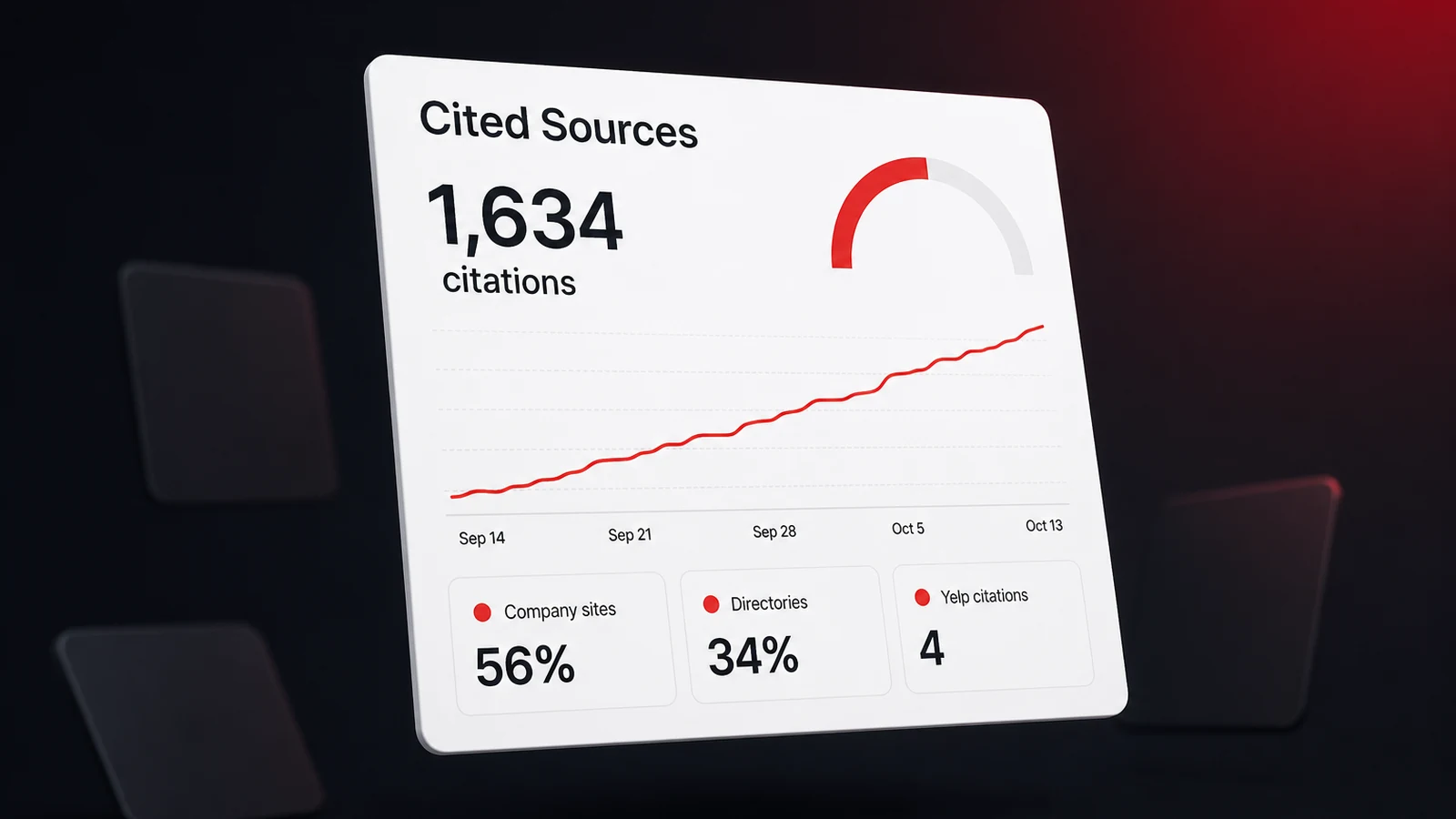
We track an Ottawa plumbing company, and the questions we track for it are the usual ones, emergency plumber near me, drain cleaning cost, who to call for a burst pipe. Between September 14 and October 13, 2026, Lighthouse Local's AI visibility tracker captured 140 answers to that company's tracked questions across the five we track and logged every source those answers cited. The tally was 1,634 citations spread over 73 domains.
Sorted by who published the cited page, the split was lopsided. Plumbing companies' own websites took 911 citations, 56 percent, across 35 domains. Directories, review sites, and lead marketplaces took 549, 34 percent, across 31 domains. Reddit, Facebook, a classifieds site, two job boards, a hardware chain, and Google's own pages took the remaining 174. Here's the part that should change how you spend. Yelp drew 4 citations in the whole month. The Better Business Bureau drew 7, Angi 2, and Houzz 1. Those four names, the ones every citation-building package leads with, added up to 14 citations out of 1,634, under one percent.
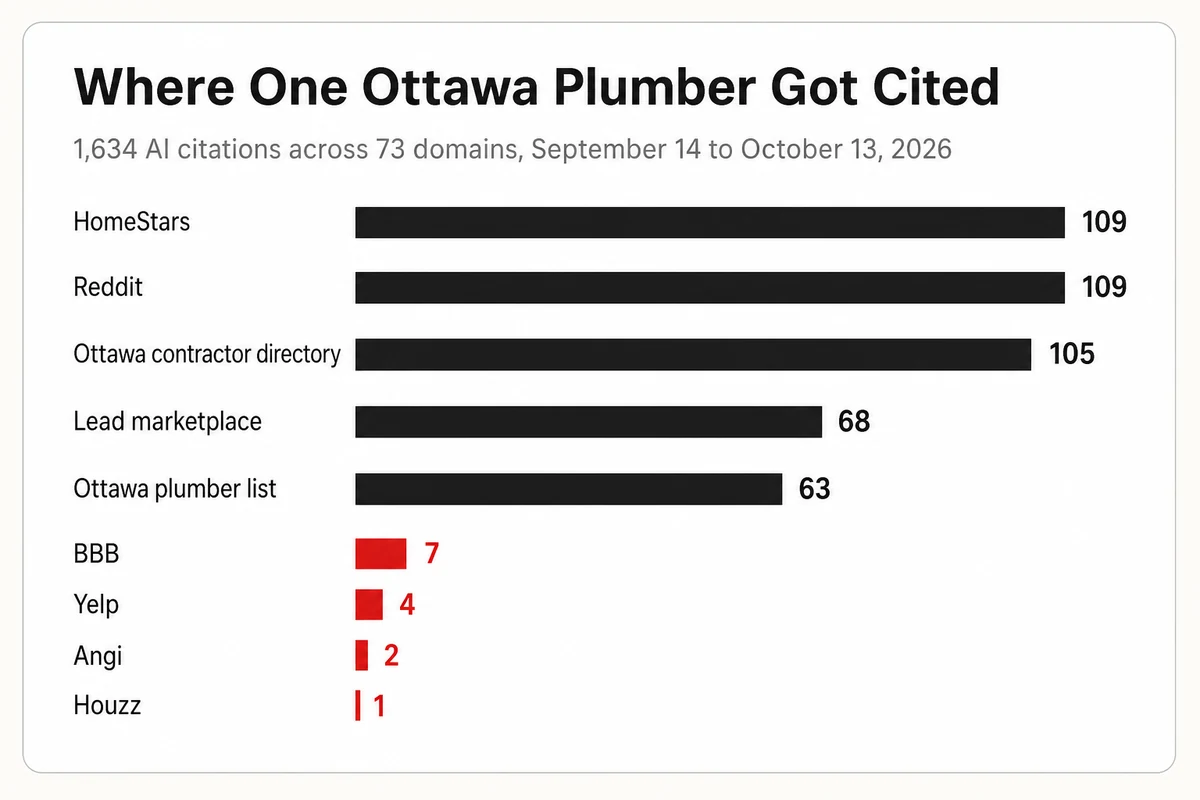
The directories that did matter were regional. HomeStars, a Canadian home-services review site, drew 109 citations, tied with Reddit. An Ottawa contractor directory drew 105, a lead marketplace 68, and an Ottawa-only plumber list 63. Those four alone were 345 citations, 21 percent of everything, and none of them appear in a typical US citation package. Twenty-five of the 73 domains were cited twice or less, 38 citations between them. The top five domains took 40 percent.
One business in one city proves nothing about yours. It proves the method. The right listings for a plumber in Ottawa weren't the right listings for a dentist in Phoenix, and the only way to know your own set is to look at what your assistants cite, which is the check at the end of this post.
ChatGPT Reads Listings, Gemini Reads Websites
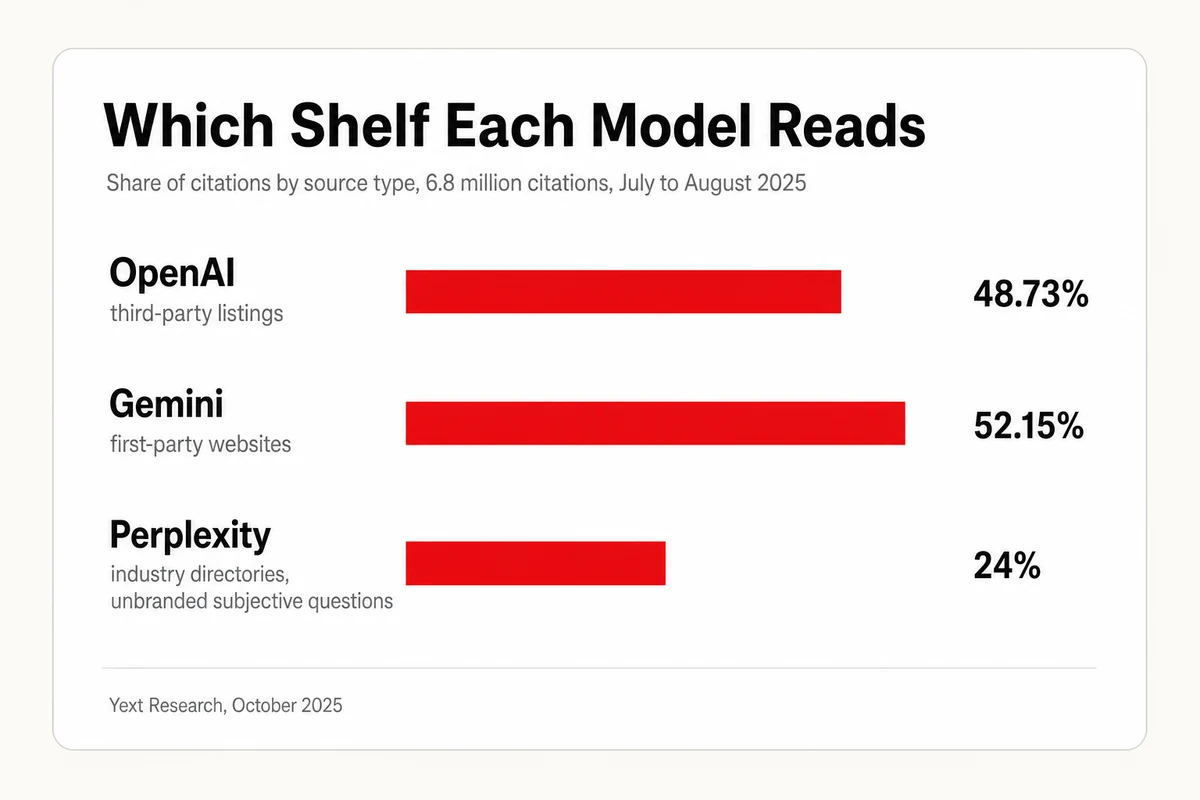
Each assistant leans on a different kind of source, so a listing can be a top citation on one and invisible on another. In October 2025, Yext, a vendor that sells listing management, published an analysis of 6.8 million citations from about 1.6 million AI answers collected through each model's API in July and August 2025 across finance, food, healthcare, and retail businesses. Third-party listings made up 48.73 percent of OpenAI's citations. For Gemini, first-party websites made up 52.15 percent. Perplexity's listing citations were led by MapQuest and its review citations by Tripadvisor, and on unbranded subjective questions Perplexity drew 24 percent of its citations from industry-specific directories, the highest of any model. Forums such as Reddit were about 2 percent of the total. Yext's own reading was that brands can manage or influence about 86 percent of the citations behind an AI answer. What a model's API cites can differ from what its consumer app shows, a limit Yext states itself.
The same split shows up when one vertical is measured across surfaces. In August 2026, Local Falcon ran 37,500 realtor searches across the 100 largest US cities and found Zillow was 39.8 percent of ChatGPT's citations but 4.4 percent of Google AI Mode's, where Google Business Profile was 72.5 percent. Across all surfaces, the top ten sources took 78 percent of citations and Yelp 4.3 percent. In the Ottawa data above, the same pattern held at a smaller scale. HomeStars was cited by every assistant we track except ChatGPT. The Ottawa contractor directory was cited by ChatGPT and by Perplexity, and by nobody else.
Claude is the hardest to read because Anthropic doesn't publish its search provider. In July 2026, Searchable ran about 3,000 prompts and found that 97.7 percent of local prompts triggered retrieval while Claude read only 0.1 conventional web pages per local query, which the authors took to mean local answers come from a listings service rather than a web search. That's an inference, not a confirmation, but it fits what we see, Claude citing HomeStars and a lead marketplace far more than plumbers' own sites. And the assistants barely overlap. Temso's analysis of 39,670 citations for dental clinics across twelve countries, updated in October 2026, found that Reddit was ChatGPT's top source at 16 percent, google.com supplied 53 percent of AI Overview citations, and the assistants shared only about 12 percent of their top domains.
One caution on reading citation counts for ChatGPT. Its local business cards are built from licensed Yelp data even when Yelp never appears as a cited link, which is why our post on whether ChatGPT runs on Google or Bing found Yelp grounding nearly every business card while showing up in about one percent of visible citations. Four Yelp citations in a month for the Ottawa plumber doesn't mean ChatGPT ignored its Yelp profile. It means the profile fed the card, not the footnote.
A Complete Listing Is Not a Recommendation
Listing completeness and getting recommended move separately in the largest data set we found. In July 2026, SOCi published listings benchmarks from its 2026 Local Visibility Index of about 350,000 locations across 2,751 multi-location brands. ChatGPT profiles for those locations were 99.9 percent complete, yet ChatGPT recommended 1.2 percent of locations. Gemini profiles were 97.1 percent complete with 11 percent recommended, and Perplexity 78.1 percent complete with 7.4 percent recommended. SOCi's own conclusion was that completeness alone doesn't guarantee AI visibility and that, among comparable brands, customer sentiment decides. The same report put the citation mix for local AI answers at Google Maps 32.5 percent, niche directories 26.3 percent, brand websites 23.1 percent, Yelp 10.5 percent, and Facebook 7.6 percent.
Two more studies looked at what travels with being named, and neither reported listings as a factor, which isn't proof that listings do nothing, only that nobody has measured it. In May 2026, Insites studied 10,000 US local businesses across 200 signals and reported that Google review volume showed the strongest correlation with AI visibility, while page speed, structured data, and llms.txt showed none. Directory presence wasn't reported as a factor at all. In June 2026, a test of 216 independent New Jersey health practices across three of the major assistants found 98.1 percent were named by none of them, and the authors pointed at the near-total absence of third-party mentions. The report didn't examine listings either way.
The practitioners who build citations for a living say roughly the same thing. In September 2026, Whitespark surveyed local SEO experts on 187 possible AI ranking factors, and the quality of structured directory citations ranked 26th, behind curated best-of lists, prominence on industry sites, and third-party review authority. The playbook's own advice was that there's no need to build hundreds of listings. It's an opinion survey from a company that sells the service, which is exactly why the ranking is worth quoting. No study has set reviews and listing count against each other directly, but the evidence that reviews shape which businesses AI recommends is far stronger than anything published about listing count, and listings earn their keep by feeding accurate facts into an answer you're already in.
The Wrong Phone Number Is the Listing Problem That Shows
Where listings can plausibly hurt is accuracy, not presence, and the accuracy problem is measured even where its cause isn't. In July 2026, Insites put the same direct question about each of 10,000 US businesses to two assistants and compared the answers to the business's Google Business Profile, a study our post on why ChatGPT gets your business facts wrong walks through in full. Only 55.58 percent of ChatGPT's answers fully matched the Google profile, and Perplexity managed 48.05 percent. The largest error by a distance was the phone number, wrong in 30.09 percent of ChatGPT answers and 38.81 percent of Perplexity's, followed by the website address. Both assistants knew the business existed over 93 percent of the time. Knowing you and reaching you turned out to be different things.
Why a stale listing can produce that error is visible in how ChatGPT assembles a local answer. In December 2025, Near Media inspected ChatGPT's new local knowledge panel and found its business facts, hours, address, phone, rating, appeared to be reconciled across multiple data providers, with MapQuest referenced in the code, while images were pulled from whatever third-party site had one. If an assistant stitches facts from several providers, a phone number that's right on Google and wrong on a directory it also reads could come out either way. Insites didn't trace its errors back to listings, and a call-tracking number on the website or a stale Google profile can produce the same mismatch, so treat the link as plausible rather than proven. A UK test made the same point from the other side. In June 2026, Searchable checked 13,365 AI responses about 165 London businesses and found that half of the small businesses got at least one false fact versus 32 percent of large companies, a gap the authors attributed to larger firms having more coverage and more consistent profiles, though that explanation wasn't tested.
None of this is new advice, which is the point. In a September 2026 Moz session recapped by Search Engine Journal, Moz's Kevin Chen said the fundamentals still hold, keep name, address, phone, and hours consistent across every platform, and treat your own website as a primary source the models now read. The listings work that pays in 2026 is correction, not construction. Find the three directories your assistants cite, make every fact on them match your Google Business Profile, and check that the phone number on each is the one you want answered.
Two Directories Have a Deal, the Rest Get Crawled
Two directories reach an assistant through a reported licensing deal, and everything else gets there by being crawled. In July 2026, Axios reported, and MarTech relayed, that Yelp licenses its reviews, ratings, photos, and business information to OpenAI for ChatGPT local answers, with Yelp branding and links shown alongside and the arrangement non-exclusive. Yelp's own second-quarter release in August 2026 said its content is powering local discovery for ChatGPT and other AI partners, and that its Other revenue rose 98 percent year over year to 33 million dollars. A Yelp profile is a direct input into ChatGPT, whatever its citation count looks like.
Perplexity's known deal is narrower. Since January 2025, Perplexity's hotel results have shown Tripadvisor ratings, perks, and images under a partnership planned to run three years. Apple's help documentation says a business can use Apple Business to be found in Apple Maps, Wallet, and Siri, and says nothing about ChatGPT. Microsoft relaunched Bing Places for Business in October 2025 as a free listing that appears in Bing search and Bing Maps, with a Google import that preserves name, hours, and contact details, and described deeper Copilot integration as something it's investing in, not something shipped. Local Falcon wrote in November 2025 that Bing Places listings feed ChatGPT without setting its ranking order, but that's a vendor's assertion with no test behind it, and Microsoft hasn't said so.
Everything else reaches the assistants the way any web page does, by being crawled and retrieved when a question matches. That's why the regional directories in the Ottawa data outperformed the national brands. A page that ranks in ordinary search for emergency plumber Ottawa gets retrieved by the assistants that run a search, and a page nobody finds gets cited by nobody. Google's own records sit underneath all of it, which is why your Google Business Profile shapes what AI says before any directory does.
What Citation Building Costs in 2026, Priced Off the Vendor Pages
Citation building is cheap, and none of the vendors selling it publishes evidence that it raises AI mentions. We fetched each price page on October 12, 2026.
| Vendor | Price | What you get |
|---|---|---|
| BrightLocal Citation Builder | $3.20 per citation, as low as $2 in bulk | Manual submission across 1,000-plus sites, duplicate removal, cleanup of existing listings, 7 to 14 day turnaround |
| BrightLocal plans | $31 to $49 a month, annual billing | Citation accuracy monitoring and a gap finder on the lowest tier, automated sync on the middle one |
| Whitespark listings service | $20 to $999 one-time | Finds, fixes, and builds listings, packages not itemized on the page |
| Whitespark Local Citation Finder | $33 to $149 a month, lowest tier on annual billing | Software that finds citation opportunities and monitors existing ones, you do the submitting |
| Semrush Local Pro | $60 a month per location | Listing management across 70-plus directories, duplicate suppression, review management |
| Synup Solo | $49 a month for one location | Listings pushed to its publisher network and kept in sync, directories not named on the page |
| Yext | No public price | Listings packaged into a wider contract, or sold through a reseller for smaller businesses |
| Uberall | No public price | Listings sit in a plan marked request pricing |
Work the arithmetic for the Ottawa plumber. A one-time cleanup of the eight or so listings the assistants cite, done at BrightLocal's per-citation rate, is under 30 dollars if those directories are in its network, and the regional ones may not be. A 1,000-site build at the same rate is over 3,000 dollars, and 25 of the 73 domains that were cited at all drew two citations or fewer. A sync subscription at 49 to 60 dollars a month buys you an alert when a directory overwrites your hours, which is worth paying for if your facts change often and worthless if they don't. What no package buys is the thing the studies most associate with the mention, which is reviews, and the pages on your own site that the assistants retrieve.
Claim, Fix, or Skip, Directory by Directory
Put the studies and the price list together and each listing sorts into one of three piles.
| Listing | Verdict | Why |
|---|---|---|
| Google Business Profile | Claim and complete | Top single source in the SOCi, restaurant, and realtor data, 72.5 percent of AI Mode's realtor citations, and the record ChatGPT's own panel facts resemble |
| Yelp | Claim and keep accurate | Licensed into ChatGPT, 14.1 percent of restaurant AI Overview citations, cited by Perplexity in every industry BrightLocal tested |
| Facebook page | Claim and keep accurate | 7.6 percent of citations in SOCi's data, the most common review source attached to Bing Places listings, and restaurants with only a Facebook or Instagram page were AI-visible 39.4 percent of the time in Local Falcon's study |
| Apple Business and Bing Places | Claim, both are free | Documented feeds into Siri and Maps and into Bing search and Maps, with Bing importing from Google |
| Your trade's own directory | Claim and keep accurate | Zillow for realtors, HomeStars for Canadian trades, Tripadvisor and OpenTable for hospitality, Avvo for lawyers, whatever your assistants cite |
| BBB, Angi, Thumbtack, HomeAdvisor | Fix if wrong, don't pay to add | Fourteen citations combined in the Ottawa data, cited only when a question matched, never a contract |
| The 1,000-site long tail | Skip, unless a listing is wrong | Cited twice or less in our Ottawa data, if at all, and a stale one can leak a dead phone number into an answer |
Two of those rows rest on evidence that surprised us. Facebook first. In September 2025, Whitespark pulled the first page of Bing Places results for 153 category-and-city queries and found Facebook was the most frequent review source, attached to nearly one and a half times as many businesses as Yelp, leading in ten of the categories. Local Falcon's June 2026 study of 10,000 US restaurants found Google's own listings drew 48.6 percent and Yelp 14.1 percent of 657,000-plus AI Overview citations, with Facebook at 2.6 percent, and separately that restaurants with only a Facebook or Instagram page were AI-visible 39.4 percent of the time against 26.2 percent for restaurants with their own website. That's a correlation inside one vertical on one Google surface, and a page that's updated weekly probably beats a site that isn't, but it argues for keeping the Facebook page alive rather than letting it rot.
The Yelp row has a second line of evidence beyond the OpenAI deal. In July 2025, BrightLocal ran 20 local searches across ten industries on four AI platforms and found Yelp was a source in 33 percent of them, Perplexity cited it in every industry, and Gemini was the only platform that didn't cite it directly. Twenty searches is a tiny test, but it matches the larger ones. Where AI gets local business data comes down to a short list of sources per trade, and the sort above is what to do with that list.
Ask Your Assistant Which Listings It Reads Before You Buy One
Before paying for anything, find out which directories your assistants cite for your questions. The slow way costs nothing. Open each assistant in a private window, set your city, and paste this.
I'm checking which sources you use for local recommendations.
Recommend three [your service] companies in [your city], then list every
website, directory, or listing you used to choose them, with a URL for each.
Mark which of those sources are business directories or review sites,
and tell me whether [your business name] appeared in any of them.
Run it on ChatGPT, Gemini, Claude, Perplexity, and Google AI, write down every directory named, and run it again with a second phrasing. Ten minutes gives you a first list. It's a photo, though, and the lists move, so a week of answers beats one.
The faster way is to let the assistant read your own tracking data instead of guessing at its sources. Lighthouse Local's tracker logs the cited domains behind every tracked question, which is where the 73-domain Ottawa list came from, and once you connect Lighthouse Local to your assistant you can ask about that log in the same chat window you'd use for anything else. The connection is one link pasted into the assistant's settings plus your usual login, it can only read, and after that two questions from our prompt library return the answer this whole post has been circling, for your business, from a month of real answers rather than one session.
How often does AI cite my own website compared with directories like Yelp?
List the ten sources AI cites most that aren't my website or a competitor's.
Which of those ten are directories I could claim a listing on?
Then do the cheap work in the order the evidence supports. Make your Google Business Profile complete and current, make Yelp and your trade's directory match it fact for fact, claim the free Apple and Bing listings, keep the Facebook page breathing, and fix any long-tail listing that's carrying an old phone number. Your own site is half the equation, since it's the source Gemini cites most, and a free AI audit returns the on-site signals it scores, ranked. If you'd rather have specialists handle the profile, listing, and review work with you approving each change, that's what Lighthouse Local for Business does. Build the listings your assistants actually read, keep every fact on them identical, and let the answers tell you whether to build any more.
Frequently asked questions
Do directory listings help AI visibility?
Partly. Listings supply the facts assistants read and a few directories are cited heavily, but no 2025 or 2026 study shows that adding listings makes an assistant more likely to name a business. SOCi's 2026 data found ChatGPT profiles 99.9 percent complete while ChatGPT recommended 1.2 percent of locations. Review volume and third-party mentions are the signals the studies associate with being named.
Which directories do AI assistants cite most for local businesses?
Google's own listings lead in several large studies, then it varies by assistant and trade. Yext found third-party listings were 48.73 percent of OpenAI's citations and first-party websites 52.15 percent of Gemini's. Local Falcon found Google plus Yelp took 62.7 percent of restaurant AI Overview citations, and Zillow was 39.8 percent of ChatGPT's realtor citations but 4.4 percent of AI Mode's.
Does NAP consistency matter for AI search?
For accuracy, yes. Insites found only 55.58 percent of ChatGPT answers and 48.05 percent of Perplexity answers fully matched a business's Google profile in 2026, with a wrong phone number the most common error, and ChatGPT's local panel appears to reconcile facts across several data providers. No study ties consistency to being named more often, so treat it as protection against wrong answers rather than a ranking lever.
Is paid citation building worth it in 2026?
Rarely as a volume play. BrightLocal charges $3.20 per citation and Whitespark sells packages from $20 to $999, and no vendor publishes evidence that more listings raise AI mentions. A one-time cleanup of the handful of directories your assistants cite is cheap and worth doing. A thousand-site build mostly fills directories that are never cited.
How do I find which directories AI uses for my business?
Ask each assistant in a private window with your city set to recommend three companies in your trade and list every source it used, then repeat with a second phrasing. Write down the directories named. A tracker that logs cited domains over weeks gives a steadier list than one session, because the sources change between runs, and once Lighthouse Local is connected to your assistant you can ask it for that list directly.