Two Thousand Pharmacies Closed and the Patients Went Searching
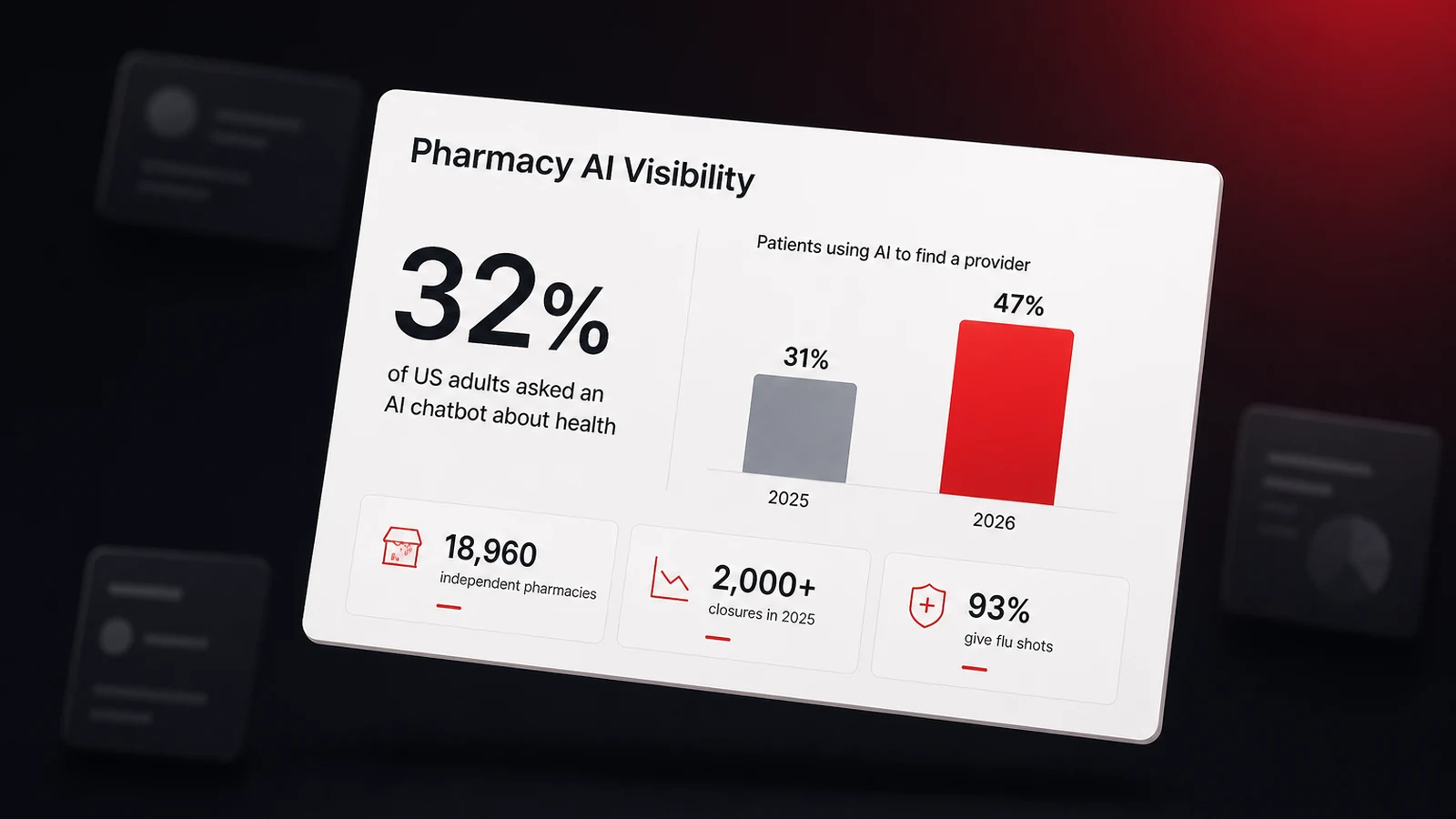
Getting a local pharmacy found on Google and named in AI answers takes the same local SEO every business needs, held to health care's stricter bar, a complete Google Business Profile, a dedicated page per service, Pharmacy schema markup, and careful review replies, all covered in this guide. That work matters right now because chain pharmacies are closing and their patients inherit the same errand. Find somewhere new to fill a prescription, usually within the week. In 2025 that errand ran at national scale. Rite Aid, which once operated more than 4,900 stores, shut its last locations after a second bankruptcy. Walgreens is partway through a plan to close roughly 1,200 stores over three years. In 2026, the industry analyst Adam Fein at Drug Channels tallied more than 2,000 retail pharmacy closures for 2025 alone, with chains making up 62% of them.
Those patients are up for grabs, and independents are well placed to win them. In late 2025, the National Community Pharmacists Association's annual Digest counted 18,960 independent community pharmacy locations, nearly 36% of US retail pharmacies and more than any single chain operates. J.D. Power's 2025 pharmacy study, as reported by Chain Drug Review, scored chain drug stores at 643 out of 1,000 on satisfaction and found their customers significantly more likely than supermarket or mass merchant pharmacy customers to say they'll switch within a year. The two brands at the top of that chain ranking, Health Mart at 759 and Good Neighbor Pharmacy at 732, are both networks of independently owned stores.
What's changed is where the searching happens. In 2026, a KFF poll of 1,343 adults found that 32% of US adults had turned to an AI chatbot for health information in the past year. The same spring, a survey of 992 patients by the reputation software company rater8, published as its Patient Choice Report, found 47% had turned to an AI tool to research or find a healthcare provider, up from 31% in its 2025 survey. That poll covered medical and dental patients broadly, not pharmacy customers alone, so treat it as a signal of the habit. So the displaced patient doesn't only type "pharmacy near me" into Google. They ask an assistant which pharmacy nearby delivers, compounds, or has a pharmacist who picks up the phone.
This guide covers both halves of that search. The local SEO that gets a pharmacy found on Google and Maps, and the AI search work that gets it named when someone asks ChatGPT, Gemini, Claude, Perplexity, or Google AI. It's the first of our industry field guides, each written for one trade at a time, because a pharmacy's search problems aren't a plumber's.
Health Questions Get Graded on a Stricter Curve
Start with the rule that separates pharmacy marketing from almost every other local business. Google's Search Quality Rater Guidelines, last revised in September 2025, put health in a class of topics called Your Money or Your Life, where bad information can hurt someone. The guidelines reach for pharmacies to make the point. Buying pencils isn't a high-stakes topic. Buying prescription drugs is, because in Google's words, "Prescription drugs have the potential to cause harm and require purchase from licensed pharmacies."
Be precise about what that document is. It trains the human raters who evaluate Google's results. It isn't the ranking algorithm, and no rater scores your site directly. It's still the clearest public statement of what Google wants its systems to reward on health topics, and the AI assistants built on web search inherit the same caution. An assistant asked where to fill a prescription wants a business it can verify is a licensed pharmacy with a real pharmacist behind the counter.
So give it the proof, in plain text on your own site.
- Name the pharmacists. Full names, credentials such as PharmD or RPh, and a short bio each. A page signed by nobody reads as written by nobody.
- Show the license. Your state board of pharmacy license number and your NPI in the footer or on the about page.
- Use real photos. The storefront, the counter, the consultation room, the delivery car. Stock photos of smiling models in lab coats verify nothing.
- Keep health content inside your lane. A pharmacist-reviewed page on what to bring to a shingles vaccine appointment helps. A generic article on managing diabetes, written by no one in particular, competes with hospital systems and loses.
This is one contest an independent can win on the merits. CVS Health's Rx Report, drawn from a Morning Consult survey of more than 2,200 adults in mid 2025, found 77% of adults trust their local pharmacist and 48% would switch pharmacies if they were confined to digital-only service. That's a chain's own research, so weigh it accordingly, but it points the same direction as everything else here. People want a pharmacist they can reach. Your job online is to prove you're one, in the places machines look, and our breakdown of the directories and profiles AI reads for local facts shows where those places are.
Claim the Pharmacy Category, Then Every Service Under It
For local search, the Google Business Profile does more work than the website, and for a pharmacy three fields carry most of the weight.
The primary category. Google's help page on choosing a business category tells owners to pick the most specific category that describes the business, and says categories affect local ranking. For most independents that's Pharmacy as the primary, with secondary categories only for things you really do, such as compounding or medical supplies. A category you added to catch extra searches, for a service you don't offer, earns a wrong-fit visit and a bad review.
The hours, all of them. A pharmacy often runs two clocks, the front of the store and the pharmacy counter. The hours on the profile should be the hours a patient can pick up a prescription. Set special hours for every holiday, because "is the pharmacy open today" is one of the most common things anyone asks about you, and an assistant will repeat whatever the profile says.
The department rule. If your pharmacy sits inside a grocery store, a clinic, or a hospital, don't hide under the host's listing. Google's guidelines for representing your business say that "Departments within businesses, universities, hospitals, and government institutions may have their own Business Profiles on Google." That's the rule that lets the pharmacy counter carry its own name, category, phone number, and hours.
Then fill in the services list with the words patients use. Flu shots, not immunization services. Prescription delivery, not logistics. We've covered why a complete Google Business Profile feeds AI answers in a separate post, and it applies to pharmacies with extra force, because the facts people ask about you (open now, delivers, takes my insurance) are profile facts.
Last, make the same name, address, and phone number appear everywhere a patient or a machine might check. Yelp, Apple Maps, Bing Places, your wholesaler network's store locator, and the pharmacy finders your insurance plans publish. One old phone number on one directory is enough for an assistant to hedge or to send a patient to a line nobody answers.
One Page per Service, Because Patients Ask by Service
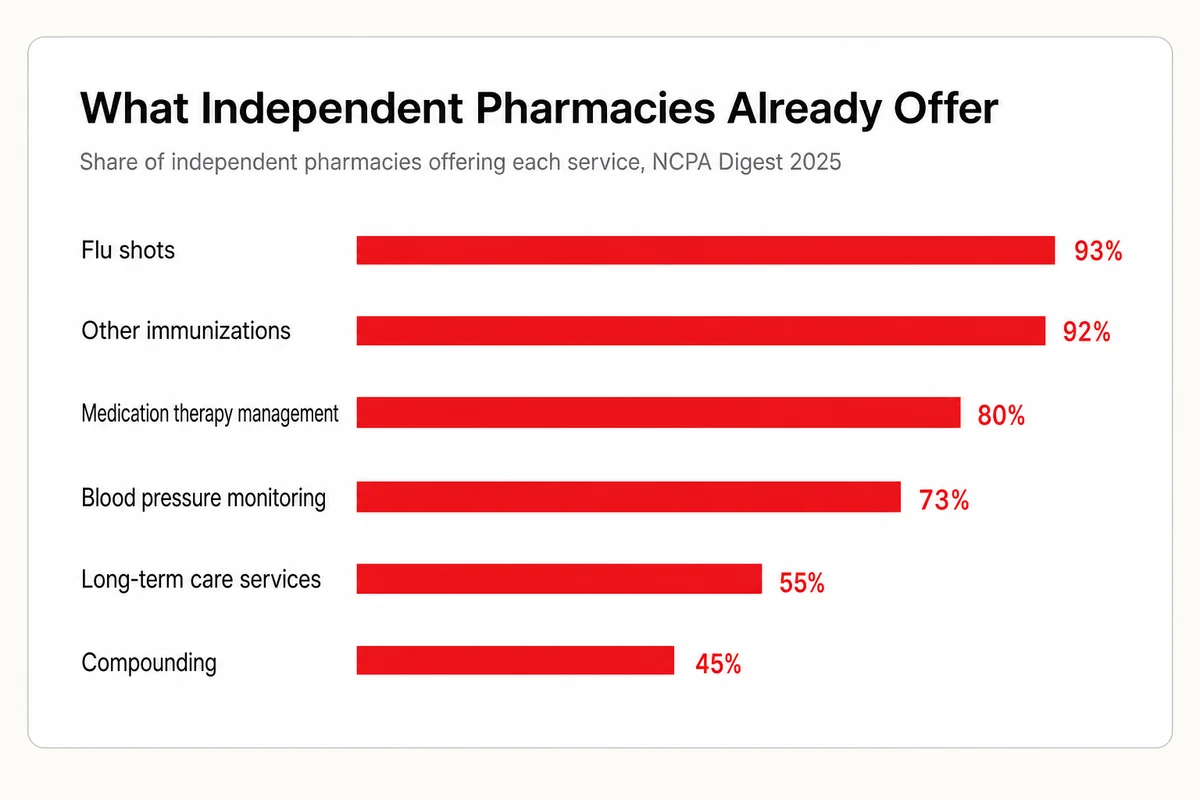
Nobody asks an assistant for "a pharmacy with comprehensive services." They ask who compounds a pet medication, who'll deliver to a parent who can't drive, who gives a shingles shot without an appointment. Independents already offer what's being asked for. According to NCPA's Digest, cited above, 93% of independent pharmacies give flu shots, 92% give other immunizations, 80% offer medication therapy management, 73% check blood pressure, 55% serve long-term care patients, and 45% compound.
The trouble is how those services show up online. A single services page with one bulleted line per service gives a search engine nothing to rank and an assistant nothing to quote. Each service a patient might ask for by name deserves its own page, and each page should answer the question in its first sentence.
| Service page | The question behind it | What the page has to state |
|---|---|---|
| Immunizations | Where can I get a shingles shot today? | Which vaccines, which ages, walk-in or appointment, insurance accepted, hours a vaccinator is on duty |
| Prescription delivery | Which pharmacy delivers to my mother's house? | The towns or ZIP codes served, by name. Days, cutoff time, cost, and how to enroll |
| Compounding | Who can make this medication in a liquid? | What you compound (pediatric, veterinary, dermatology), turnaround time, and how a prescriber sends the order |
| Medication synchronization | Can I pick up all my refills on one day? | How the program works, who it suits, and how to sign up |
| Transfer a prescription | My pharmacy closed. How do I move my prescriptions? | The exact steps, what the patient needs on hand, how long it takes, and a phone number or form |
That last row is the one most pharmacy sites skip and the one the closures made urgent. A patient whose store just shut is searching for that exact sentence. Write the page so its opening line answers it, something like "[Pharmacy name] can transfer your prescriptions from any closed or closing pharmacy, usually the same day. Call [phone] with your name, date of birth, and the name of your old pharmacy, and we handle the rest." Fill in only what's true for you.
Name places the way patients do. "We deliver within ten miles" is invisible to a question that says "in Maple Grove." A delivery page that lists the towns you reach can match it.
Pharmacy Schema Markup, Ready to Paste
Schema markup is a block of labeled facts in your site's code that tells machines what kind of business yours is without making them guess from the prose. Most local businesses use the generic LocalBusiness type. Pharmacies have their own. Schema.org's Pharmacy type, defined simply as "A pharmacy or drugstore," sits under MedicalBusiness, which sits under LocalBusiness. It adds no properties of its own, so everything you'd put on a LocalBusiness works here, plus a few it inherits from the medical side, such as whether you're accepting new patients.
Here's a starting block. Replace every bracketed value, delete any line that doesn't apply, and place it in the head of your homepage or location page.
<script type="application/ld+json">
{
  "@context": "https://schema.org",
  "@type": "Pharmacy",
  "name": "[Your Pharmacy Name]",
  "url": "https://www.yourdomain.com",
  "image": "https://www.yourdomain.com/storefront.jpg",
  "telephone": "[+1-000-000-0000]",
  "isAcceptingNewPatients": true,
  "address": {
    "@type": "PostalAddress",
    "streetAddress": "[Street address]",
    "addressLocality": "[City]",
    "addressRegion": "[State]",
    "postalCode": "[ZIP]",
    "addressCountry": "US"
  },
  "geo": {
    "@type": "GeoCoordinates",
    "latitude": "[Latitude]",
    "longitude": "[Longitude]"
  },
  "openingHoursSpecification": [
    {
      "@type": "OpeningHoursSpecification",
      "dayOfWeek": ["Monday", "Tuesday", "Wednesday", "Thursday", "Friday"],
      "opens": "09:00",
      "closes": "18:00"
    },
    {
      "@type": "OpeningHoursSpecification",
      "dayOfWeek": "Saturday",
      "opens": "09:00",
      "closes": "13:00"
    }
  ],
  "areaServed": ["[Town you deliver to]", "[Another town]"],
  "sameAs": [
    "[Your Google Business Profile link]",
    "[Your Facebook page]"
  ]
}
</script>
Two cautions. The hours in the markup must be the pharmacy counter's hours and must match your Google profile, because conflicting facts are worse than missing ones. And markup labels facts, it doesn't create them. It won't lift a pharmacy that has thin pages and no reviews. If the format is new to you, our plain-English walkthrough of how local schema markup works covers where the code goes and how to test it.
Reply to Reviews Without Confirming Anyone Is a Patient
Reviews decide healthcare choices more bluntly than most owners assume. Tebra's patient perspectives survey of 803 patients, collected in September 2025, found 62% had avoided booking with a provider because of negative reviews, and 71% said they're more likely to trust a provider who responds thoughtfully to a bad one. Tebra sells software to medical practices and surveyed patients of providers in general, not pharmacies alone, so read those as directional. The direction is clear enough. Reply to reviews, and reply well.
Here's the trap that's specific to you. A pharmacy is a covered entity under HIPAA, and the Privacy Rule's general standard says a covered entity "may not use or disclose protected health information, except as permitted or required" by the rule. The fact that a named person fills prescriptions with you is protected health information. It stays protected even when the reviewer announced it first. A roofer can reply "sorry about the delay on your Tuesday install." You can't write the pharmacy equivalent.
| Risky reply | Safer reply |
|---|---|
| We're sorry your blood pressure refill was late on Tuesday. Our records show your insurer rejected the claim twice. | Thank you for the feedback. We work to fill every prescription promptly, and we'd like to look into this. Please call our pharmacy manager at [phone] so we can help directly. |
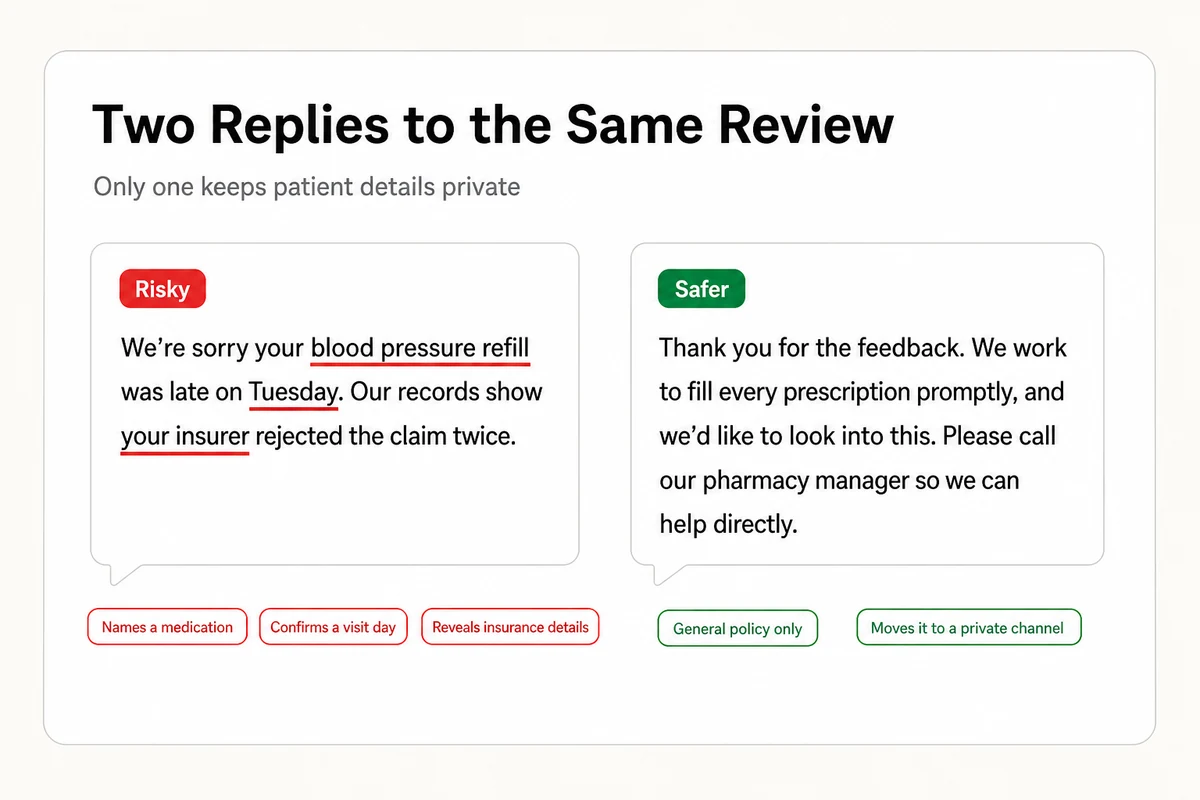
The safer reply never confirms the reviewer is a patient, never mentions a drug, a date, or an insurer, and moves the conversation to a private channel. Speak to your general standards, not the person's visit. Write two or three templates like it, have whoever handles your compliance approve them once, and make them the only replies staff are allowed to post. This isn't legal advice, and your state may add rules of its own.
Asking for reviews is simpler. A small card at the pickup counter with a QR code to your Google profile works, offered to everyone and never in exchange for a discount. What patients write matters as much as the star count, because AI assistants read review text for details such as short waits, a pharmacist who explains things, or delivery that shows up. Those phrases become the reasons an assistant gives when it names you.
Ask the Assistants What a New Patient Would Ask
Once the profile, the pages, and the markup are in place, check what the assistants say. Ask the way a stranger new to town would, with the town written into the question and no mention of your name. These five cover the ground for most independents.
1. My pharmacy in [town, state] just closed. Where should I transfer my prescriptions, and why?
2. Which pharmacies in [town, state] deliver prescriptions to your home?
3. Where can I get a shingles vaccine in [town, state] without an appointment?
4. Is there a compounding pharmacy near [town, state]?
5. Which independent pharmacy in [town, state] has the best reviews, and what do people say about it?

For each answer, list the web pages you used, with a link for each.
Run each one in a private or temporary chat on ChatGPT, Gemini, Claude, Perplexity, and Google AI, since your own account's history tilts the answer, a problem we unpack in our post on why AI answers differ from person to person. For every answer, write down four things. Whether you were named. Who was named instead. Whether the facts about you (hours, services, address) were right. And which pages the assistant cited. The cited pages are the to-do list. If every answer leans on a directory where your listing is half empty, fix that listing first.
Expect the answers to wobble from run to run, so one check proves little. Twenty-five chats a month is a real chore for someone who also has a counter to run, which is the reason Lighthouse Local's AI visibility tracker exists. It runs prompts like these on a schedule across each of those assistants, with the town written in and no account history behind the question, and shows whether you were named, who was named instead, and which sources the answer drew on. It tracks and reports. It doesn't guarantee a mention, and no honest tool can.
What Pharmacy Marketing Can't Shortcut
A few limits are worth knowing before you spend money.
Ads are gated. Google's healthcare and medicines policy says "Advertisers must be certified by Google in order to serve ads for prescription drug services," and notes that some certifications first require accreditation from a third party such as LegitScript or NABP. NABP's Digital Pharmacy Accreditation is a three-year accreditation for pharmacies whose websites offer interactive services such as refill or transfer requests, and it requires an active .pharmacy domain. If you plan to advertise online refills, budget time for that paperwork. The organic and local work in this guide needs none of it, which is one more reason to start there.
Search can't fix your network status. If a patient's plan won't pay at your counter, no ranking changes that. Say plainly on your site which major plans you accept, so the patients who find your pharmacy are ones you can serve.
Nobody controls the answer. Assistants draw on your site, your profile, directories, and reviews, then phrase things their own way, differently each time. Anyone promising a guaranteed spot in ChatGPT is selling something that doesn't exist. What you control is whether the facts about your pharmacy are complete, consistent, and easy to quote everywhere an assistant looks.
It takes hours you may not have. Most of this guide is an afternoon of work per section, and most pharmacy owners don't have spare afternoons. If you'd rather hand it off, Lighthouse Local for Business brings in specialists for the profile management, the service pages, and the citation cleanup, and every change waits for your sign-off before it goes live.
Be the Pharmacy the Answer Names
A chain closing down the street is a one-time event, and the patients it releases choose a new pharmacy once. They'll choose from whatever Google, Maps, and an AI assistant put in front of them that week. The pharmacies that show up won't be the ones with the biggest budgets. They'll be the ones whose profile is complete, whose services each have a page that answers a real question, whose markup says Pharmacy, whose review replies are careful, and whose facts agree everywhere. None of that needs a marketing department. If you want to know where your own site stands, our free AI visibility audit sorts your pages by what needs fixing first, no signup required. It grades the site, not the answers, so run it alongside those five prompts above. You already earned the trust at the counter. Now put it where the next patient is looking.
Frequently asked questions
How do I get my pharmacy recommended by ChatGPT?
Make the facts about your pharmacy complete and consistent where assistants look. That means a fully filled Google Business Profile with the Pharmacy category, a separate page for each service such as delivery, immunizations, and compounding, Pharmacy schema markup, steady reviews, and matching name, address, and phone on every directory. No one can guarantee a mention, but those are the inputs an assistant draws on.
What schema type should a pharmacy website use?
Use the Pharmacy type from Schema.org. It's a subtype of MedicalBusiness, which is a subtype of LocalBusiness, so it accepts the usual local fields such as name, address, phone, hours, and coordinates, plus inherited medical fields such as whether you're accepting new patients.
Can a pharmacy respond to Google reviews without violating HIPAA?
Yes, if the reply never confirms the reviewer is a patient and never mentions a medication, a date of service, an insurer, or any other detail of their care. Thank them, speak to your general standards, and invite them to call a named manager. Have your compliance contact approve a few templates and use only those.
Does a pharmacy inside a grocery store need its own Google Business Profile?
It can have one. Google's guidelines allow departments within other businesses to have their own Business Profiles. A separate profile lets the pharmacy show its own category, phone number, and counter hours, which often differ from the host store's.
Do independent pharmacies need NABP accreditation to show up in search?
No. Accreditation matters for paid advertising of prescription drug services, where Google requires certification, and for pharmacies that fill or refill through their website. Organic search, Google Maps, and AI answers don't require it.