Your Screen Is the Most Biased Screen in Town
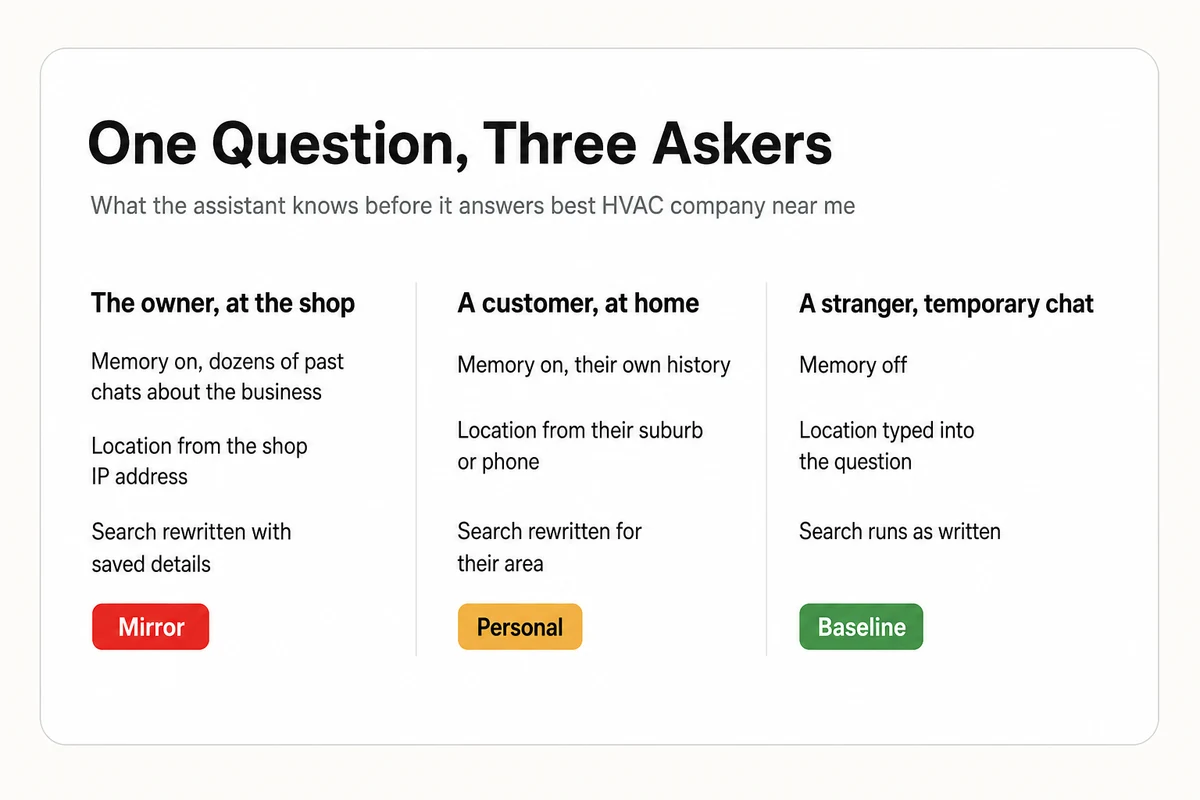
AI recommendations differ by user because memory, assumed location, and randomness all bend the answer before it reaches a screen. Here's a scene that plays out in a lot of shops. The owner opens ChatGPT, types "best HVAC company near me," and reads the answer. Either their name is in it and they relax, or it isn't and they start worrying. Both reactions rest on the same mistake. The screen the owner is looking at is the one screen in town that least resembles what a customer sees.
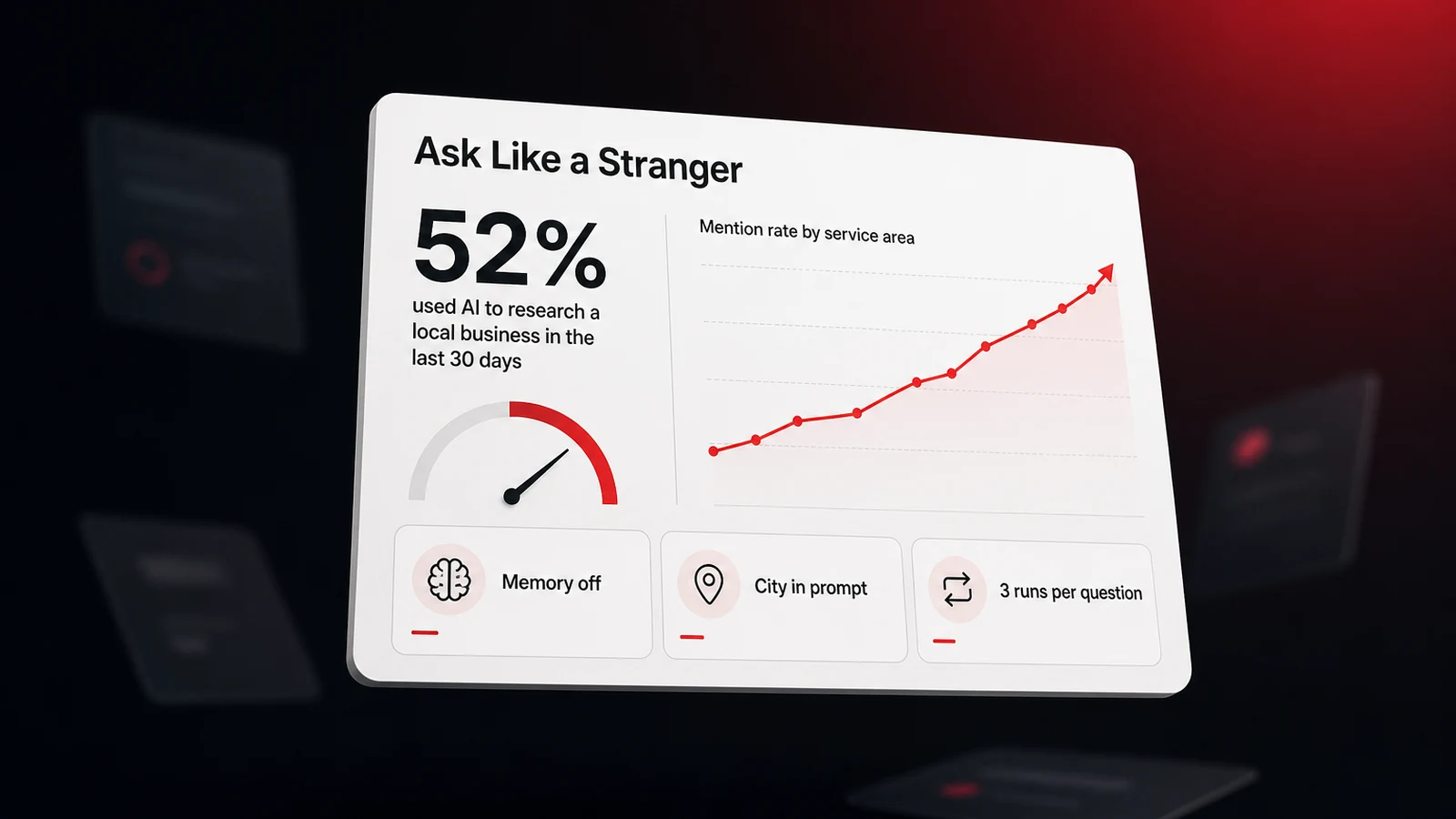
Customers are asking. In 2026, SOCi's Local Discovery Index, which polled over 1,000 US consumers, found that 52% had used an AI tool to research a local business in the past 30 days. Every one of those people asked from their own account, in their own neighborhood, with their own history of chats behind them, and the assistant shaped its answer around each of them. Your check ran through your account, on your shop's connection, after every conversation you've ever had with that assistant about your own business.
Three things bend an AI answer before it reaches any screen. Memory of the person asking. Where the assistant thinks that person is standing. And plain randomness in how it searches. This post walks through each one using the AI companies' own documentation, then shows how to run a check that strips the first two out, and why the results only mean something when you track them by the areas you serve rather than by your storefront.
Memory Makes Your Own Chats a Thumb on the Scale
Think about what an assistant already knows about your business by the time you ask it for a recommendation. You've drafted service pages with it, pasted reviews into it, asked it to rewrite your Google Business Profile description, and asked "does AI recommend me" a dozen times before. OpenAI's Memory FAQ describes ChatGPT's memory as a continually updated synthesis of context from your past chats, one that helps it "personalize your experience." When it names your business back to you, that isn't visibility. That's familiarity.
It isn't only ChatGPT, and on some assistants you never switched it on. Anthropic's help center states that memory is on by default for Claude's Free, Pro, and Max plans. Gemini's personalization with memory of past chats runs for anyone 18 or over on a personal Google account with Keep Activity on. In late 2025, Perplexity announced memory that remembers "your preferences, interests, and conversations" across models. And Google's Personal Intelligence in AI Mode references your previous searches and saved activity to tailor what it suggests. In 2026, Google expanded that across AI Mode, the Gemini app, and Chrome, with Gmail and Google Photos as optional inputs.
Every major assistant now carries some memory of the person asking, and on Claude's individual plans and ChatGPT with memory enabled, it shapes answers unless you switch it off. The customer's assistant has memory too, but it remembers the customer, a homeowner who asked about furnace noises last winter, not you. Two accounts, two different thumbs on the scale, and neither one is a fair reading of where you stand.
"Near Me" Means Wherever the Assistant Thinks You Are
The second bend is location, and OpenAI spells out the mechanics in its own help center. Its help article on ChatGPT search for workspaces says ChatGPT can turn a request into one or more search queries, that it "collects general location information based on IP address," and that it may pass that approximate location along to its search providers "to improve the accuracy of results." Put those together and a "near me" question never reaches the web the way you typed it. The assistant writes its own search, and the place it writes in is wherever your connection says you are. Memory stacks on top. The Memory FAQ linked earlier gives the example of ChatGPT remembering that you live in San Francisco and opening an answer with "Since you live in San Francisco." Memory and location don't act separately. They multiply.
The pattern holds across the assistants we track. Google says Gemini uses your general location, or your device's precise location if you allow it. Anthropic's privacy center, in a page dated March 2026, says Claude may use your IP address for coarse city-level location when web search looks for local results. Perplexity's account settings guide says that without a location in your profile, "responses will be based on your network location." And Google Search, which feeds AI Overviews and AI Mode, works out where you are from your device, your saved home and work addresses, your past activity, and your IP address.
Every assistant we track resolves "near me" from the asker's IP address or account location, so an owner asking from the shop and a customer asking from home are running two different searches. You sit inside your own service area on the shop's connection. Your customer sits in a suburb fifteen miles out, on a phone, or on a VPN that thinks they're in another state. A business that serves five suburbs isn't competing in one answer. It's competing in five, and the owner's own check only ever samples the one they're standing in.
Two Strangers in the Same City Still Get Different Lists
Strip memory and location out and there's a third bend that no setting removes. In 2026, the local-search firm Steady Demand repeated 497 identical Gemini queries on the same day and found the two runs shared only 43.0% of their cited domains on average. Waiting didn't help. Pairs separated by hours and pairs separated by a day drifted about the same amount, which led the authors to conclude that elapsed time doesn't explain the drift, so there's no quiet window to wait for.
The same firm matched 1,500 local queries across 50 metros and ten service categories, running each one on ChatGPT, then again on Gemini. When both engines named a recognizable business, they picked the same one first just 4.9% of the time. Two strangers in the same city, asking the same thing on different assistants, are almost never handed the same first pick.
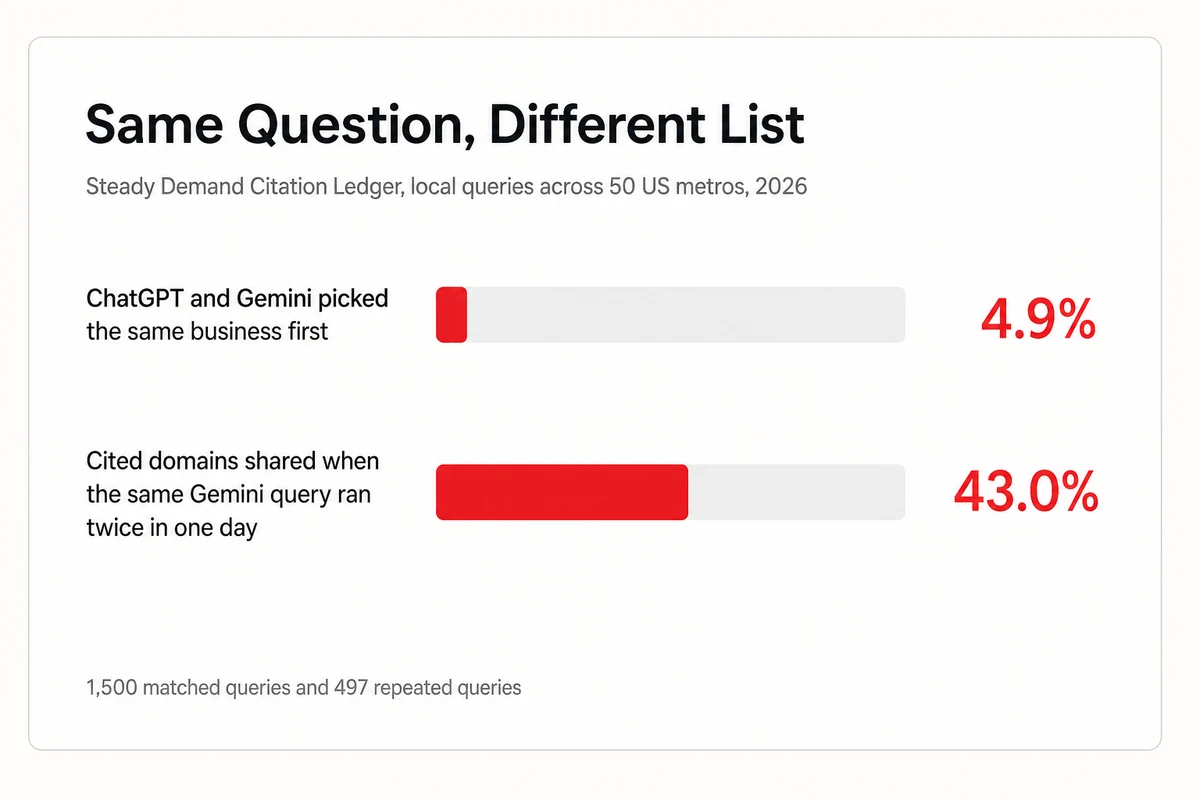
So even a perfectly neutral question produces a sample of one. That's why visibility is a rate over many answers, not a single screenshot. Our post on how many AI checks before a number means something walks through the math. For this post, the practical point is simpler. One check tells you almost nothing. Three checks, run the right way, start to tell you something.
How to Ask Like a Stranger
The right way is to ask the way a customer who has never heard of you would, from where they'd ask. Each assistant has a private mode that switches memory off, and the companies document what each one drops.
| Assistant | Private mode | What it switches off, per the company's own docs |
|---|---|---|
| ChatGPT | Temporary Chat | Doesn't use existing memories or create new ones. |
| Gemini | Temporary chat | No personalized responses, and nothing saved for future personalization. |
| Claude | Incognito chat (the ghost icon) | Nothing saved to memory or chat history. |
| Perplexity | Incognito | Searches are never stored, and memory and search history are disabled. Signed-out threads are anonymous by default. |
| Google AI | Signed out, or personalization off | AI Mode personalization is opt-in, so leaving it off returns the answer a stranger gets. |
Private mode strips memory. It doesn't strip location. A temporary chat still runs on your IP address, so the second rule is to write the place into the question and never type "near me." Name the suburb or neighborhood the way a customer there would. Here's a prompt to paste, with your details filled in.
I live in [neighborhood or suburb], [city, state]. Which three [service] companies would you recommend to me, and why each one? List the web pages you used, with a link for each.Run it three times in fresh private chats, on each assistant, once for every area you serve. If you can, do at least one round from a phone on cellular rather than the shop's wifi, since that hands the assistant a different IP address than the one it associates with your building. Then read each answer against the checklist in our guide to spotting your business in an AI answer. Named or not, where in the list, described accurately or not, and which pages it leaned on. Write it down, because the apps keep no record you can go back to.
Track by Service Area, Not by Storefront
Do the math on the manual version. Five areas, the five we track, three runs each, monthly, is 75 private chats a month before you've read a single answer. It works for one location and one area. It stops working the moment you serve more than one town, which is most service businesses.
This is exactly why Lighthouse Local built its AI visibility tracker the way it did, following directly from the three bends above. It asks through each company's developer channel where one exists, and reads Google's AI Overview off a live results page where none does, so no account, chat history, or memory of you sits behind any answer, a setup we describe in our post on how we know what ChatGPT says about your business. It writes the city and state into every local prompt so the assistant isn't guessing from an IP address, and the same prompt can carry a different city for each area you serve. And it repeats on a schedule so the randomness averages into a rate you can watch move.
Be clear about what that shows. The tracker sees the stranger's baseline, the answer an assistant starts from before any one person's memory bends it. It never sees a specific customer's personalized screen, and neither does any other tool, because that screen exists only on that customer's phone. The baseline is still the number that matters. It's what moves when your public footprint changes, and our guide to which sources feed an assistant's local answers covers what an assistant reads to build it. When the answers surface gaps you'd rather not close yourself, Lighthouse Local for Business teams the tracker with specialists who own the on-page fixes, the profile management, and the citation work, with every step approved by you first.
Trust the Answer You Didn't Help Write
The screen in your shop is a mirror, not a window. It reflects your chats, your building, and one roll of the dice. A customer's screen reflects theirs. The only version worth acting on sits in between, the answer a stranger gets when they name your suburb and ask. So ask in private, write the place in, ask three times, do it for every area you serve, and read the rate. If the rate says the assistants don't know you yet, the fix usually starts with your own pages, and our free AI visibility audit hands back a prioritized list of what needs work first. It scores your pages, not the answers. Reading the answers, month after month, is what the tracker is for. Whatever tool you use, hold it to one standard. The only answer worth acting on is the one you had no hand in.
Frequently asked questions
Does ChatGPT give different recommendations to different people?
Yes. With memory on, ChatGPT personalizes answers from your past chats, it infers your location from your IP address to answer local questions, and its web search varies from run to run even for the same person. Two people asking the same question in the same city routinely get different businesses.
Why does AI recommend my business when I ask, but not when my customers ask?
Your account has a history of chats about your business, and you're asking from your shop's location. The assistant's memory and location handling make it more likely to name you back to you. Test in a temporary or incognito chat with the customer's suburb written into the question, and you'll see the answer a stranger gets.
Should I check AI recommendations logged in or logged out?
Logged out, or in the assistant's private mode, so memory can't shape the answer. Then write the city or suburb into the question, because private mode still uses your IP address for location. Run each question three times, since single answers vary a lot.
Does ChatGPT know where I am?
Roughly, yes. OpenAI's documentation says ChatGPT collects general location information from your IP address and may share that rough location with its search providers to sharpen local results. A saved memory that mentions where you live can steer answers too, so write the city into your question when you test.
How can I see what AI recommends in a town I serve but don't sit in?
Name that town in the prompt instead of saying "near me," and ask from a private chat. For ongoing tracking, a tool that writes the city into every local prompt and asks with no account or memory behind it gives you a baseline per service area without driving out there.