How a Prospective Client Finds a Lawyer in 2026
A firm gets named when a client's three research stops agree with each other, Google, a directory, and an assistant. Four things a solo or small firm controls make that happen. A practice area page that answers the state law question a client is really asking, complete profiles on the handful of legal directories AI reads, a Google Business Profile for the firm and one for each attorney, and review replies that stay inside the bar rules. The sections below cover those four, plus the bar rules, the markup, and the cost, with a real test run against Raleigh's car accident lawyers to show which inputs each surface actually used.
The reason to care is that the research step moved. Martindale-Avvo's own State of the Legal Consumer report for 2026, vendor research, found that 92.4% of legal consumers are likely to research their issue before contacting an attorney, and 47.6% named responsiveness as a key criterion. Clio's Legal Trends Report page now describes more than half of clients as turning to AI first. When Canadian Lawyer covered Clio's 2025 edition in October 2025, it reported that among clients who had asked AI a legal question, 28% were told to contact a lawyer. That's the moment a firm wants to be the name that follows.
Referrals haven't gone away, they just stopped being the last step. In October 2025, Scorpion's survey of 3,000 consumers, as reported by Localogy, found 74% of legal clients research a firm online even after a personal recommendation, 57% called online reviews their top deciding factor, more than half won't hire a firm rated under four stars, and 72% won't wait more than 24 hours for a callback. So the friend's recommendation gets checked against Google, a directory, and increasingly an assistant, and the firm has to hold up on all three.
Pharmacies, dentists, and CPA firms each got a guide like this one, the first three of our local industry field guides, and lawyers get the fourth. A pharmacy's problem was proving it's a licensed pharmacy with a reachable pharmacist. A law firm's problem is different. It has to prove competence on a high-stakes question without crossing advertising rules written long before ChatGPT, and it competes against directories that have spent twenty years becoming the page an assistant trusts.
One Raleigh Crash, Three Lists, Eight Different Firms
On October 12, 2026, we asked ChatGPT and Google's AI Mode the same question, signed out, with no account history. "I was rear-ended in Raleigh, North Carolina. Which car accident lawyer should I call, and why?" Then we ran a plain Google search for a Raleigh car accident lawyer and recorded the map pack. Perplexity asked us to sign up before it would answer, so it sat this one out.
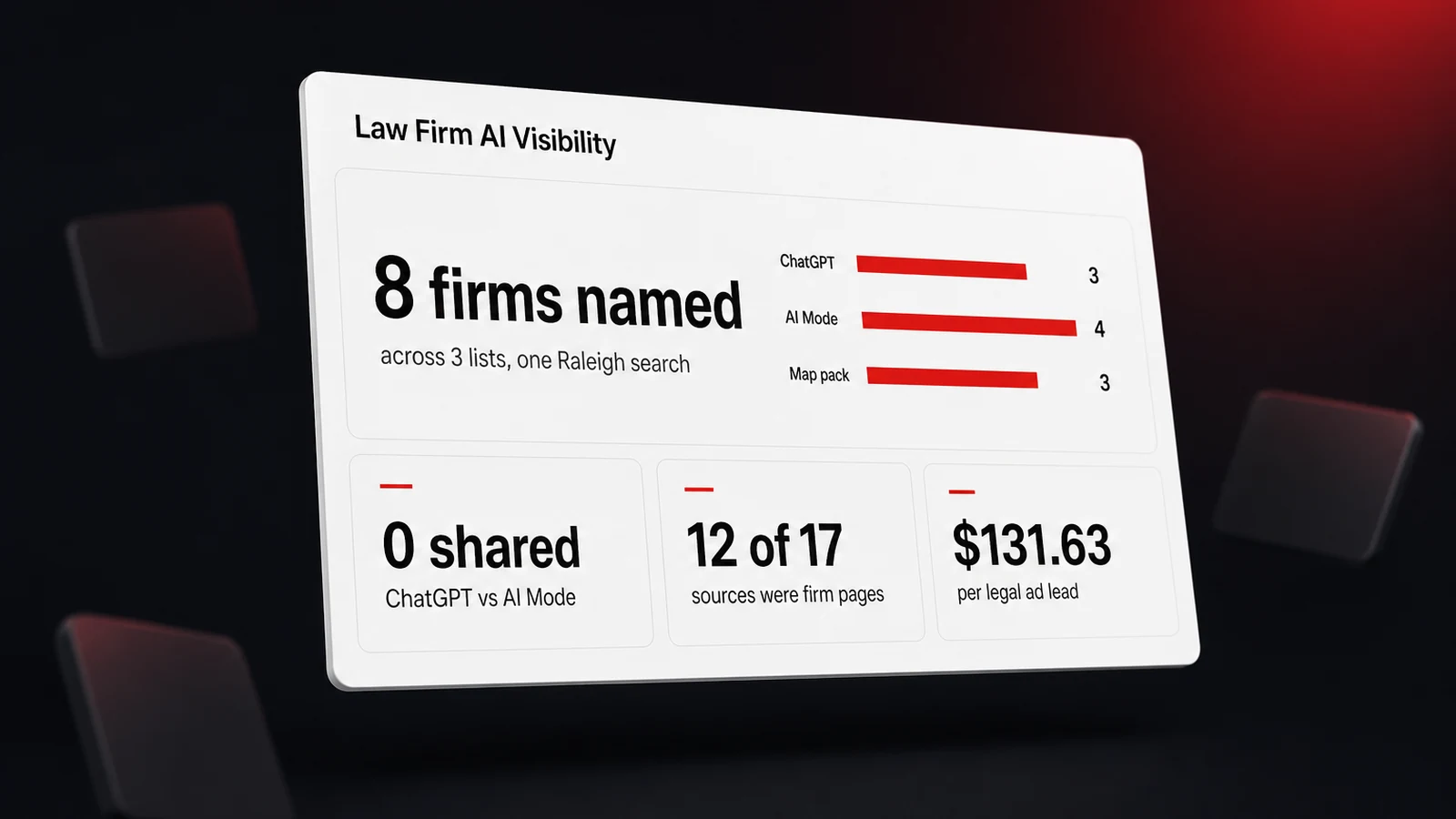
ChatGPT named three firms, each with a street address and phone number, and gave a reason for each. One for a trial focus and "a substantial volume of client reviews" on its Raleigh listing, one because its practice page lists rear-end collisions, one as a local comparison. It closed by asking whether we were injured at all, since a property-only claim might not need a lawyer. Google AI Mode opened with North Carolina's contributory negligence rule, then named four firms in a table with phone numbers, years in practice, and fee terms, followed by reminders about the three-year filing deadline and contingency fees. The map pack held three firms, every card showing a star rating, review count, years in business, 24-hour hours, and one quoted review line.
| Surface | Firms named | Shared with ChatGPT | Shared with AI Mode | Shared with the map pack |
|---|---|---|---|---|
| ChatGPT | 3 | 0 | 1 | |
| Google AI Mode | 4 | 0 | 1 | |
| Google map pack | 3 | 1 | 1 |
Ten slots, eight different firms, and no firm on all three lists. ChatGPT and AI Mode didn't share a single name. That's a stranger result than the plumber search we ran for our comparison of Google AI Overviews versus AI Mode, where the two Google surfaces shared four of five. One possible reason is that legal is crowded enough to fill each list separately.
The sources explain the split. ChatGPT listed seven pages it used. Four were directories and listicles, Expertise, Avvo, TrustAnalytica, and Super Lawyers. Two were bar bodies, the North Carolina State Bar's page on checking a lawyer's license and the state bar association's referral service. One was the statute of limitations itself. ChatGPT quoted a firm's practice-page wording for one pick, but no firm website appeared among the seven pages it listed as used, and two of the three firm cards were grounded on google.com, meaning Business Profiles. AI Mode went the other way. Of the 17 sources in its panel, 12 were law firm pages from eight different firms, and the other five were directory pages, two from Super Lawyers, two from LawInfo, one from Yelp.
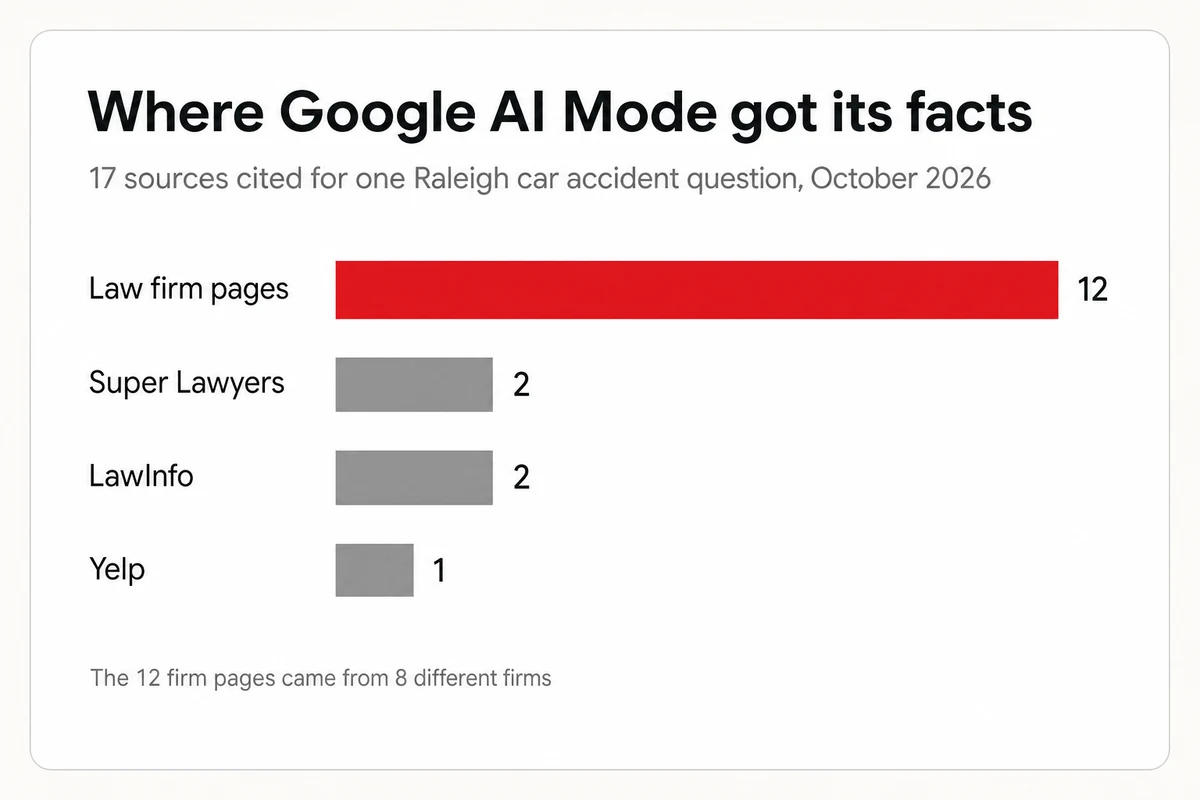
Three of the four firms AI Mode named had a page of their own in that panel. The fourth got in through its Super Lawyers and LawInfo listings alone. So the same firm can be absent from one assistant for lack of directory presence and absent from another for lack of a page that answers the question. The rest of this guide takes those two gaps in turn, then the profile, the rules, the markup, and the cost.
Practice Area Pages That Answer the State Law Question
The firm pages AI Mode cited had something in common. They answered a legal question, not a marketing one. One explained who's at fault in a rear-end crash under North Carolina law. One explained what to do after being rear-ended. Two explained contributory negligence, the rule that can bar a claimant found even slightly at fault, and the three-year deadline to file. Three of those pages showed update dates from the previous three weeks. The pages that got cited were the pages that behaved like the first five minutes of a consultation.
That's also the standard Google's own quality raters are told to apply. Pages on topics that can affect someone's health, money, or safety, a group Google labels Your Money or Your Life, are held to its highest bar for accuracy and for agreement with expert consensus. A car crash claim, a custody dispute, a bankruptcy, or a criminal charge touches money and safety at once. A page written by a licensed attorney in that state, naming the attorney, is the plainest way to meet that bar.
Build one page per practice area, then one page per question clients actually ask inside it. Not "personal injury" alone, but the rear-end page, the deadline page, the fault page, and the page on what the other driver's insurer will ask. Each page opens by answering its question in the first sentence, in the law of your state, before any mention of the firm. Here's an opening paragraph shape that fits the pattern AI Mode rewarded. Fill in only what's true in your jurisdiction.
In [State], [one sentence on who is usually at fault in a rear-end crash], and [State] applies [contributory or comparative negligence], so [one sentence on what that means for a claimant]. You have [N] years from the crash to file a lawsuit. [Attorney full name], a [State]-licensed attorney at [Firm] ([Bar number]), handles rear-end claims in [City] on a contingency fee, meaning [one sentence on what the client pays and when].

Last reviewed by [Attorney name] on [Month Day, Year].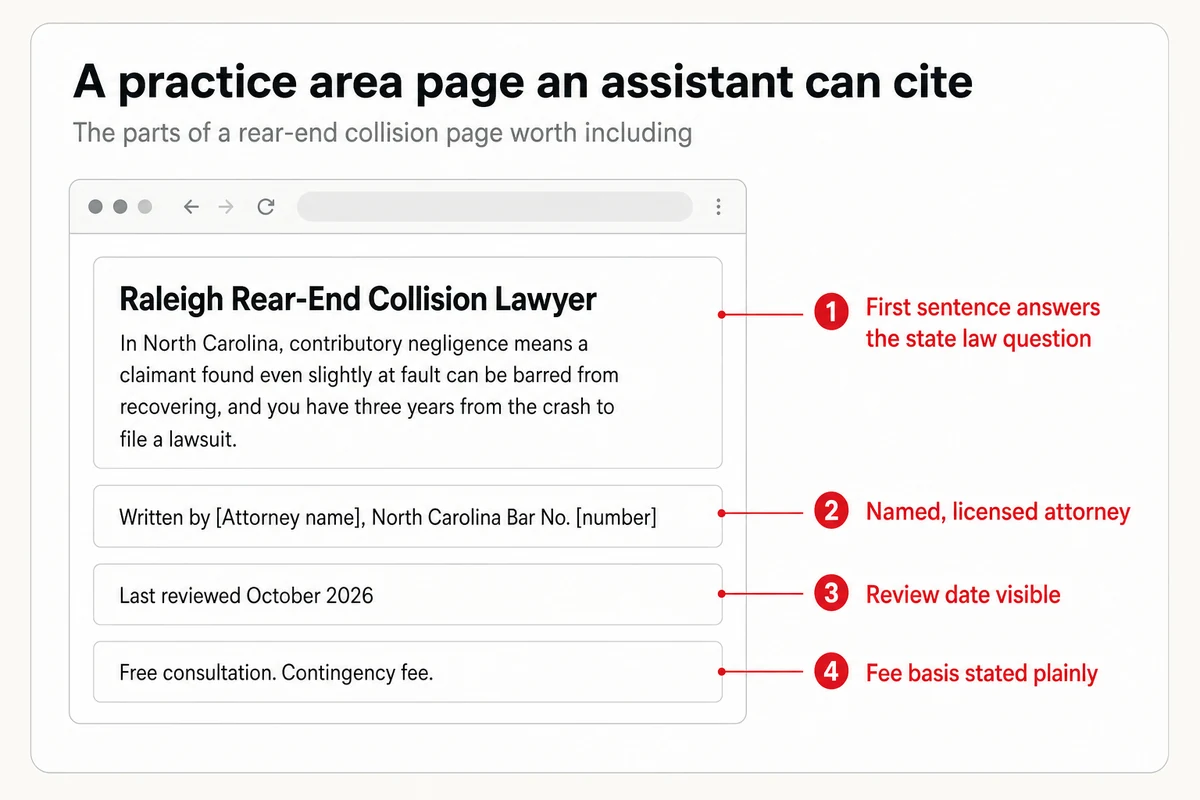
Keep the attorney's name, bar number, and the review date on the page itself, not only in a bio buried under the About tab. The assistants we tested leaned on the pages they cited, and a page with a named, licensed author gives them something to repeat. A page with "our experienced team" gives it nothing.
The Directories ChatGPT Reads Before Your Website
ChatGPT built its Raleigh shortlist from directories and the state bar, with firm websites nowhere in its list of pages used. That matches what the larger studies found. In April 2026, the PR firm 5WPR published a Legal AI Visibility Report built with the Haute Lawyer Network, testing finder, decision, and elite queries across eight practice areas. It found that when an assistant is asked to recommend a lawyer, the answer comes from about seven ranking directories, Super Lawyers, Avvo, Justia, and Martindale among them, that Super Lawyers consistently held the top position on finder queries, and that zero law-focused editorial sources appeared in the top results for any legal query it tested. The study's named test subjects were large firms, so weigh it as a reading on how assistants pick lawyers in general, not on how a two-partner firm fares.
Martindale-Avvo, which owns two of those directories, says on its white paper page on legal directories and AI search that 86% of AI search results for legal services cite its directory networks, and that appearing in three or more authoritative legal directories was the strongest predictor of search visibility in its data. That's a vendor measuring its own value with a method it doesn't publish, so treat the exact figure with care. The direction, though, matches our own run and 5WPR's independent one.
The practical work is unglamorous. Claim the firm and each attorney on Avvo, Super Lawyers, and LawInfo, the directories that surfaced in our run, and on Justia, FindLaw, and Martindale, the ones the 5WPR study names, then fill every field, and make the name, address, phone, and practice areas identical to your website and your Business Profile. Then do the one directory most firms forget, your state bar's own lawyer search. ChatGPT cited the North Carolina State Bar's license lookup as a page it used, because an assistant asked for a lawyer wants to confirm the person is one. A bar record with a current address and no discipline is the cheapest trust signal in legal marketing, and it's free. The general directories matter too. Our breakdown of where AI gets data about local businesses covers that layer, and legal adds its own on top.
Two cautions on directories. First, a flat-fee directory listing is generally treated as an advertising cost under the model rules, while paying per lead or per client is where state opinions split, so check yours before you sign. Paying anyone for a recommendation is a separate line the rules draw, covered below. Second, a directory profile with zero reviews is a listing an assistant can verify but has no reason to prefer. Reviews belong on the directories as well as on Google.
A Business Profile for the Firm and One for Each Attorney
The map pack cards in our Raleigh search all carried the same six facts. A primary category reading Personal injury attorney, a star rating with the review count, years in business, hours showing open 24 hours, a phone number, and one quoted line from a review. Those are Business Profile fields, and ChatGPT grounded two of its three firm cards on Business Profiles. For a law firm the profile is the first thing to get right.
Lawyers have an option most trades don't. Google's guidelines for representing a business on Google define an individual practitioner as a public-facing professional with their own customer base, name lawyers among them alongside doctors and dentists, and say a practitioner should create a dedicated profile when they work in a public-facing role and can be reached directly at the location during stated hours. The same guidelines say the firm creates its own profile when several practitioners share one address, and that a practitioner holds one profile, not one per specialization. So a firm keeps its profile, and each attorney who meets the public can hold a practitioner profile under their own name, with a title such as Esq. or JD, their own category, such as Family law attorney, and their own reviews. A client who was told by a friend to call a specific lawyer searches that lawyer's name, and a practitioner profile is what answers.
Pick the most specific primary category that's true, Personal injury attorney, Criminal justice attorney, Estate planning attorney, Immigration attorney, rather than the generic Law firm. Set the hours to the hours a human answers, which for firms running an after-hours intake line means 24 hours is honest and for everyone else means it isn't. Scorpion's survey found 72% of clients won't wait more than a day for a callback, and an assistant that reads "open 24 hours" will tell a 2 a.m. caller to expect an answer.
Reviews decide the rest. In the same survey, 57% of clients called reviews their top deciding factor and more than half ruled out any firm under four stars. The quoted review line on each map pack card is drawn from review text, and our earlier look at how reviews shape AI recommendations explains why an assistant repeats specific phrases, "returned my calls the same day" or "explained the settlement math," rather than a star count. After checking your state's testimonial rules, ask every client at the close of a matter, with a direct link to the profile, and never in exchange for anything of value. The rules on that are stricter for you than for the pharmacy down the street, and they come next.
What Bar Rules Let a Law Firm Website Say
Most of what a marketing vendor would write for a plumber is off limits for a lawyer, and the limits come from the ABA Model Rules that nearly every state has adopted in some form. Model Rule 7.1 bars any false or misleading communication about a lawyer or the lawyer's services, and defines misleading to include omitting a fact needed to keep the statement from misleading as a whole. A page that says "we recover millions for our clients" and leaves out that most clients recover far less is the kind of omission the rule targets.
Model Rule 7.2 adds four rules that bite directly on SEO work.
- No paying for recommendations. A lawyer can't give anything of value to a person for recommending the lawyer's services, with narrow exceptions for the cost of advertising, the usual charges of a not-for-profit or qualified referral service, and nominal thank-you gifts. A gift card for a Google review is on the wrong side of that line. A flat-fee advertising charge is on the right side.
- No specialist claims without certification. A lawyer can't state or imply certification as a specialist in a field unless an approved certifying organization granted it and the communication names that organization. "Personal injury specialist" in a title tag is a claim, so use "personal injury lawyer" or "handles personal injury cases" unless you hold the certification.
- Name a responsible lawyer. Any communication under the rule must include the name and contact information of at least one lawyer or firm responsible for its content. That's one more reason the practice area page carries an attorney's name, not just a form.
- Any medium is allowed. The rule explicitly lets a lawyer communicate through any media, so the rule limits what you say, not where you say it.
The self-awarded superlatives that fill law firm homepages, top-rated, award-winning, most trusted, are where this gets tested. A rating from a named directory, stated as that directory's rating with its name attached, is a fact. The same words with no source are a claim you have to be able to back. States layer their own rules on top, from required disclaimers on testimonials to filing requirements for ads, so run your pages past whoever handles your ethics questions. None of this is legal advice. It's the floor every state builds up from.
A Bad Review Gets a Neutral Reply or None at All
A lawyer may not reveal information about a client's representation to answer a bad review, even when the review is wrong. The ABA's GPSolo magazine spelled this out for solo and small firms in a June 2026 article by Nicole Reid on what to do when you get a negative online review. It walks through ABA Formal Opinion 496, which holds that an online review doesn't create the kind of controversy that would trigger the self-defense exception to the confidentiality rule, and that the duty covers all information relating to the representation, not only privileged material. Even confirming that the reviewer was a client can be a disclosure if that fact wasn't already public. Florida's bar, the article notes, has gone further and warned that a carefully worded reply can still reveal the lawyer's involvement in the events described.
The same article collects the neutral language several bars have endorsed, and the point it makes about that language is the useful one. The reply isn't for the reviewer. The audience is the next prospective client reading down the page, who expects a lawyer to be bound by rules and reads a detailed public rebuttal as a warning sign, not a defense. Two replies in that spirit, to adapt to your firm's voice and clear with your ethics contact once.
Thank you for taking the time to write. Our professional obligations keep us from discussing any matter in a public forum, including whether someone was a client. If you would like to talk this through, please call our office at [phone] and ask for [name].

We take every piece of feedback seriously. Ethics rules limit what we can say here, but we would welcome a direct conversation. Please reach [name] at [phone] or [email].
Notice what's missing. No "we represented you," no dates, no outcome, no "the court agreed with us." The instinct to set the record straight is the one the article ties to discipline cases, and a reply that follows it costs more than the review did. Keep the templates short, use only approved ones, and put the time you save into asking satisfied clients for the reviews that outweigh the rare bad one.
LegalService Schema, and Why Not Attorney
Schema.org gives law firms two types, and one of them is retired. LegalService is the live one, defined as "a business that provides legally-oriented services, advice and representation, e.g. law firms," and it sits under LocalBusiness, so address, hours, phone, and coordinates all apply. Beneath it, the Attorney type is marked deprecated, with the note that LegalService "is more inclusive and less ambiguous." Use LegalService for the firm and describe each lawyer as a Person with the job title Attorney.
Here's a starting block for a firm homepage or office page. Swap in your own values, drop the lines that don't fit, and keep every fact in step with your Business Profile and directory listings so a crawler never sees two versions of your hours.
<script type="application/ld+json">
{
  "@context": "https://schema.org",
  "@type": "LegalService",
  "name": "[Firm name]",
  "url": "https://www.yourdomain.com",
  "image": "https://www.yourdomain.com/office.jpg",
  "telephone": "[+1-000-000-0000]",
  "priceRange": "[Free consultation, contingency fee]",
  "address": {
    "@type": "PostalAddress",
    "streetAddress": "[Street address]",
    "addressLocality": "[City]",
    "addressRegion": "[State]",
    "postalCode": "[ZIP]",
    "addressCountry": "US"
  },
  "geo": {
    "@type": "GeoCoordinates",
    "latitude": "[Latitude]",
    "longitude": "[Longitude]"
  },
  "openingHoursSpecification": {
    "@type": "OpeningHoursSpecification",
    "dayOfWeek": ["Monday", "Tuesday", "Wednesday", "Thursday", "Friday"],
    "opens": "08:30",
    "closes": "17:30"
  },
  "areaServed": ["[City]", "[County]", "[Nearby town]"],
  "knowsAbout": ["[Practice area]", "[Practice area]"],
  "employee": [
    {
      "@type": "Person",
      "name": "[Attorney full name]",
      "jobTitle": "Attorney",
      "url": "https://www.yourdomain.com/attorneys/[name]",
      "sameAs": [
        "[State bar profile link]",
        "[Avvo profile link]"
      ]
    }
  ],
  "sameAs": [
    "[Google Business Profile link]",
    "[Justia profile link]",
    "[Super Lawyers profile link]"
  ]
}
</script>
The sameAs links are the part specific to law. They tie the firm and each attorney to the directory and bar records an assistant already trusts, which is the connection the Raleigh run showed matters. Put the block on the homepage or on each office page and run it through a validator before it ships. Our post on local schema markup for small businesses shows how.
What a Client Costs Through Ads, Google Verified, and Search
Legal is the most expensive of the industries LocaliQ benchmarks, which is the honest case for doing the organic work at all. LocaliQ's search advertising benchmarks, updated in June 2026 from thousands of its customers' Google and Microsoft campaigns, put Attorneys and Legal Services at an average cost per click of $9.87, a click-through rate of 5.87%, a conversion rate of 5.55%, and a cost per lead of $131.63. A lead is a form or a call, not a signed client, so the cost per retained matter runs a multiple of that, and the meter resets to zero the day the budget stops.
Local Services Ads are the other paid lane, and they come with a screening step. Google's page on business screening and verification requirements lists lawyers under Professional Services, with separate entries from bankruptcy and criminal through immigration, personal injury, and traffic law, and requires licenses at the state level, a public and verified Google Business Profile, and an average of three to four weeks to clear. Advertisers who pass earn what Google now calls the Google Verified badge, a single badge that replaced Google's earlier badges. For a firm, the badge is worth having for the trust it signals, and it's one more surface where your Business Profile has to be clean first.
Organic search and AI answers compound instead of resetting. The practice area page you write this month gets cited next month and the month after, and the directory profile you complete once feeds every assistant for as long as it stays accurate. The trade-off is time. Nothing in this guide pays off in a week, and a firm that needs cases now should run ads while the organic work matures. If you'd rather not handle the profile management and citation cleanup yourself, Lighthouse Local for Business assigns specialists to it, and every change waits for your approval before it goes live. Your attorney still writes and signs the practice pages.
Run the Raleigh Test for Your Own Practice Area
Before changing anything, find out what the assistants say about your firm today. Ask as a prospective client would, naming your city and a specific legal problem, and leave your firm out of the question. Adapt these five to your practice area.
1. I was [rear-ended / served divorce papers / arrested for DUI] in [city, state]. Which lawyer should I call, and why?
2. What is the deadline to file a [personal injury / medical malpractice] claim in [state], and which [city] firms handle them?
3. Which [practice area] lawyers in [city, state] offer a free consultation and work on contingency?
4. Who is a [practice area] attorney in [city] with strong client reviews, and what do the reviews say?
5. Is [Attorney name] at [Firm] licensed in [state], and what do they handle?

After each answer, show me every source you relied on, as a link.
Run each one on ChatGPT, Gemini, Claude, Perplexity, and Google AI in a fresh temporary chat, or logged out where the assistant allows it, since Perplexity asked us to create an account before it would answer. Score every answer on four points that matter to a law firm. Was the firm named at all. Were the practice areas, office address, and bar status stated correctly. Did the answer call the firm a specialist, or promise results, in words the firm itself couldn't publish under its state's rules. And which sources carried the answer. A wrong practice area usually traces to a stale directory profile, and a specialist claim to a review or a listing that used the word. Our guide to checking which local competitors AI recommends shows how to log a run so the next one is comparable.
Answers shift between runs, and a firm named today can be missing tomorrow. Lighthouse Local's AI visibility tracker exists for that drift. It repeats a set of client-style questions across each assistant we track on a schedule, logs whether the firm appeared, which firms appeared instead, and which pages carried each answer, so a month of runs shows a pattern rather than a coin flip. What it can't do is make an assistant name you, and anyone selling that guarantee is selling air.
The Client Who Never Typed Your Name
The firms in our Raleigh run showed up with a practice page that answered the rear-end question, a complete directory profile, a Business Profile with more than 600 reviews, or a bar record that confirmed a license. Each of those is within reach of a solo or small firm, inside the rules, on evenings and a few Saturdays. Start with the page that answers your state's version of the question a scared client asks at midnight, then bring the directories and the profile into line with it, then run those five prompts again in a month. Our free AI audit checks only your own site, never what the assistants say, so it can't replace the prompts above. It grades the pages and markup, ranks what to fix first, and needs no signup. The client who never typed your name is already asking who to call. Make sure the answer has a reason to say you.
Frequently asked questions
How do I get my law firm recommended by ChatGPT?
Make your firm verifiable in the places ChatGPT reads. In our test the pages it listed were legal directories such as Avvo and Super Lawyers, the state bar's license lookup, and the statute, with its firm cards grounded on Google Business Profiles. Complete those listings with identical name, address, phone, and practice areas, collect reviews on them, and keep your bar record current. No one can promise a mention, yet those are the inputs it used.
What schema type should a law firm website use?
Use LegalService from Schema.org. As a subtype of LocalBusiness, it accepts address, phone, hours, and coordinates, and it's the type Schema.org recommends over Attorney, which is marked deprecated. Describe each lawyer inside it as a Person with the job title Attorney, and link each one's bar and directory profiles in sameAs.
Can a lawyer respond to a negative Google review?
Yes, but only without revealing anything about the representation, including whether the reviewer was a client. ABA Formal Opinion 496 holds that a review doesn't trigger the self-defense exception to confidentiality. Several state bars have endorsed short neutral replies that acknowledge the review, note that ethics rules limit what you can say, and invite a direct conversation. Use only approved templates.
Can a lawyer call themselves a specialist on their website?
Under ABA Model Rule 7.2, only if an organization approved by the state or accredited by the ABA has certified the lawyer as a specialist, and the certifying organization is named in the communication. Otherwise describe the work, such as handling personal injury cases, rather than claiming specialist status. State rules can add further limits.
Should each attorney have their own Google Business Profile?
Google's guidelines allow individual practitioners at a shared location to hold their own profiles alongside the firm's, as long as each is a distinct, public-facing practice. A practitioner profile lets a lawyer carry their own category and reviews and answers the client who searches the lawyer's name after a referral.