Twelve Answers Named 24 Rivals, and the Owner Tracked Four
You tell whether AI assistants are recommending your competitors by asking each one the question a customer would ask for your service and your city, writing down every business it names, and checking that list against the businesses you think of as rivals. The first time most owners do it, the two lists barely overlap, and one Miami case shows exactly why.
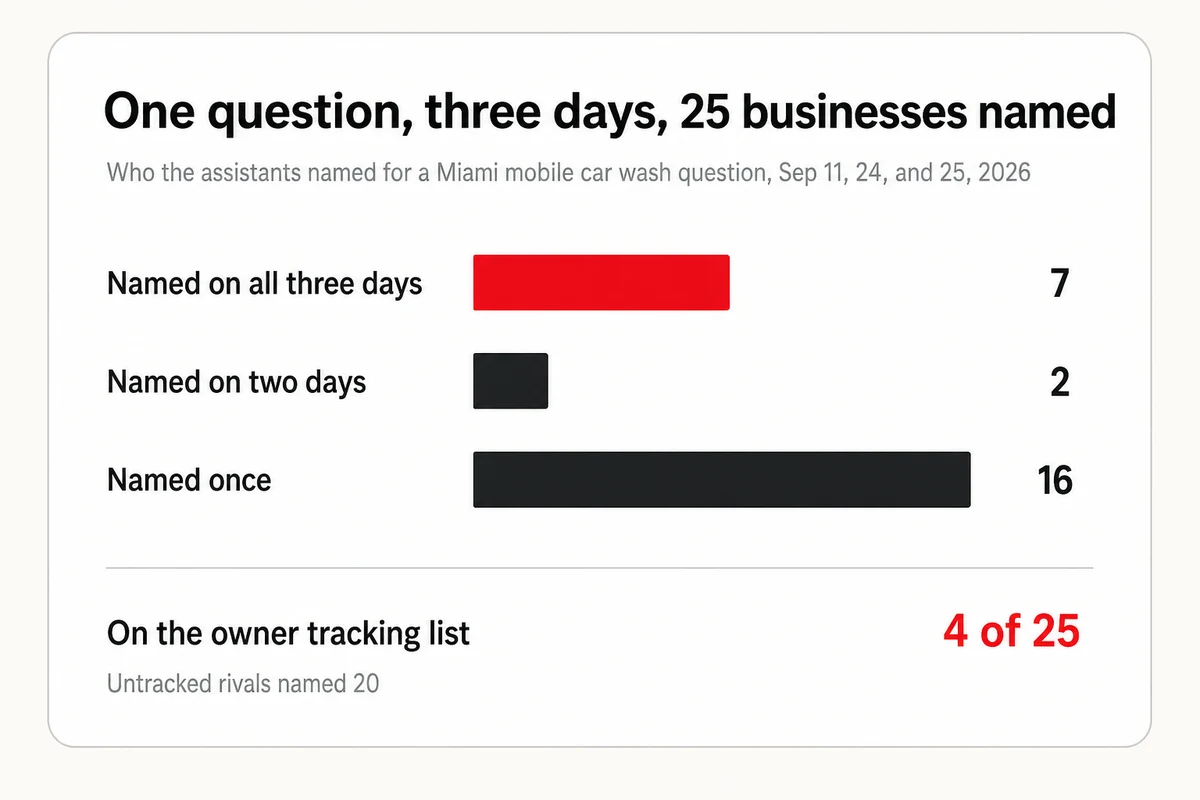
This mobile car wash tracks 21 customer questions in Lighthouse Local's AI visibility tracker, and we covered its overall numbers in our post on AI visibility for local business. For this piece we opened one question, "who's the best mobile car wash in Miami?", on three days, September 11, 24, and 25, 2026, and read every answer ChatGPT, Gemini, Claude, Perplexity, and Google AI gave. Twelve answers in all. They named 25 different businesses. One was the car wash. The other 24 were rivals, and the owner had chosen to track four of them.
The four tracked rivals did show up. So did a booking marketplace the owner had never heard of, two cafe-style washes, a detailer with more than 1,100 Google reviews, and a near-namesake business with a 4.1 rating that a customer could easily confuse with the car wash. None of those were on the list. That's the first thing this check teaches. Your competitors in AI aren't the shops you compete with on the street. They're whoever the assistant names, and you don't know who that is until you ask.
The check itself is the same twenty-minute routine that shows whether AI recommends your business, pointed at the other names in the answer. Below is how to run it so the rival list is worth keeping.
Ask for a Shortlist, Not a Verdict
Assistants hedge. Ask "is my car wash any good" and you'll get a paragraph about you. Ask "who should I hire" and you'll get a list, and the list is where your competitors live. Every prompt in the check should force a shortlist, name your city or neighborhood, and cover the three moments a customer actually asks. Copy these and fill in your own service.
1. Who should I hire for [service] in [city]? Name specific companies and say why each one made the list.
2. [service] near [neighborhood]. List the top options with their ratings and review counts.
3. How much does [service] cost in [city], and which local companies offer it at that price?
4. Compare [your business] with [a rival the assistant named] for [service] in [city].
The third one matters more than it looks. For the car wash, the plain price question about what a wash should cost got the business cited as a source by the five we track, yet only two of them named it in the answer. Meanwhile the rival that wins most took 44 answers to that question outright between August 27 and September 25, named while the car wash wasn't. A price question is a recommendation question in disguise, and it's where a rival with a clearer price page walks off with the customer.
Run each prompt in a fresh chat, signed out where you can, because the assistants lean on your own history and location, and the answer a stranger gets is the one that counts. That mechanism is the whole subject of our piece on why AI recommendations differ by user. Ask each of the five we track, since a rival that owns Gemini can be invisible on ChatGPT. And ask at least twice, a few days apart, for a reason the next sections make plain.
Log Every Name, Including the Ones You Have Never Heard Of
Keep a sheet with one row per business named, and columns for each assistant and each day you asked. Don't filter it to the rivals you recognize. The whole point is the names you don't. Here's the car wash's sheet for its one question across three days, with the businesses described rather than named.
| Business named | Days named, of 3 | Assistants naming it | On the owner's list |
|---|---|---|---|
| The car wash | 3 | 3 | You |
| The rival that wins most | 3 | 4 | Yes |
| A detailer with 1,100+ Google reviews | 3 | 2 | No |
| A 24/7 mobile detailer | 3 | 2 | No |
| An on-demand booking app | 3 | 2 | Yes |
| A mobile detailer | 3 | 2 | Yes |
| A wash with three reviews | 3 | 1 | No |
| A booking marketplace | 2 | 1 | No |
| An eco-focused wash | 2 | 1 | No |
| A South Beach detailer | 1 | 1 | Yes |
| 15 other businesses | 1 each | 1 each | No |
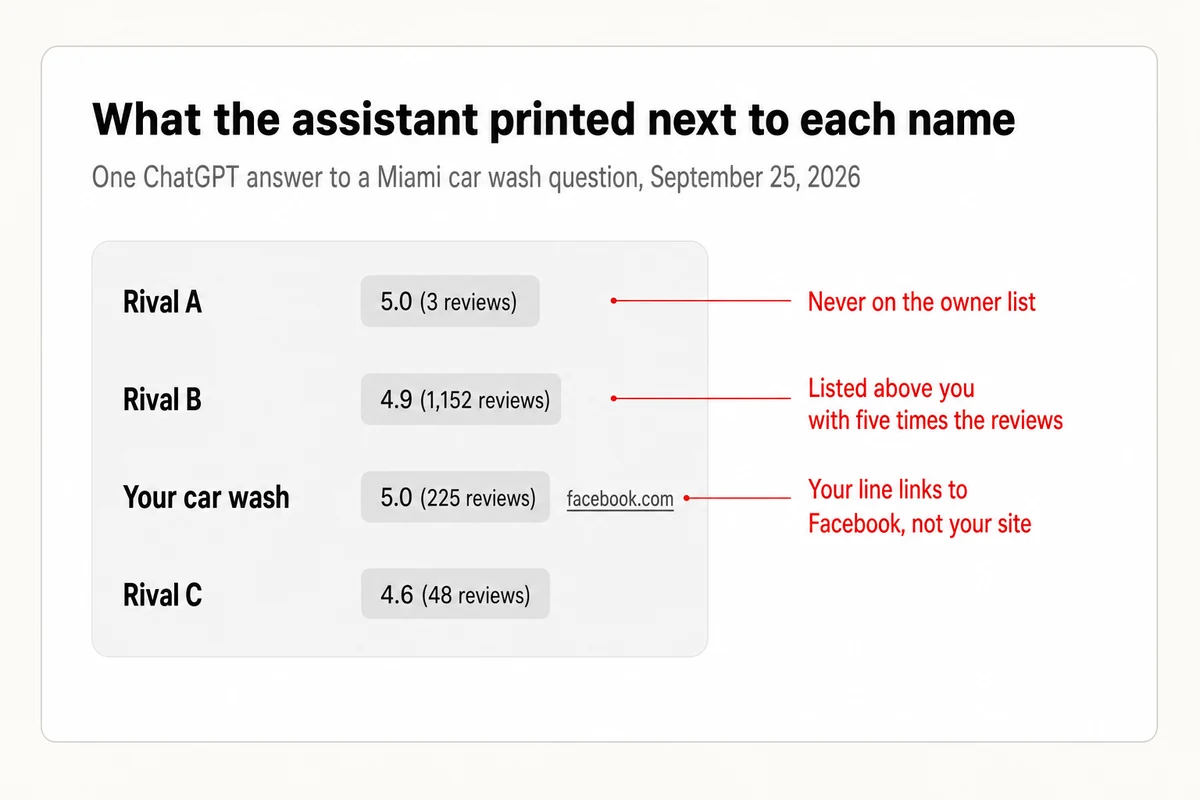
Two things jump out. Seven businesses were named on all three days, and that group is the real competitive set for this question. Fifteen appeared once and vanished. And a wash with three reviews in total made the list every day, because ChatGPT pulled it from a Google Maps search and printed its 5.0 rating right next to the car wash's, which has 225.
This spread isn't a Miami quirk. In August 2026, MentionedOn's study of 840 local AI leaderboards across 21 trades and 40 US metros found assistants named an average of 9.2 businesses per trade but gave 56.2 percent of all mentions to only three of them, with the single most-mentioned business taking about a quarter. So the sheet is doing two jobs. It's finding the three names that matter, and it's showing you how much of the answer they already own.
Read the Rival's Line the Way a Customer Would
Once you have the names, read what the assistant says about each one, because that sentence is the pitch your customer sees before they ever see yours. The assistants don't describe rivals in the abstract. They print specifics. On September 25, ChatGPT's answer listed the car wash as "5.0 (225 reviews)" and, one line above it, a rival as "4.9 (1,152 reviews)", and it linked the car wash to a Facebook page rather than its website. The day before, Gemini sorted five businesses into labels, "Best Overall", "Best for High-End and Luxury Vehicles", "Best for Tech and Effortless Booking", and gave the car wash none of them, even though it cited the car wash's pricing page as its first source.
Three things to record per rival. The review count the assistant quotes, and whether yours is quoted beside it. The specialty it assigns them, because that's the job the assistant thinks they're for. And the source it read them from, since a rival pulled from a directory listing is winning on a page you can also be on.
The review count is the one that separates named from skipped. In May 2026, Insites analyzed 10,000 US local businesses in two assistants for its 2026 AI Visibility Report and found that businesses both assistants surfaced averaged 133 Google reviews, against 11 for the ones neither could find, and that businesses in Google's local pack were recommended 3.5 times more often. When a rival's line reads "thousands of 5-star reviews" and yours reads "locally owned," you've found the gap, and it's the same gap that decides how reviews shape AI recommendations across the board.
And remember what the customer does with that line. In April 2026, Idea Grove's survey of 1,000 US adults found only 2 percent would buy from an unfamiliar AI-recommended brand without checking further, while 45 percent immediately search Google for it and 18 percent head to a review site. The assistant's shortlist decides who gets searched. Your rival's Google Business Profile decides what happens next.
Named Everywhere and Still Losing Answers
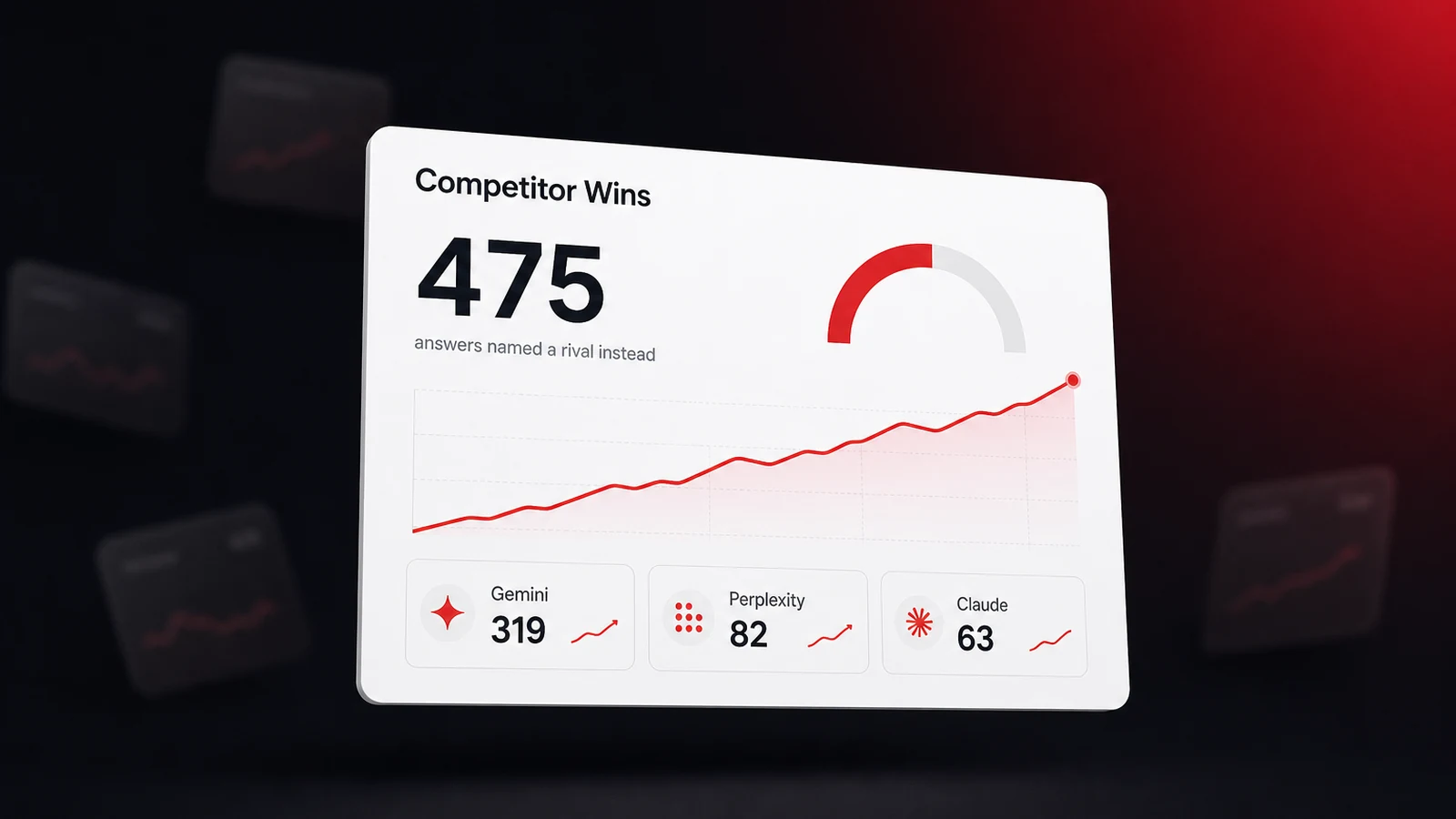
Being named yourself doesn't end the competitor question. On the "who's the best mobile car wash in Miami?" prompt, the car wash appeared in at least one answer from each assistant we track over the 30 days to September 25. The rival that wins most still took 31 of those answers on its own, on three of the five we track, without the car wash getting a mention. Across all 21 questions, 475 of the 2,095 answers the tracker captured in that window named a rival and not the business. That's more than one answer in five, for a business that's named in over half of them.
The reason is that each assistant reads the market from a different set of sources, and a rival can own a source you've never touched. In September 2026, Cheers ran 32 home-services prompts across 100 US and Canadian metros on four engines and classified 356,019 citations in its AI search engine source baseline. Gemini sent 80.7 percent of its citations to contractors' own websites. ChatGPT sent 48.8 percent to contractor sites and 44.7 percent to directories and review platforms. So a rival with a thin website but a rich Yelp and Google listing can win ChatGPT while losing Gemini, and your check will show it as long as you asked both.
That's why the source column in your sheet matters as much as the name. The car wash's price question is the clean example. The five we track all cited it, but only two named it, and the rival that won 44 answers on it was being read from directory pages the car wash isn't on. Where each assistant gets its local facts is its own subject, and we mapped it in our post on how each assistant sources its local answers. For the competitor check, the short version is that a rival named on ChatGPT and absent on Gemini is usually a directory story, and the reverse is usually a website story.
One Check Is a Photo of a Moving Target
Run the same question a day later and the list changes. On September 11, Gemini named five businesses for the car wash's question. On September 24 it named five again, and only two were the same. ChatGPT went from eight names on the first day to four on each of the other two. Perplexity named the car wash on two of the three days and skipped it on the third, while citing its site all three times. If the owner had checked once, on the wrong day, they'd have a rival list that was already fiction by the weekend.
This is the normal condition, not a bad week. In September 2026, Detailed.com tracked more than 70,000 responses to over 1,300 prompts, daily for 28 days in two engines, for its AI response volatility study. Pick two random days and you get an identical list of brands less than 3 percent of the time. But the core brands on ChatGPT changed only 13 percent day to day while the tail changed 78 percent, and the leading brand showed up on 82 percent of days. Translate that to your sheet. The rivals worth acting on are the ones named on most of the days you check. The ones that flicker in for a day are noise, and chasing them is how a month disappears.
So the check needs a second and a third pass before the list means anything. Two days apart is enough to separate a core rival from a flicker. A month apart is enough to see whether a fix moved anything.
Turn the List Into the Next Three Fixes
A core rival, plus the line the assistant wrote about them, points at exactly one of three gaps, and the sheet tells you which.
- They have the reviews. The assistant quoted a review count next to yours and theirs was bigger, or it called them "highly rated" and called you nothing. The fix is review volume and recency on Google first, then on whichever review site the assistant cited. This is the slowest fix and the one that moves the most answers.
- They have the page. The assistant named them for a neighborhood, a price, or a specialty you also serve, and cited a page of theirs that says so. The car wash's top rival took the Kendall question 24 times and the price question 44 times in a month. The fix is a page of your own that answers that exact question in its first two lines, since a site the assistant never reads is the usual reason AI names a competitor instead of you.
- They have the listing. The assistant read them from a directory, a booking marketplace, or a Google Maps search you don't appear in. The fix is being on that source, with the same name, address, and phone you use everywhere else.
Work the three in that order only if the review gap is real. If the assistant quotes similar counts for you and the rival, skip to the page. Your own site's readiness to be read at all sits underneath all three, and our free AI visibility audit runs the same checks on your own site and lines up the fixes, no account needed. It reads your site, not the assistants, so it tells you what to fix, and the competitor sheet tells you why.
The Rival You Track Should Be the One AI Names
The car wash's owner started with four rivals from the street. After three days of one question, the list had 24, seven of them steady. On Gemini, where the car wash is named in 6 percent of answers, rivals won 319 of 468 answers in the window, about two in three. That number was invisible from the ChatGPT tab, where rivals won exactly one. The competitor problem was real, specific, and on one assistant, and it took reading the other names to find it.
You can keep the sheet by hand, and for one or two questions you should, at least once, because reading the answers yourself is how the pattern sinks in. Past that, it's a job for software. Our tracker sorts every captured answer into one of three states, mentioned, not mentioned, or competitor won, ranks which businesses AI names most for your questions, and flags the searches a rival is winning that you aren't, so the fourth name on the list gets found the week it appears rather than the month a customer mentions it. If you'd rather not close the gaps yourself, Lighthouse Local for Business hands the profile, page, and listing work to a specialist while the tracker keeps score.
Ask the question, write down every name, and read the rival's line as a customer would. Then ask again. The competitor AI recommends is the one you haven't looked up yet.
Frequently asked questions
How do I find out which competitors AI recommends instead of me?
Ask ChatGPT, Gemini, Claude, Perplexity, and Google AI the buyer questions for your service and city in a fresh chat, and write down every business each answer names. Repeat a few days later. The names that show up on most days are your real AI competitors, whether or not you've heard of them.
Why does AI recommend a competitor with fewer reviews than me?
Each assistant reads different sources. A rival can sit on a directory or booking marketplace the assistant leans on, or have a page that answers the exact question asked, while your site is cited but never named. Check which source the assistant read them from before assuming reviews are the gap.
How many competitors should I track in AI search?
Start with whoever the assistants name on most days for your core questions, usually three to seven businesses, rather than the shops you compete with on the street. Add a rival when it appears on two separate days, and drop one that hasn't been named in a month.
Does being cited by an AI assistant mean it recommended me?
No. Cited means the assistant read a page on your site while writing the answer. Recommended means it printed your name in the shortlist. The two move separately, and a rival can be named in an answer that cites only you.