Where an AI Answer's Facts Come From
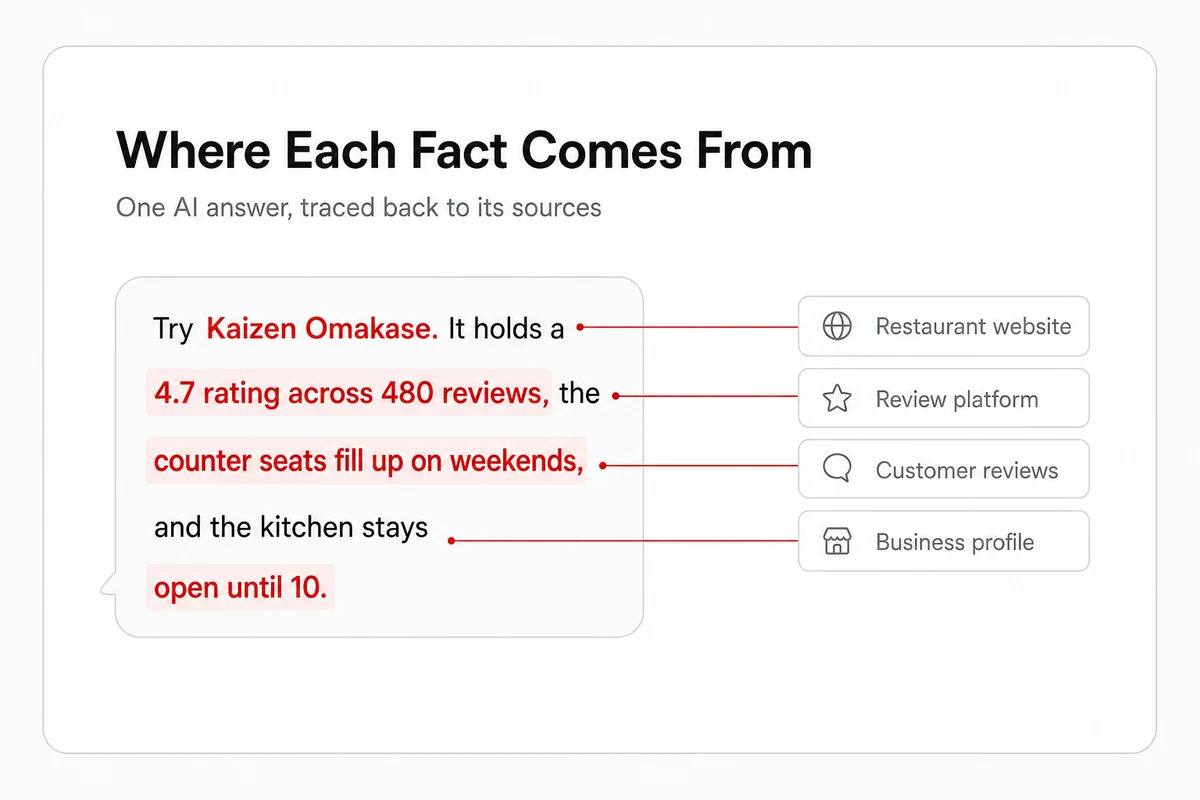
AI gets its local business data from a short list of sources, mainly Google's records, Yelp, review sites, directories, and the business's own website, read and weighed before the assistant answers. Ask ChatGPT for a sushi restaurant in Denver and it answers like it knows the town. It names Kaizen Omakase, mentions the 4.7 rating across 480 reviews, notes the counter seats fill up on weekends, and adds that the kitchen stays open until 10. Helpful, confident, specific. And none of it came from ChatGPT. Every fact in that answer was pulled from a source the assistant read, weighed, and quoted in the seconds before it replied.
That sourcing layer is the part most business owners never see, and it decides who gets named. The rating came from a reviews platform. The hours came from a business profile. The weekend-crowd detail came from review text written by real customers, and the omakase description came from the restaurant itself, on its own website. Change what those sources say about you and you change the answer.
For years that layer was a black box everyone guessed at. In 2026 it stopped being a guess. The largest studies of AI citations ever published now show, in ranked and counted detail, which directories, platforms, and pages the assistants lean on when they recommend a local business. This guide walks through that data and turns it into a short, ordered list of places your business needs to be.
Two Million Citations, Counted
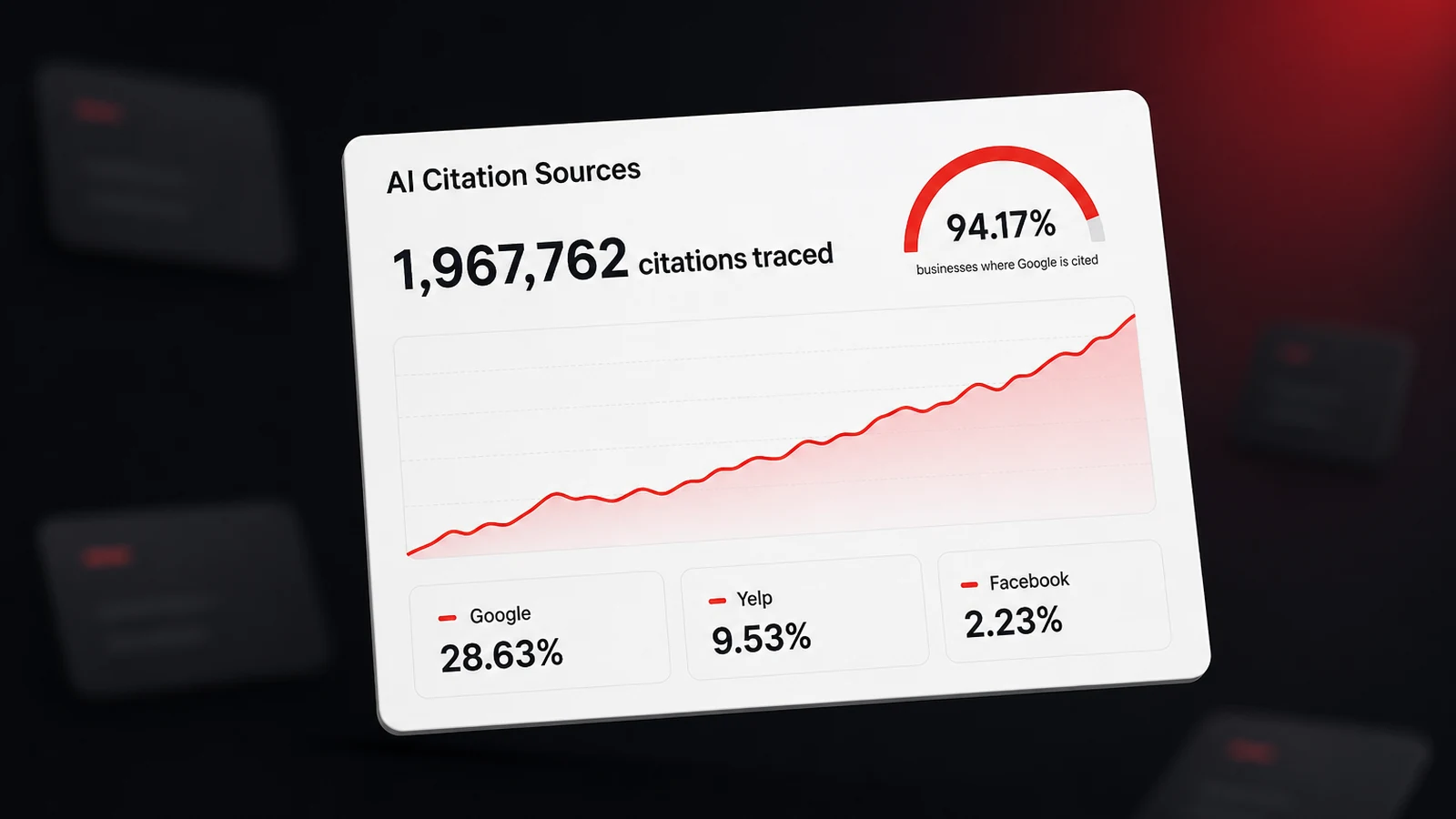
In 2026, BrightLocal published the widest look yet at where AI cites local business information from. The team ran 60,970 checks across 1,355 real business locations in the US, UK, and Australia, spanning restaurants, home services, health practices, and professional firms, and logged 1,967,762 citations pointing at 116,670 unique domains across Google AI Overviews, Google AI Mode, and ChatGPT.
The concentration at the top is the finding. Google's own pages took 563,272 of those citations, 28.63% of everything, and showed up for 94.17% of the businesses studied. Yelp came second at 9.53%. After that the shares fall off a cliff. Facebook took 2.23%, Tripadvisor 1.79%, and OpenTable 1.18%.
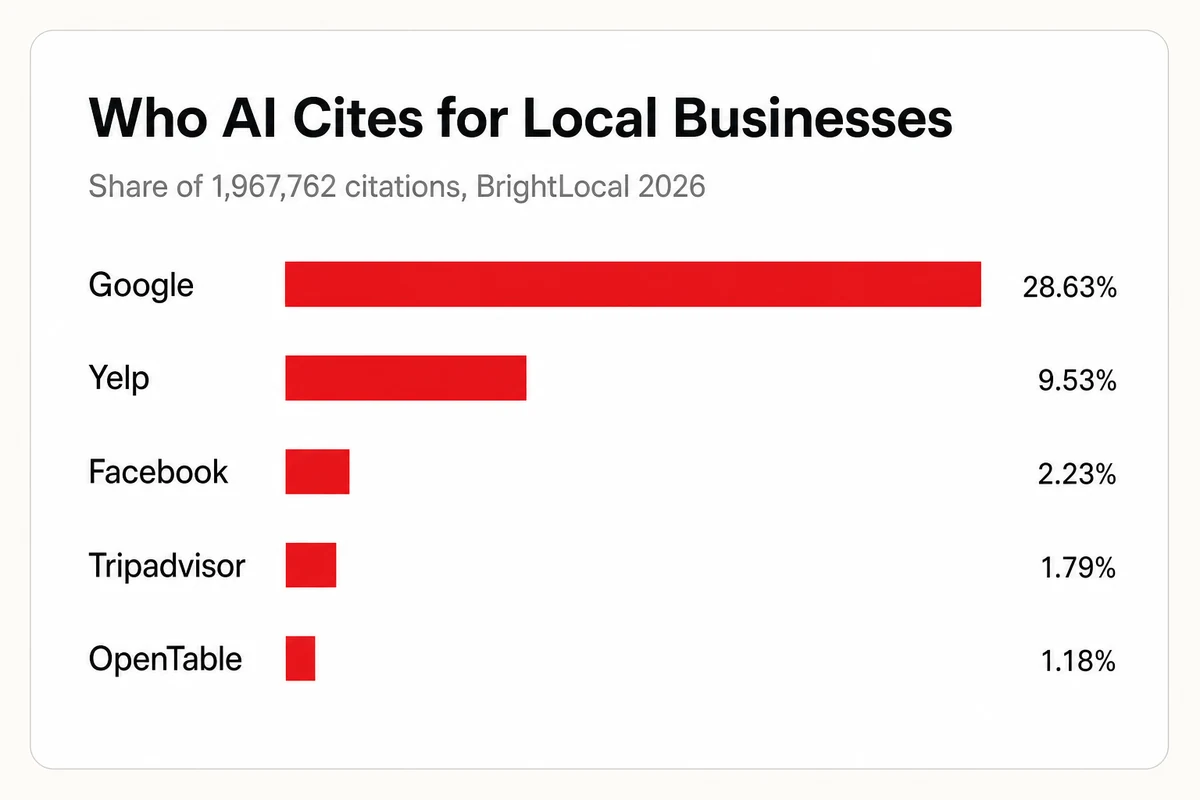
Read as a to-do list, that chart is almost merciful. You don't need a presence on a hundred directories to be quotable. Two platforms account for nearly four in ten AI citations, and a handful more cover most of the rest. The real question is which handful applies to your industry, and the same study answers that below.
The Google Layer Under Every Assistant
Split the data by platform and Google's weight gets heavier. Inside Google AI Overviews, google.com was the top cited source at 108,018 citations. Inside Google AI Mode it drew 455,123, far ahead of Yelp's 76,124. Google's assistants answer local questions substantially from Google's own records, the Maps listings and Business Profiles it already holds.
And the lean is growing. In 2026, Profound measured an 8.4x surge in google.com citations inside AI Mode over ten weeks, enough to make Google the second most cited domain in its own product. Hospitality, home services, restaurants, real estate, and healthcare were the categories most affected, local-intent verticals almost by definition.
For a business owner the takeaway is blunt. The record Google holds about you isn't one listing among many, it's the substrate two of the biggest AI surfaces answer from. Whether you need a Google Business Profile for AI visibility stops being a debate when the citation counts look like this. Claim it, complete it, and keep it current before touching anything else.
Yelp Owns ChatGPT's Local Answers
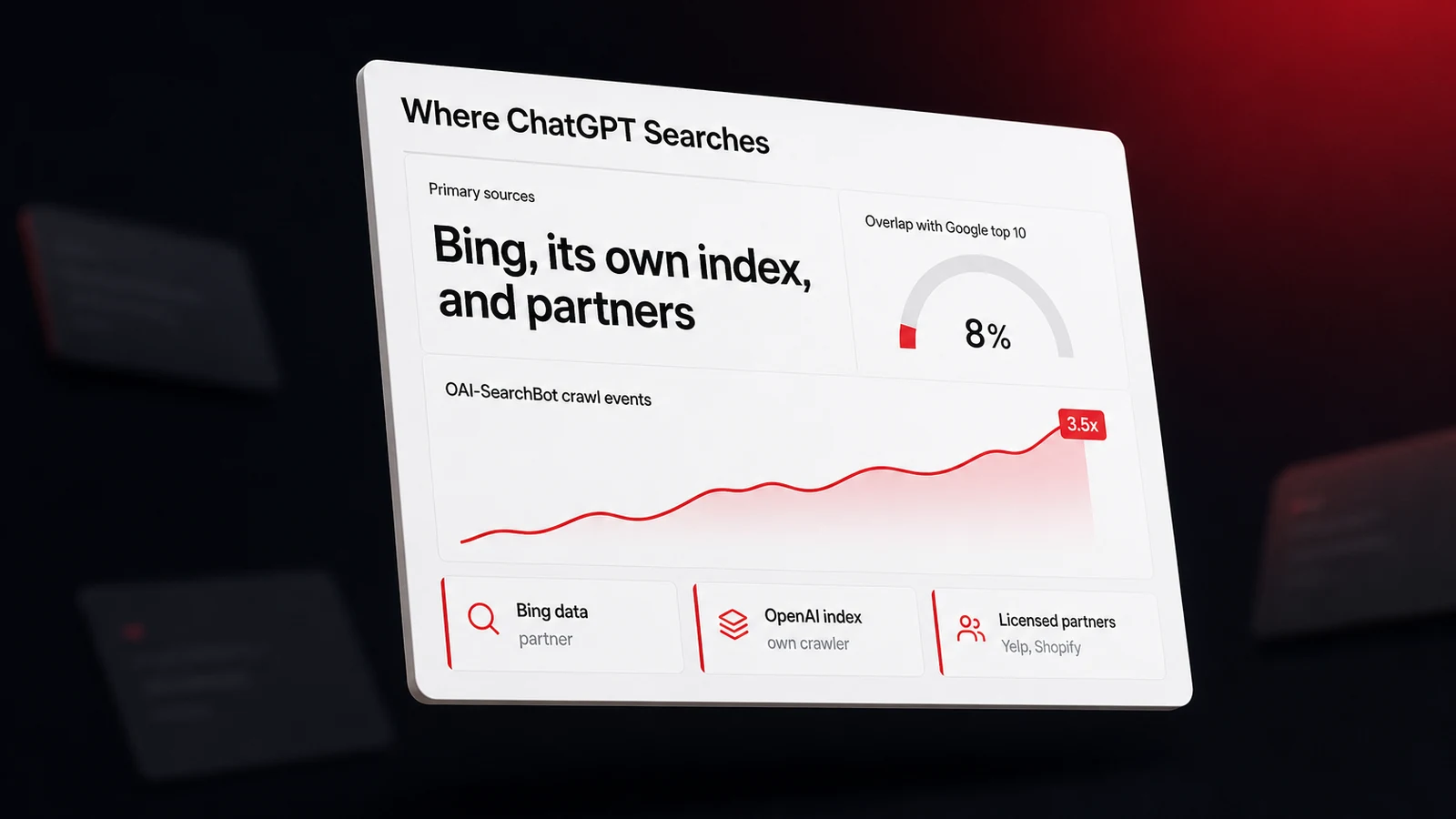
ChatGPT reads a different map, since it searches Bing data and its own index rather than Google's. In BrightLocal's data it cited yelp.com 99,281 times, and a Yelp link appeared in 80% of its local answers. The next closest domain, Tripadvisor, drew 10,227 citations, roughly a tenth of Yelp's count. One platform, in other words, shapes the bulk of what the most-used chatbot says about local businesses.
That dominance is now contractual, not accidental. In 2026, Yelp signed a licensing deal with OpenAI covering its reviews, photos, ratings, and business details, complete with a request-a-quote flow for service businesses built directly into ChatGPT. Yelp's CEO told reporters that anyone wanting to answer local queries really needs Yelp, and the citation counts back the boast.
For you, the doorway into those answers is one you already know. A claimed Yelp profile with accurate details, current photos, and a steady flow of recent reviews is now a direct feed into ChatGPT. The words your customers write there carry extra weight, since reviews steer which businesses AI recommends using the exact phrases reviewers chose. A year of thin, stale reviews reads the same to a model as it does to a person, just at machine speed.
Every Trade Has Its Own Third Slot
Past Google and Yelp, the citation map splits by industry, and the splits are where the practical wins hide. BrightLocal's per-industry cuts show each vertical carrying its own preferred sources, usually one or two specialist platforms sitting right behind the big two.
| Industry | Top cited sources and their share of citations |
|---|---|
| Restaurants | Google 45.2%, Yelp 21.8%, Tripadvisor 7%, OpenTable 6.6% |
| General services | Google 45%, Yelp 12.3%, Facebook 4.4%, BBB 1.6% |
| Dentists | Google 57%, Yelp 15.4% |
| Veterinarians | Google 59.2%, Yelp 19.5% |
| Lawyers | Google 42%, Yelp 7.9%, Justia 3.2%, Avvo 2.5% |
| Plumbers | Google 54%, Yelp 13.8% |
The pattern to steal from that table is the third slot. A restaurant that ignores OpenTable and Tripadvisor leaves two of its four biggest AI sources empty. A law firm with no Justia or Avvo presence concedes the two legal directories the assistants demonstrably quote. Dentists, veterinarians, and plumbers live in a more concentrated world where Google and Yelp carry nearly everything, which makes depth on those two profiles count double.
If your industry isn't in the table, find your third slot the manual way. Ask each assistant the questions your customers would ask, and note which domains it cites back. Ten minutes of asking usually surfaces the directory your vertical leans on.
The Sleeper Source Is Your Own Website
The most overlooked number in BrightLocal's study has nothing to do with directories. Of the 116,670 unique domains the assistants cited, roughly 93% were individual business websites. The aggregators take the biggest shares of total citations, but the long tail of AI answers is built from what businesses publish about themselves.
The pattern holds at a much larger scale. In 2026, Profound analyzed 11.84 billion AI citations across eight platforms and 29 industries and found that roughly 57% of them point at brands' own domains rather than third-party coverage. ChatGPT sat lowest at 47%, Gemini highest at 69%. Whichever assistant your customers favor, your own pages are somewhere between its second source and its first.
That only pays off if your site is written for a reader that scans structure. Clear service pages, city and neighborhood names in real sentences, and local schema markup that labels your name, category, and area as data all raise the odds a model quotes you instead of paraphrasing a directory. The businesses winning the long tail aren't gaming anything, they're simply the easiest source to quote.
Fifteen Sources or Three, Depending Who You Ask
How many sources sit behind one answer depends on which assistant fields it. In 2026, Semrush analyzed 126 million US AI search prompts and found ChatGPT averages 15 sources per response while Gemini averages 3, with both leaning noticeably on Reddit and Wikipedia. The same index found that on Gemini, the overlap between brands that get mentioned and brands that get cited can run as low as 30%, so a mention alone is no proof your pages were read.
BrightLocal's local data echoes the social lean. Instagram drew 37,520 citations, slightly more than Tripadvisor overall, and Reddit followed close behind at 35,144. Threads where locals argue over where to eat are becoming source material, one more reason a real community footprint beats a directory-only presence.
ChatGPT, Gemini, Claude, Perplexity, and Google AI each read the web their own way, which is why single-platform checks mislead. A business can dominate ChatGPT and be invisible to Gemini in the same week, because a strong Yelp profile feeds one while a thin Business Profile starves the other. The sourcing differences aren't trivia, they're the reason visibility has to be measured per assistant.
Build the Footprint in Order
Put the numbers together and the work orders itself. This is the sequence the citation data supports, highest impact first.
- Complete your Google Business Profile. It feeds the top cited domain in every study here, and Google sources appeared for 94.17% of businesses in BrightLocal's data. Categories, hours, services, photos, all current.
- Claim and work your Yelp profile. It's ChatGPT's heaviest local source and now a licensed one. Accurate details plus a steady review flow.
- Fill your industry's third slot. OpenTable and Tripadvisor for restaurants, Justia and Avvo for law firms, the BBB for service trades. One or two, chosen from what the assistants in your vertical cite.
- Make your own site the easiest source to quote. Plain-language service pages, real location names, labeled data.
- Keep the facts identical everywhere. A name, phone, or hours mismatch across sources gives a model a reason to trust none of them, and one stale listing is enough to put a wrong phone number or closed label into an answer.
None of these steps needs an agency to start, and all of them need upkeep to keep paying. If you'd rather hand that upkeep off, Lighthouse Local for Business puts specialists on the profile, citation, and on-page work while you approve each change.
Put Your Facts Where AI Already Looks
You can't edit an AI answer, but every source feeding it stays editable, and now the sources are ranked and public. Start by seeing what the assistants currently say. Twenty minutes spent checking whether AI recommends your business tells you which sources are already working for you. Your website's half of the equation is scoreable too. Our free AI audit reads your site the way a machine does and returns a ranked fix list in a couple of minutes.
Then give the changes time to propagate and watch what moves. Our AI visibility tracker asks each assistant about your business on a schedule and records whether the answers name you, so profile work stops being an act of faith. The assistants have shown us where they look. Put accurate facts in those places and let the answers catch up.
Frequently asked questions
Where does ChatGPT get its information about local businesses?
Mostly from Yelp, which appeared in 80% of ChatGPT's local answers in BrightLocal's 2026 study and now licenses its reviews and business data to OpenAI directly. Google-sourced business data and the business's own website fill in most of the rest.
Which sources do AI assistants cite most for local businesses?
Google's own pages lead at 28.63% of nearly 2 million citations studied, with Yelp second at 9.53%. Facebook, Tripadvisor, and OpenTable follow, and specialist directories like Justia and Avvo carry weight inside their own verticals.
Do I need to be listed on every directory for AI visibility?
No. AI citations concentrate heavily, so a complete Google Business Profile, a worked Yelp profile, one or two industry directories, and a machine-readable website cover the sources behind most local AI answers.
Does my own website matter if AI mostly cites directories?
Yes. Roughly 93% of the unique domains cited in BrightLocal's study were individual business websites, and Profound found about 57% of billions of AI citations point at brands' own domains.
How do I find out which sources AI uses in my industry?
Ask each assistant the questions your customers would ask and note which domains it cites, or use a tracking tool that records citations over time. Most verticals lean on one or two specialist directories beyond Google and Yelp.