Five Questions a Patient Settles Before Calling a Dentist
Getting a dental practice found on Google and named by an AI assistant comes down to answering five questions a patient asks before they ever call. Do they take my insurance? Can they see me today? What will it cost? Are they good with kids, or with someone who dreads the chair? What do other patients say? Each answer has a home, a specific field on your Google Business Profile or a specific page on your site, and this guide walks through each one, with Dentist schema markup and a prompt set at the end so you can check the answers yourself.
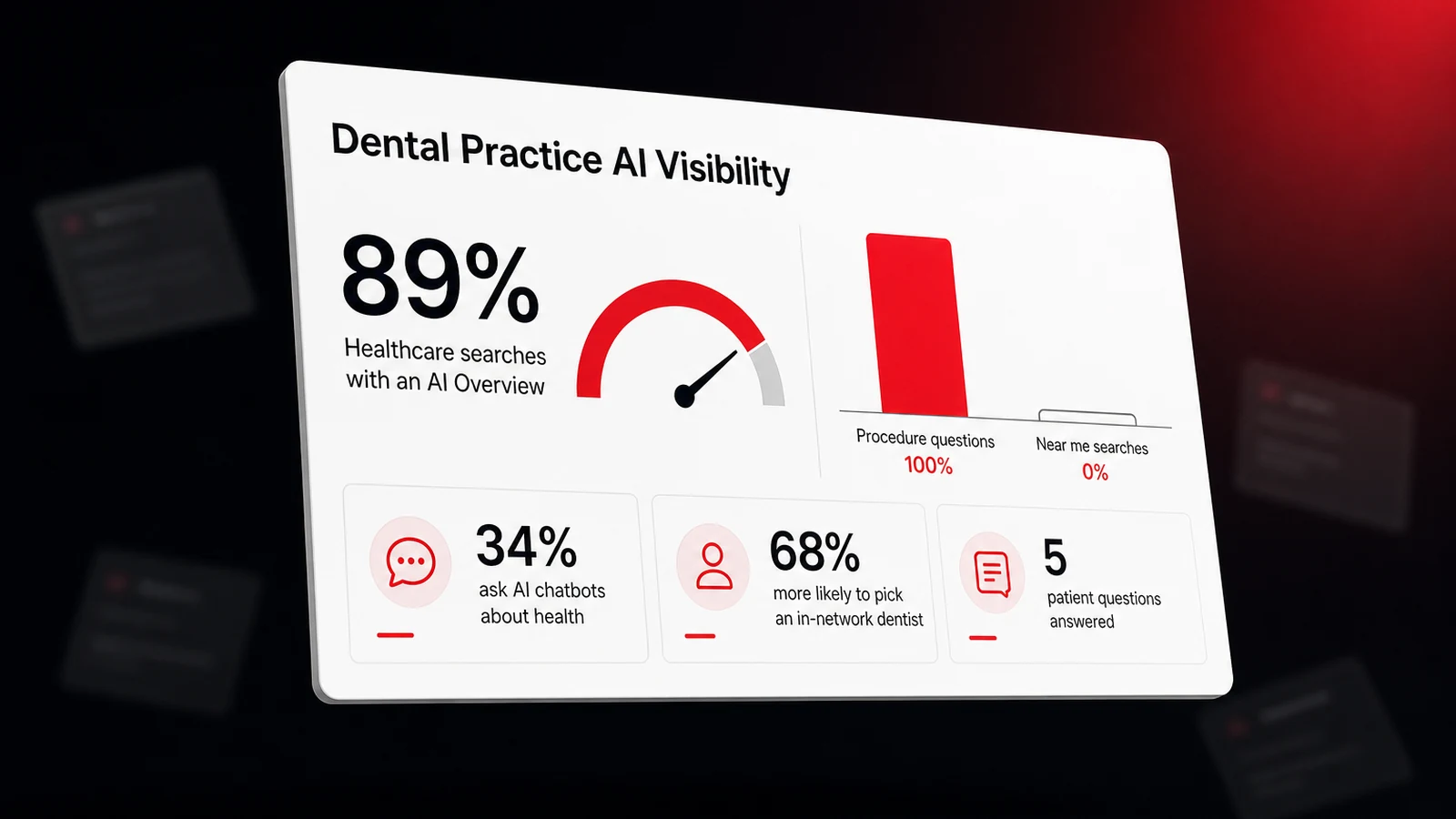
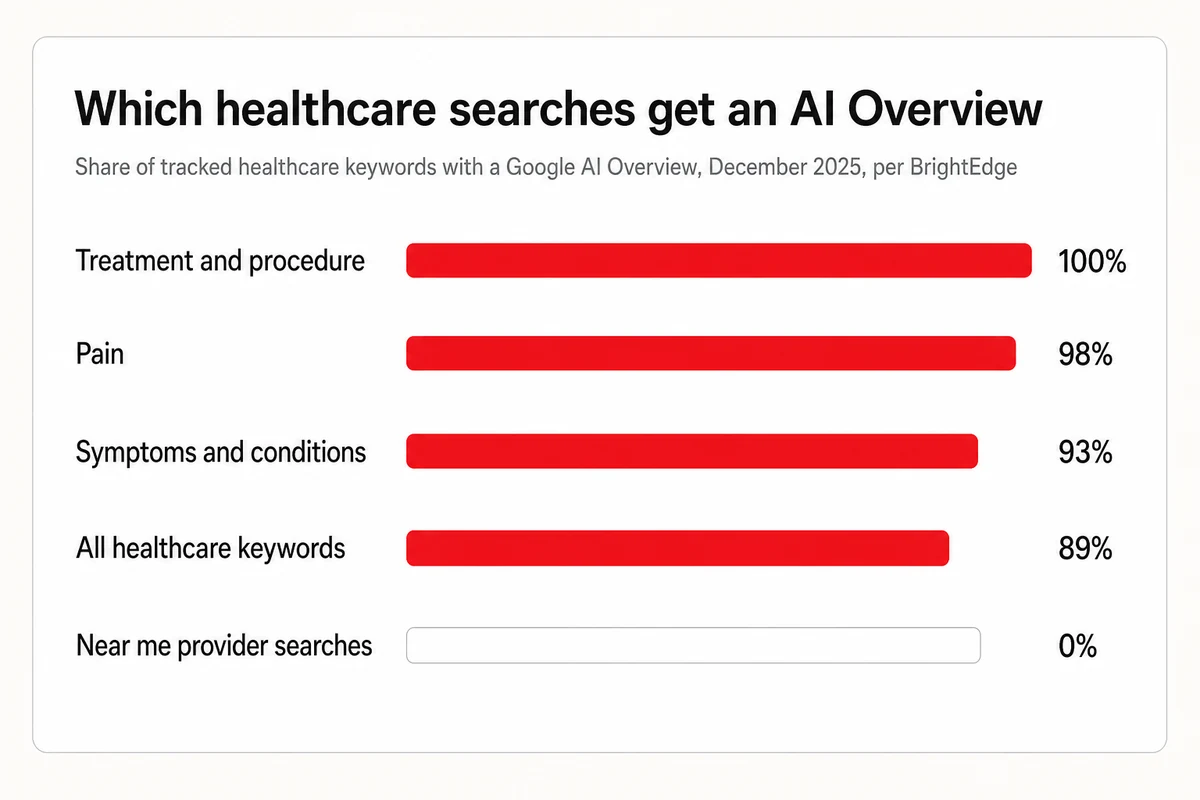
The reason to organize the work around questions is that this is how patients now search. In 2026, Pew Research Center surveyed 3,488 US adults and found 34% use AI chatbots for at least one health or medical reason, and 15% use one to help decide whether to see a doctor at all. On Google, healthcare searches phrased as questions get an AI-written answer most of the time. BrightEdge's three-year tracking of healthcare keywords, published in December 2025, found 89% carried an AI Overview, including every treatment and procedure query it followed, while "near me" provider searches such as pediatric dentist near me had dropped to none, so on that tracking a nearby-provider search is answered by the map pack and your Business Profile rather than an AI summary. That's one vendor's keyword set rather than all of Google, but the split is the useful part. A question about a procedure or a price gets answered by AI. A search for a dentist nearby gets answered by your Business Profile.
Independent practices are still most of the market, and they have the most to gain from getting this right. The American Dental Association's Health Policy Institute, in its 2025 dentist workforce report, found the share of US dentists affiliated with a dental support organization more than doubled from 7.2% in 2015 to 16.1% in 2024, and that 34% of dentists still practice solo. DSO affiliation there covers any practice that hands some nonclinical work, such as billing or marketing, to an outside company, so it's a broad measure. A DSO can put a marketing team behind every location. A solo practice has a front desk and a website, so the website has to do the answering. This is the second of our trade-by-trade field guides, after the one on local SEO and AI search for pharmacies, and like that one it covers Google and Maps alongside what ChatGPT, Gemini, Claude, Perplexity, and Google AI say when someone asks.
Do They Take My Insurance?
For many patients this is the deciding question, and it's one most practice websites answer vaguely. In 2026, Humana published an Opinium survey of 2,000 US adults, and 68% of those who make their household's dental insurance decisions said they're more likely to choose a dentist in their network. An insurer has a reason to publish that number, so weigh it as you would any sponsored survey. Coverage is the norm, too. The National Association of Dental Plans counted nearly 284 million Americans with some form of dental benefit in its 2025 report, about 83% of the population.
Answering it online means naming plans, not categories. "We accept most major insurance" gives an assistant nothing it can repeat, and gives Google nothing to match against a search for a dentist that takes Delta Dental PPO. Put a page on your site called Insurance and Fees, list every plan you're in network with by its full name, state plainly whether you also see out-of-network patients and how that billing works, and say whether you're accepting new patients, since a patient asking will want it stated plainly and the schema block later in this guide has a field for it. Keep the list current, since a plan you dropped last year is a cancelled appointment waiting to happen.
Then put the same facts where Google reads them first. Your Business Profile's description and services fields can carry the plan names, and the hours and phone number there should match the site exactly, a point we've made before about how your Google Business Profile feeds AI answers. Here's the shape of an opening paragraph for the insurance page, written so its first sentence is the answer.
[Practice name] is in network with Delta Dental PPO, Cigna DPPO, MetLife PDP Plus, and Aetna Dental PPO, and we file claims for most other PPO plans as an out-of-network provider. We are accepting new patients. Call [phone] with your member ID and we will confirm your coverage before your first visit.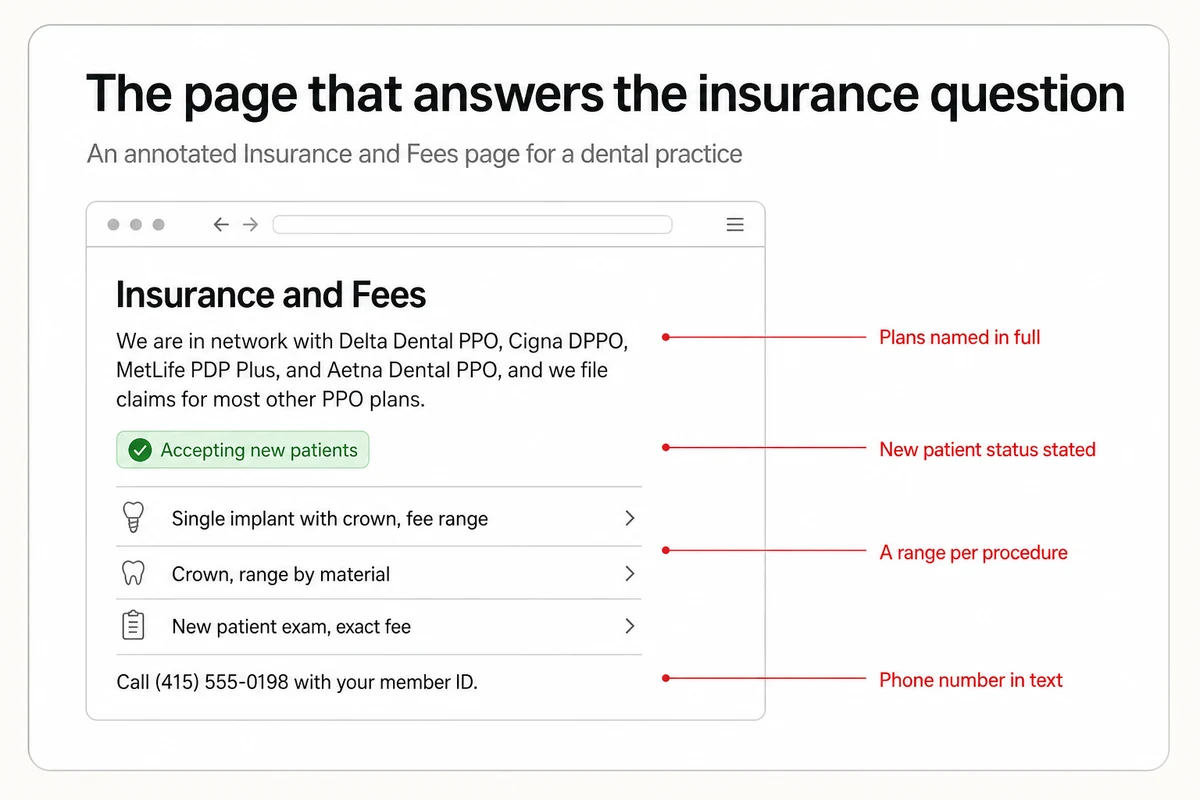
Fill in only the insurance plans you really hold a contract with. An assistant that names you for a plan you don't take sends a patient who leaves angry, and an angry patient writes the review that costs you the next one.
Can They See Me Today?
The second question is about time, and it comes in two versions. The toothache version is urgent, and the people asking it often end up somewhere expensive. The CareQuest Institute for Oral Health tracked emergency department visits for dental problems and counted 1.6 million of them in 2022, at a cost of $3.9 billion, for conditions that weren't injuries. Two thirds of those visits came from people on Medicaid or with no coverage at all, but anyone with a cracked molar at 7pm on a Friday is asking the same thing. Who nearby can see me now?
An assistant answers that from your hours, so your hours have to be true in the three places it checks. Your Business Profile, your site, and your schema markup should agree to the minute, with special hours set for every holiday, because a profile that says open on a day the office is dark gets you named and then gets you a one-star review. If you hold same-day slots for emergencies, say so in a sentence on the homepage and on a dedicated emergency page, with the phone number in text rather than inside an image, so a model can read it. If you don't, say that too, and name who you refer to after hours. A clear no beats a wrong yes.
The calmer version of the question is about scheduling a first visit, and here the Business Profile categories do the work. Google lets a profile hold one primary category and several secondary ones, and the names matter because they're what a search matches against. Dentist is the primary for a general practice. Pediatric dentist, Cosmetic dentist, Emergency dental service, and Dental implants provider are secondaries you add only if you really offer the service and have a page about it. A secondary category with no supporting page is a promise the site can't keep, and the Google surfaces that build local cards from Business Profile records will repeat whatever the category claims.
What Will It Cost?
Cost is the question dentists avoid online and the one patients put to AI most freely. The ADA Health Policy Institute's 2026 report on dental care use and cost barriers found that 12.9% of Americans went without needed dental care in 2025 because of cost, against 5.0% for medical care and 4.9% for prescriptions, which makes dentistry the most cost-blocked kind of care it measures. Among working-age adults the dental figure is 17.0%. The frustration isn't only the total. In 2026, a second Humana survey on dental insurance transparency found 42% of people who manage their household's dental coverage named unexpected costs as their top frustration with dental insurance, and 19% named a lack of cost transparency, both about their insurance rather than any one practice. Humana sells dental coverage, so weigh it accordingly, but a posted range is the part of the bill you control.
Recall the BrightEdge finding above. Every treatment and procedure search it tracked got an AI Overview. "How much does a dental implant cost" is exactly that kind of search, and the assistant answering it will quote a range from somewhere. Run that search for your own town and look at which pages it quotes. If none belongs to a local practice, that's the opening. You don't need a full price list. You need one page per procedure patients price-shop, with an honest range, what moves a patient within it, and what's included.
| Page to write | What gets typed into the assistant | The opening lines should cover |
|---|---|---|
| Dental implants | How much is a single tooth implant in [city]? | A fee range for one implant with its crown, what raises it (a bone graft, an extraction), financing, and whether the consult is free |
| Clear aligners | What does Invisalign cost for an adult? | A range by case length, what insurance typically covers, and the payment plans you offer |
| Crowns | How much is a crown without insurance? | A range by material, the number of visits, and which in-network plans cover part of it |
| New patient exam | What does a first visit cost with no insurance? | The exact fee for exam, x-rays, and cleaning, or the membership plan that covers them |
| Emergency visit | How much is an emergency dental visit? | The exam fee, what a same-day extraction or temporary fix adds, and whether you see non-patients |
A range is honest, and it's what a patient needs to decide whether to call. Write it the way you'd say it at the front desk. "A single implant with its crown runs [low] to [high] at our office. A bone graft adds [low] to [high] if one is needed, and we'll tell you at the consult whether it is." Then give the membership plan, if you have one, a page of its own, because for the roughly one in six Americans without a dental benefit, by NADP's count, that plan is the price. If you'd rather not write five procedure pages between patients, you can hand them to Lighthouse Local for Business instead, and nothing goes live until you've approved it.
What Do Other Patients Say About Them?
The fourth and fifth questions get answered by the same source. Whether a dentist is gentle with a nervous adult, patient with a six-year-old, or willing to explain a treatment plan before billing for it isn't something your homepage can prove. Reviews can. Tebra's 2025 patient perspectives survey of 3,964 US adults found 79% read reviews before choosing a provider, and 82% give a provider one or two chances before switching. Those are patients of every kind of provider, not dental alone, and Tebra sells practice software, so take the precision loosely and the direction seriously.
What assistants do with reviews is read the words, not just the stars. When a model is asked for a dentist who handles anxious patients well, it looks for reviews that say so, and it quotes them back as its reason for naming you. The mechanics are in our post on how review text shapes which businesses AI recommends. For a dental practice the practical move is to ask at the moment the fear has passed, right after a procedure went better than the patient expected, and to ask everyone the same way, with no discount attached.
Two dentist-specific traps follow. The first is where the reviews land. Google's help page on duplicate profiles lists individual practitioners at a shared location among the cases where one address can carry more than one listing, so a practice can end up with a profile for the office and another for each dentist. Say the founding dentist's personal profile holds most of your reviews and the practice profile holds a handful. An assistant asked about the practice reads the thin one. Point every new review request at the practice profile, link that one from the site, and fill in the practitioner profiles enough that they never contradict it.
The second trap is the reply. In 2026, HIPAA Journal reported on a study of 80,300 Google review replies from medical and dental practices in California and the Pacific Northwest that estimated about 26% disclosed or confirmed something about a patient, usually by confirming a detail the reviewer had already posted. The same article recounts a dental practice that paid $23,000 to settle a federal investigation into its review replies. Our pharmacy guide walks through a reply that never confirms someone is a patient, and the same rule holds at a dental office. Thank them, speak to your general standard of care, and move the conversation to a phone call. Treat this as general guidance rather than legal advice, since your state board may add advertising rules of its own.
Dentist Schema Markup, the Fields Worth Filling
Structured data gives a crawler your practice's facts as labeled fields instead of making it infer them from prose. Schema.org has a Dentist type, a child of both MedicalOrganization and LocalBusiness, so it takes the usual local fields such as address, hours, and a price range, plus two from the medical side that matter here. The isAcceptingNewPatients field is a yes or no, and medicalSpecialty names the discipline. It doesn't take a list of services, so the procedure pages above carry that job in plain prose. Here's a block to adapt. Replace every bracketed value and delete anything that isn't true for you.
<script type="application/ld+json">
{
  "@context": "https://schema.org",
  "@type": "Dentist",
  "name": "[Practice name]",
  "url": "https://www.yourdomain.com",
  "image": "https://www.yourdomain.com/office.jpg",
  "telephone": "[+1-000-000-0000]",
  "priceRange": "$$",
  "isAcceptingNewPatients": true,
  "medicalSpecialty": "https://schema.org/Dentistry",
  "address": {
    "@type": "PostalAddress",
    "streetAddress": "[Street address]",
    "addressLocality": "[City]",
    "addressRegion": "[State]",
    "postalCode": "[ZIP]",
    "addressCountry": "US"
  },
  "openingHoursSpecification": [
    {
      "@type": "OpeningHoursSpecification",
      "dayOfWeek": ["Monday", "Tuesday", "Wednesday", "Thursday"],
      "opens": "08:00",
      "closes": "17:00"
    },
    {
      "@type": "OpeningHoursSpecification",
      "dayOfWeek": "Friday",
      "opens": "08:00",
      "closes": "13:00"
    }
  ],
  "employee": [
    {
      "@type": "Person",
      "name": "[Dr. First Last, DDS]",
      "jobTitle": "Dentist"
    }
  ],
  "sameAs": [
    "[Your Google Business Profile link]",
    "[Your Facebook page]"
  ]
}
</script>
The same two cautions apply as for any local business. The hours in this block must match the profile and the page, and markup labels facts rather than creating them, so it helps once the page, the profile, and the reviews already carry those facts. Google reads a documented subset of these fields for its own features, so treat the medical ones as a bonus rather than a lever. For a primer on the format, our walkthrough of adding local schema markup to a small business site covers where the block goes and how to test it.
Run These Five Questions Past the Assistants Yourself
With the pages and the profile in place, ask the assistants what a new patient would, with your town in the question and your own name left out. These map one to one onto those five questions above.
1. Which dentists in [town, state] are in network with [plan name] and accepting new patients?
2. I have a toothache and need a dentist in [town, state] today. Who can see me?
3. How much does a dental implant cost in [town, state], and which practices publish their fees?
4. Which dentist in [town, state] is good with anxious patients or young kids, and what do reviews say?
5. Who are the highly rated dentists in [town, state], and what do patients praise about each?

After each answer, name the pages you relied on and link each one.
Run each in a fresh or temporary chat on ChatGPT, Gemini, Claude, Perplexity, and Google AI, and write down whether you were named, who was, whether the plan list and hours it gave for you were right, and which pages it cited. Then expect drift. The same question a week later can name a different practice, which is why Lighthouse Local's AI visibility tracker runs this kind of prompt on a schedule, across each assistant we track, from a clean session with the town written in, and logs who was named and which source the answer leaned on. What it can't do is force a mention, and it never claims to.
Answer the Questions Before They Reach the Front Desk
A patient choosing a dentist in 2026 asks an assistant the same five things they used to ask your receptionist, and the assistant answers from whatever it can find. If your plans are named, your hours are right in three places, your procedure pages carry an honest range, your reviews mention what nervous patients care about, and your markup says Dentist, you've given it the facts it needs to name you. Most of it takes a working afternoon per question, and none of it requires a marketing department. For the on-site half, run a free AI audit against your site. It scores the machine-readability signals, structured data among them, and ranks what to fix first, while the prompts above tell you what the assistants are saying in the meantime. The patient has already asked. Make sure the answer is yours.
Frequently asked questions
How do I get my dental practice recommended by ChatGPT?
Give the assistant five facts patients ask about, in places it can read. Name your in-network plans in full on an insurance page, keep your hours identical across your website, your Google Business Profile, and your schema markup, publish an honest fee range per procedure, earn reviews that describe how you treat nervous patients and children, and mark the site up with the Dentist schema type. No one can promise a mention, but these are the inputs it draws on.
Should a dentist list accepted insurance plans on the website?
Yes, by full plan name. A survey published by Humana in 2026 found 68% of people who handle their household's dental insurance are more likely to choose an in-network dentist, and an AI assistant can only repeat a plan name it has seen written down. A generic line about accepting most major insurance matches nothing.
What schema type should a dental practice use?
Use the Dentist type from Schema.org. It inherits from both MedicalOrganization and LocalBusiness, so it takes address, phone, hours, and priceRange, plus isAcceptingNewPatients and medicalSpecialty from the medical side. It has no services field, so describe procedures on their own pages.
Should each dentist in a practice have a separate Google Business Profile?
Google's duplicate-profile guidance lists individual practitioners at a shared location among the cases where one address can hold more than one profile, so a dentist can have a profile of their own when they meet Google's eligibility rules. The risk is that reviews split across them and an assistant reads the thinner profile. Promote the practice profile on your review requests and your site, and keep the practitioner profiles consistent with it.
Do dentists need to publish prices to show up in AI answers?
Not a full price list, but a range per procedure helps. BrightEdge's tracking found Google showed an AI Overview on every treatment and procedure search it followed in December 2025, and the assistant quotes a cost from whichever page states one. A page that gives a fee range for an implant, a crown, or a first visit, and explains what moves the number, is the kind of page that gets cited.