Many Clients Tell a Chatbot Before They Search for You
A therapist gets found on Google and named by AI assistants the same way any local practice does, with a Google Business Profile in the right category, a page for each problem and each practical question a client asks, a schema block that says what the practice is, directory listings that agree with the website, and reviews handled inside the ethics rules of the license. This guide walks through each of those for a private practice, solo or group, and ends with the questions to put to the assistants yourself. It's one of our industry field guides, a series that began with AI search and SEO for local pharmacies, because a counselor's search problem looks nothing like a pharmacist's.
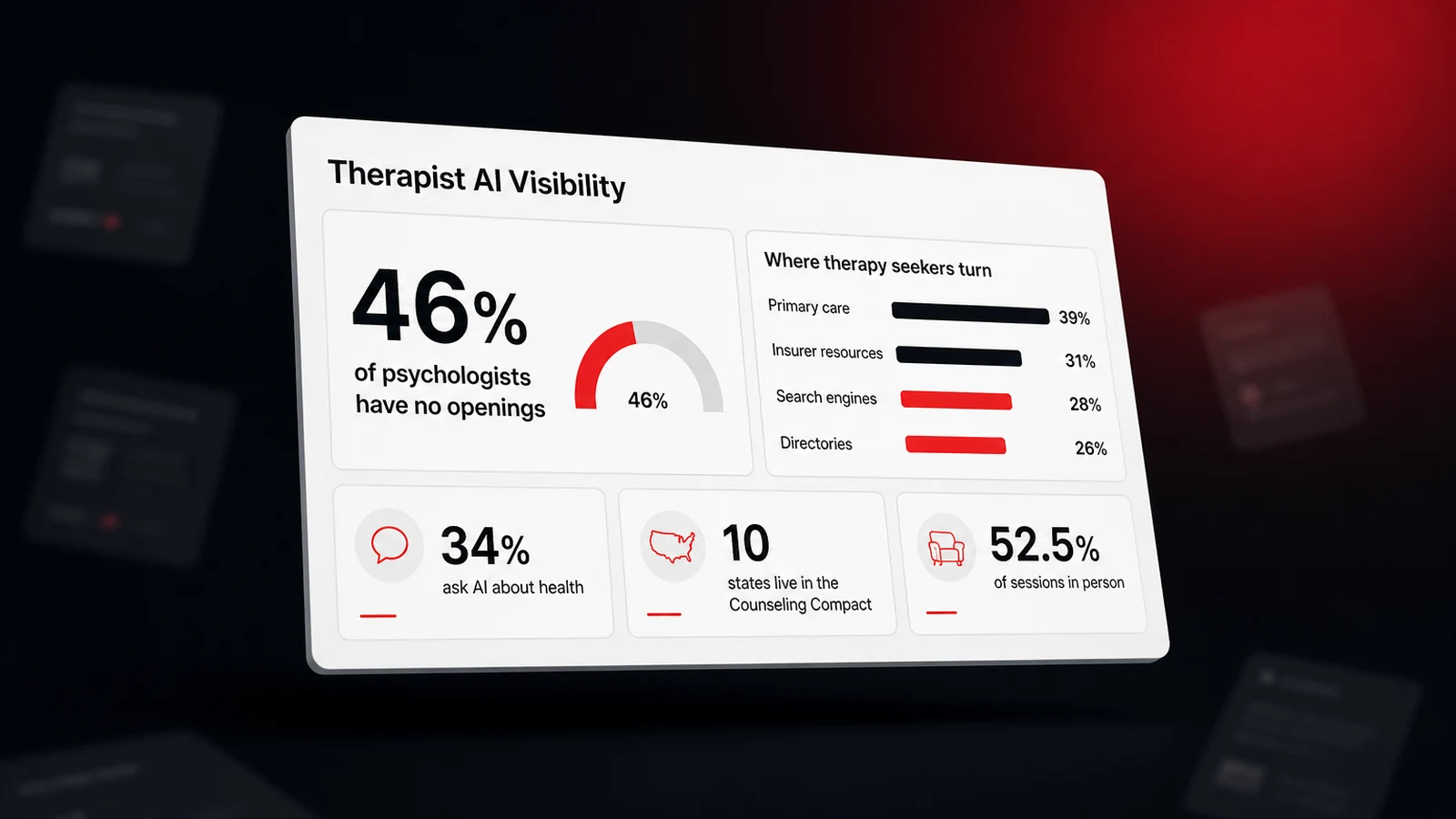
The demand side needs little selling. In 2026, SAMHSA's release of the National Survey on Drug Use and Health put any mental illness at 20.6% of US adults, 54.6 million people, and found that only 50.9% of them received treatment in the past year. On the supply side, the American Psychological Association's Practitioner Pulse Survey of 1,742 psychologists, published in December 2025, found 46% had no openings for new patients and 40% kept a waitlist. HRSA's quarterly shortage-area report, as of September 30, 2026, counted 7,127 mental health shortage designations covering about 154.6 million people, with 26% of the need met. A practice with an open hour isn't short of people who need it. It's short of those people finding it.
What's new is that a third of adults have now taken a health question to a chatbot. Pew Research Center's survey of 3,488 US adults, published in August 2026, found 34% have used an AI chatbot for at least one health reason, and 18% for health information they're uncomfortable talking about. Two months earlier, the APA's survey of 1,242 psychologists found more than three quarters say their patients bring up AI in session, and 35% had patients treating a chatbot as an additional mental health professional. Clients aren't choosing between a chatbot and you, though. A Thriveworks survey of 2,000 adults, fielded by Wakefield Research in March 2026, found 64% have less confidence in AI than in a human therapist, and among people who had tried an AI tool for mental health, 75% used it alongside therapy rather than instead of it. That's a provider's own survey, so weigh it as one, but its shape matches Pew's.
The law is pushing the same direction. Illinois' Wellness and Oversight for Psychological Resources Act, signed August 1, 2025, bars anyone from using AI to provide therapy, with a civil penalty of up to $10,000 per violation. Nevada's AB 406, effective July 1, 2025, forbids an AI provider from representing that its system can deliver professional mental or behavioral health care, at up to $15,000 per violation. A March 2026 legislative snapshot from ASTHO adds Utah's disclosure rules for mental health chatbots and New York's crisis-referral requirement for AI companions. So when someone types "I can't sleep and I'm anxious all the time" into a chatbot, the assistant's legal and practical job is increasingly to hand them to a licensed human nearby. The question for your practice is whether it hands them to you.
Every Therapist Question Has Five Slots
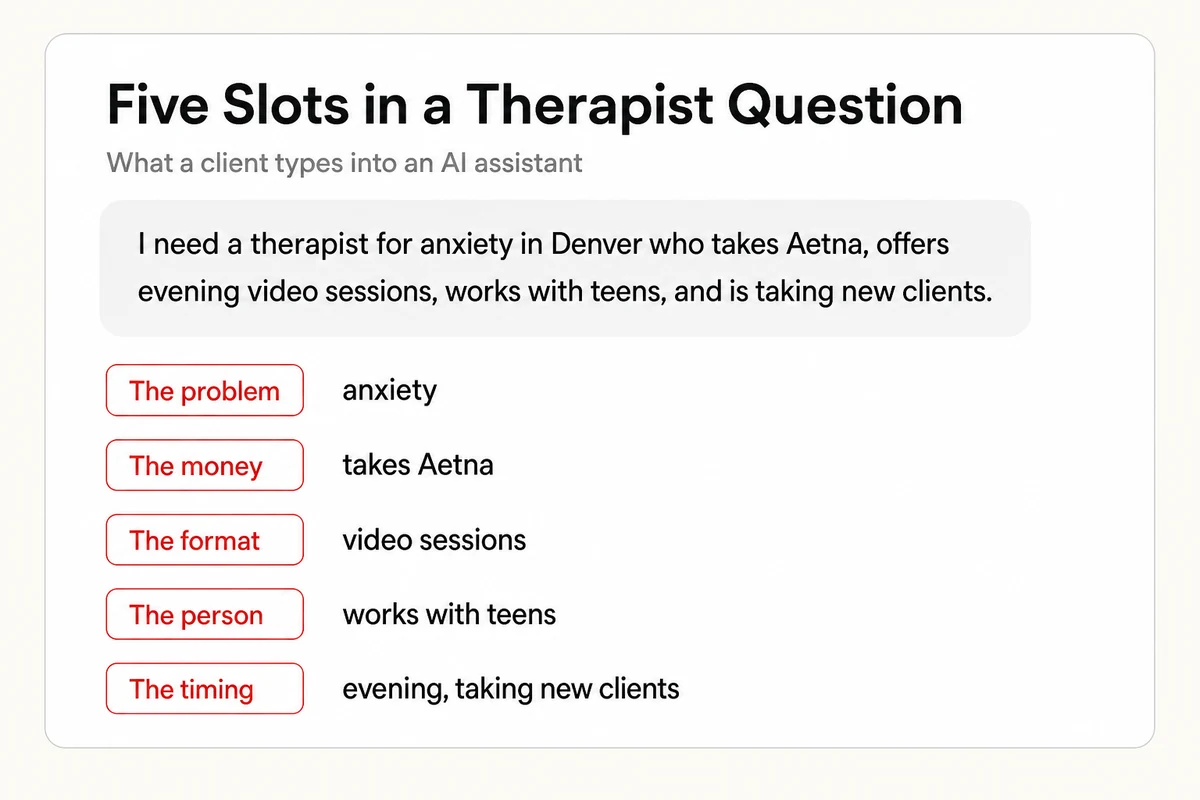
Nobody asks an assistant for "a therapist." They ask for a therapist for a specific problem, who takes a specific insurance, in a specific format, for a specific kind of person, with room this month. Those are the slots, five in all, and the practices that get named are the ones whose website and listings fill every one in words a machine can match.
- The problem. Anxiety, couples, grief, ADHD, trauma, postpartum. Clients name the problem and almost never the modality. EMDR and CBT appear in the question only after a client has already read about them.
- The money. An insurance carrier by name, a sliding scale, a flat fee, or out-of-network with a superbill. This slot decides more bookings than any other and is the one most practice sites leave blank.
- The format. In person at an address, by video, or either. In 2026, SimplePractice's state of private practice report, drawn from more than 245,000 clinicians on its platform, found in-person sessions held a slight national majority at 52.5%. Roughly half of clients want the other option, so your pages have to say which you offer.
- The person. Teens, veterans, LGBTQ+ clients, a specific language or faith, new parents. A client asking for a therapist who works with teenage boys won't click a profile that lists adults, adolescents, children, couples, and families as one undifferentiated string.
- The timing. Taking new clients, evening hours, a first appointment within a week. The same SimplePractice data found 60.5% of independent clinicians had an opening within seven days, so saying so on the page sets you apart from the 46% of psychologists who are full.
Here's what one of those questions looks like in the wild. In February 2026, the therapist website studio Reframe Practice ran a single prompt through ChatGPT in ten cities, "Recommend a therapist for anxiety in [city]. I want someone who specializes in anxiety and is taking new clients." Two slots filled, three left open, and ChatGPT with web browsing named three to five providers per city, more than 90 in all. The practices it named shared two traits, a website with dedicated specialty pages and a presence across several directories. Therapists listed only on Psychology Today were, in the study's words, rarely mentioned. It was one run per city with no repeats, so treat it as a snapshot, which is what its authors call it. The pattern still tells you where to work.
Clients book on access first. Thriveworks' survey of more than 2,000 therapy seekers, published in November 2025, found 79% named access and convenience as a reason they booked and 70% named trust and quality of care. Fill those five slots and you've answered both.
Psychology Today Is a Landlord, Not a Competitor
Most therapists treat Psychology Today as the rival that outranks them. For AI search it's closer to a landlord. The assistants rent facts from it and from a short list of other directories, and the question is whether your unit in the building is furnished.
Two small 2026 tests, both by vendors who sell therapist websites, say the same thing from different angles. In July 2026, WebsiteTherapy ran 32 local therapy queries such as "couples counseling Alpharetta GA" through ChatGPT with browsing, through Perplexity, and through Gemini with search grounding. Psychology Today was named or cited in 33% to 50% of answers in every market, Yelp in about a fifth of the answers it could classify, and GoodTherapy, Zocdoc, TherapyDen, and Healthgrades almost never. Reframe's ten-city test above found a Psychology Today profile alone rarely got a therapist named. Both are small, two metros and four practices in one case, one prompt per city in the other, and they disagree about how much a directory profile is worth. Where they agree is that the directory is the floor and the website is what gets you off it.
The larger datasets point the same way for health care generally. Yext's October 2025 study of 6.8 million AI citations found that in healthcare, listings made up 52.6% of what the assistants cited, more than any other source type. Yext sells listings software, so read it as a vendor's number, but it fits the therapist-specific tests and our own look at where AI gets local business data.
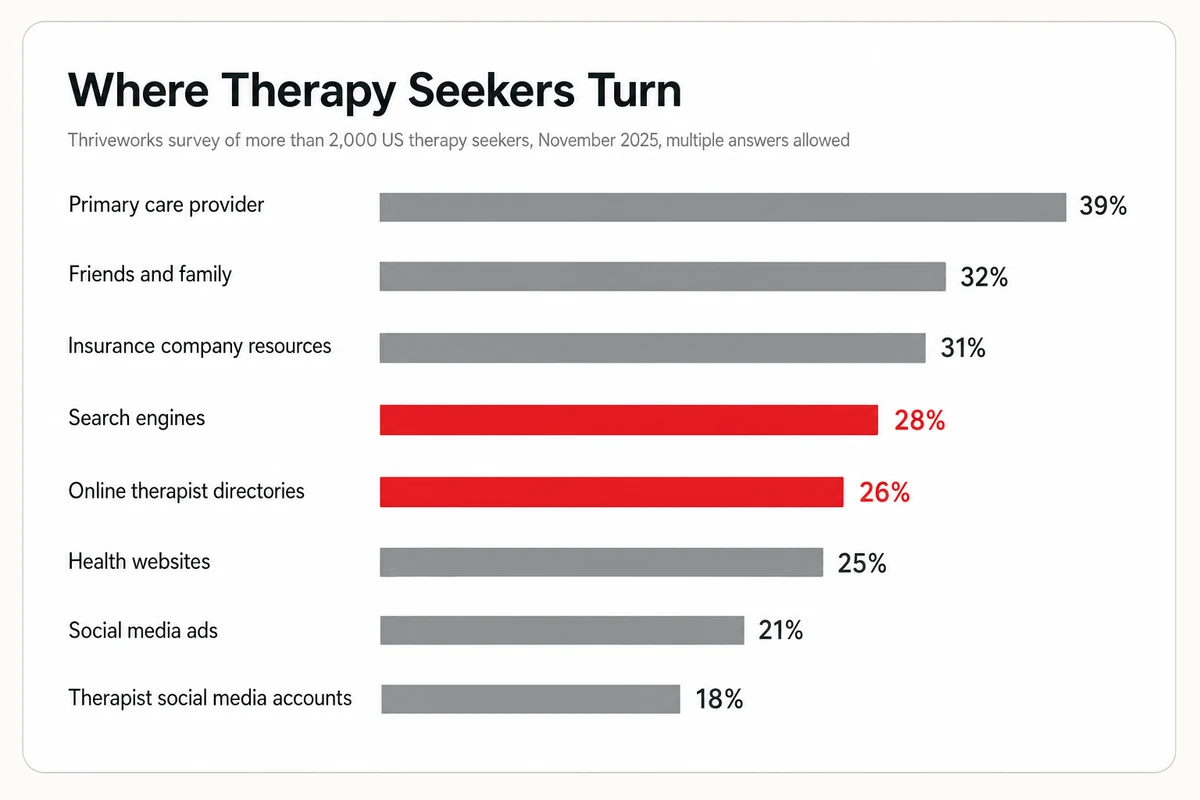
Clients arrive by several doors at once, and most use more than one. Thriveworks' seeker survey, which let people pick several, found 39% turn to their primary care provider, 32% to friends and family, 31% to their insurer's resources, 28% to a search engine, and 26% to a therapist directory. Your name has to survive every one of those routes and say the same thing on each.
The practical rule is consistency, not volume, and the numbers below are the directories' own, as of October 2026. Psychology Today's own membership signup advertises 971,000 average weekly unique users of its US directory for a flat $29.95 a month. Headway says it lists more than 80,000 providers who bill insurance through it. Open Path Collective lists more than 40,000 therapists at reduced fees. Zocdoc's company overview says it helps patients book across insurance directories, practice websites, search and review sites, and AI platforms, which tells you where the directories think the next client is coming from. Be on the two or three that fit your model, an insurance platform if you take insurance, a sliding-scale directory if you offer one, and make every profile match the website on those five slots. One stale fee or a dropped panel on a single directory can make an assistant hedge, or send a client to a number that goes to voicemail.
One Clinician, One Profile, and Keep the Address Honest
Google's Business Profile guidelines treat health practitioners as a special case, and a therapy practice should know three of the rules before it claims anything.
A practitioner can have their own profile. Google's guidelines for representing your business allow an individual practitioner a dedicated profile when they're the public-facing provider and clients can reach them at the location during stated hours, and it permits a title or degree in the name. A solo clinician whose practice is just them needs one profile, not two. A group practice is the reverse. The practice gets a profile for the location, and each clinician who's public facing can hold their own, which is how a group with six therapists ends up with seven profiles that all point at the same door. What a practitioner can't do is open a profile per specialty. One person, one profile.
Pick the category a client would pick. Google offers categories such as Psychotherapist, Counselor, Psychologist, Mental health service, Marriage or relationship counselor, and Family counselor. The primary category should match the license and the main thing you do, with secondaries only for services you deliver. A category added to catch extra searches earns a wrong-fit inquiry and an awkward first call.
Hide the address only if you never see anyone there. Google's help page on managing your business address says the address on a profile is public and that you should only choose not to show it if your business is a service-area business. A fully remote telehealth practice is one, and it follows Google's rule for service-area and hybrid businesses, which says to remove the address if you don't serve customers at it and allows up to 20 service areas on one profile. A practice that sees clients in an office isn't a service-area business, and hiding the address for privacy makes the profile look like a practice with no office, which is exactly what a client asking for in-person therapy filters out. Keep the suite number, set the hours a client can actually book, and put the telehealth states in the service areas.
Write the Page for the Problem the Client Typed
Once the profile is right, the website carries the specifics the profile can't. A single Services page listing twelve issues in a bulleted column answers none of those five slots. Build a page per question instead, and open each one with the sentence that answers it.
| What the client asks | The page that answers it | What it has to state |
|---|---|---|
| Therapist for anxiety in [town] | Anxiety therapy, one page per core problem | What you treat and how, with the modality named second, typical length, what a first session covers, in person or video |
| Does anyone near me take [carrier]? | Fees and insurance | Each panel by name, the session fee, sliding-scale terms, out-of-network superbills, how to check benefits |
| Couples counselor who does evenings | Couples therapy | Who it suits, how the first session runs, evening and weekend slots, how both partners consent |
| Teen therapist who's taking new clients | Teens and adolescents | Ages seen, how parents are involved, confidentiality rules, current availability in plain words |
| Online therapist licensed in [state] | Telehealth | Every state you're licensed in, by name, the platform you use, how a first video visit works |
Two lines belong on every one of those pages and on the homepage. Whether you're taking new clients this month, and how soon a first appointment usually happens. With 46% of psychologists reporting no openings, an honest "accepting new clients, first appointment usually within two weeks" is the most quotable sentence on your site. Update it the week it stops being true, because an assistant will keep repeating it until you do.
Write the problem first and the method second. Google's own overview of its Search Quality Rater Guidelines puts health in the category it names Your Money or Your Life, holds those pages to very high quality standards, and rates them on experience, expertise, authoritativeness, and trust For a therapist that means a named clinician with a license number and state on the page, a photo of the real office, and content that stays inside your scope. A page on how EMDR works, written by the EMDR-trained clinician who'll deliver it, builds trust. A generic article on the symptoms of depression competes with hospital systems and loses.
The Schema Block Without a Therapist Type
Schema markup is a labeled block of facts, written into the code of your site, that tells a crawler what kind of business it's reading without inferring it from prose. Here's the awkward part for a therapist. Schema.org has no Therapist, Counselor, or Psychologist type. Its MedicalBusiness type has 26 subtypes, and the only mental health one is Psychiatric, framed as the medical specialty of psychiatry, which a non-prescribing counselor shouldn't claim. The general ProfessionalService type is deprecated. The honest choice is MedicalClinic, a MedicalBusiness that also inherits the medical organization properties you want, whether you're accepting new patients, the insurance networks you're in, and the services you offer.
Replace the bracketed values, delete anything untrue, and paste it into the head of your homepage.
<script type="application/ld+json">
{
  "@context": "https://schema.org",
  "@type": "MedicalClinic",
  "name": "[Your Practice Name]",
  "url": "https://www.yourdomain.com",
  "image": "https://www.yourdomain.com/office.jpg",
  "telephone": "[+1-000-000-0000]",
  "isAcceptingNewPatients": true,
  "healthPlanNetworkId": ["[Insurer one]", "[Insurer two]"],
  "paymentAccepted": "Cash, Credit Card, Insurance",
  "priceRange": "[$150-$200 per session]",
  "availableService": [
    {
      "@type": "PsychologicalTreatment",
      "name": "Cognitive behavioral therapy for anxiety"
    },
    {
      "@type": "PsychologicalTreatment",
      "name": "Couples therapy"
    }
  ],
  "address": {
    "@type": "PostalAddress",
    "streetAddress": "[Street address, Suite]",
    "addressLocality": "[City]",
    "addressRegion": "[State]",
    "postalCode": "[ZIP]",
    "addressCountry": "US"
  },
  "areaServed": ["[State you are licensed in]", "[Another state]"],
  "openingHoursSpecification": [
    {
      "@type": "OpeningHoursSpecification",
      "dayOfWeek": ["Monday", "Tuesday", "Wednesday", "Thursday"],
      "opens": "09:00",
      "closes": "19:00"
    }
  ],
  "sameAs": [
    "[Your Psychology Today profile]",
    "[Your Google Business Profile link]"
  ]
}
</script>
Three notes on it. The healthPlanNetworkId field is where insurance panels go, by name, because Schema.org has no property for accepting insurance. The services use PsychologicalTreatment, which Schema.org defines as a treatment that relies on counseling, dialogue, and communication rather than drugs, and it's the closest fit for talk therapy. And medicalSpecialty is left out on purpose, since its only mental health value is Psychiatric. If you run a psychiatric practice that prescribes, add it. If the format is unfamiliar, our plain-English guide to adding local schema markup shows where to paste the code and how to test it. Markup labels what's true. It won't lift a site with thin pages, and a group practice can add a Person node per clinician later, once the clinic block is live.
Telehealth Widens the Map, the License Draws the Border
Telehealth made a therapist's market bigger than their office, and the license decides how much bigger. For the first quarter of 2026, FAIR Health found 52.1% of patients with a telehealth claim had a mental health condition, the top telehealth diagnosis in every age group and region, with psychotherapy the second most common telehealth procedure nationally. That's the mental health share of telehealth, not the telehealth share of therapy, but it says where video care actually went.
The border moves state by state, and three compacts are redrawing it.
| Compact | Who it covers | Status in October 2026 | What it means for your pages |
|---|---|---|---|
| PSYPACT | Psychologists | Legislation passed in 43 jurisdictions on its official list, with Alaska and Iowa enacted this year and not yet active | A psychologist holding the compact's telepsychology authorization can name every participating state |
| Counseling Compact | Licensed professional counselors | Live in ten states as of October 1, with 29 more and DC completing setup | Counselors licensed and living in a live state can apply for a privilege to practice in the others, then list them |
| Social Work Licensure Compact | Social workers | Activated, with multistate licenses not yet issued | Watch it, and list only the states you hold a license in today |
Turn each state you can practice in into a sentence a machine can read. On the telehealth page, list the states by name. In the schema block, put them in areaServed. On the Business Profile, add them as service areas. Then the client three hours from your office who asks for an online therapist licensed in their state finds a page that says yes before they finish asking.
One caution. Being licensed in nine states and writing "online therapy nationwide" is the kind of claim an assistant repeats and a licensing board notices. State names, not slogans.
Reviews You Can't Ask For and Replies You Can't Personalize
Reviews feed AI answers the same way they feed Google, and we've covered how reviews shape AI recommendations. For a therapist the rules are tighter than for any other local business, and they come from your own code of ethics before they come from any regulator.
- The American Psychological Association's Ethics Code, Standard 5.05, bars psychologists from soliciting "testimonials from current therapy clients/patients or other persons who because of their particular circumstances are vulnerable to undue influence." The task force reviewing the code expects to finish in late 2026 or early 2027, and the standard stands until then.
- The American Counseling Association's Code of Ethics, C.3.b, goes further, telling counselors who use testimonials not to solicit them from "current clients, former clients, or any other persons who may be vulnerable to undue influence." The ACA is revising its code too, so check the current text before quoting it.
- Social workers carry a similar standard in the NASW code, and most state boards echo one of the three.
So the review routine most local businesses run, a card at the counter and a text after the visit, is off the table. What's left is permitted and still works. A client who leaves a review unprompted on Google or a directory is free to. Your intake paperwork can explain that you don't ask for reviews and why, which clients tend to respect. Professional references from colleagues, supervisors, and referring physicians aren't client testimonials and can appear on the site. And a star count may matter less for a therapist than for a restaurant. Neither test above found ratings driving who got named. The citations went to directory profiles and specialty pages.
Replying is where privacy law takes over. A practice that bills insurance electronically is a HIPAA covered entity, and your ethics code and state law add confidentiality duties either way, so the fact that a named person is or was your client stays protected, even after they've said so in public. In September 2025, the HHS Office for Civil Rights settled with Cadia Healthcare for $182,000 after it posted details of 150 patients as success stories on its website and social media, and OCR's director said a valid written authorization is generally required before a provider posts an individual's health information in a testimonial. The same principle governs a reply to a one-star review. You can't confirm the reviewer was a client, mention a session, a diagnosis, a date, or a billing dispute, or defend yourself with any detail from their file. A workable reply speaks to policy and moves the conversation offline. "We take all feedback seriously and are glad to talk through any concern directly. Please reach our office at [phone]." Write two of those, have them approved once, and post nothing else. This isn't legal advice, and state boards add rules of their own.
Six Questions to Put to the Assistants Before a Client Does
With the profile, the pages, the markup, and the directories done, see what the assistants answer. Phrase each question the way someone who just moved to town would, with the town included and your name left out of all but the last question.
1. I think I have anxiety and I live in [town, state]. Who should I see, and are they taking new clients?
2. Which therapists in [town, state] take [insurance carrier]?
3. Find me a couples counselor near [town, state] with evening appointments.
4. Who works with teenagers in [town, state], and how do they involve parents?
5. I'm in [state] and want online therapy. Which licensed therapists can I see by video?
6. What do people say about [your practice name] in [town, state]?

For each answer, list the web pages you used, with a link for each.
Open a fresh temporary chat in each of ChatGPT, Gemini, Claude, Perplexity, and Google AI and run all six, because a signed-in account with your own history tilts the answer, as our guide to why AI recommendations differ by user explains. Note four things per answer. Did it name you. Who did it name instead. Were your facts right. Which pages did it cite. The citations are the work order. If a directory profile shows up carrying your old fee or a dropped panel, that's the first fix.
Expect the list to change between runs. Reframe's authors called their own ten-city result unstable, and that was one prompt. Thirty temporary chats a month, read carefully, is an afternoon a clinician doesn't have between sessions. Lighthouse Local's AI visibility tracker runs questions like these on a schedule across the assistants we track, with the town named in the prompt and no history behind it, and reports which assistants named you, which named someone else, and which sources each one leaned on. It monitors and reports. Nobody can promise a mention, and a tool that does is overselling.
What a Full Caseload and an Insurance Panel Decide for You
Some of what decides whether you're named sits outside the reach of SEO, and it's better to know that before spending on it.
A full caseload is a visibility problem in reverse. If you're among the 46% with no openings, being named sends people to a voicemail that says no. Set isAcceptingNewPatients to false, say so on the homepage, offer a waitlist form, and flip them back the week a slot opens. An assistant that reads "not accepting new clients" and moves on is doing you a favor.
Panels decide the money slot for you. If you're out of a client's network, no page changes that. State the panels you're in and the out-of-network process plainly, so the clients who find you will be ones you can see.
The answer isn't yours to control. The two therapist tests above disagree with each other about the value of a directory profile, and each was a handful of prompts. The assistants read your site, your profiles, the directories, and the reviews, then put the answer in their own words, differently each run. Anyone who promises a guaranteed place in ChatGPT is selling a product that doesn't exist.
Ads have their own gate. Google's healthcare and medicines policy restricts addiction recovery ads to advertisers Google has certified and allows telemedicine advertisers only with LegitScript verification, with details that vary by country. Read it before advertising either, and budget time for the paperwork. None of the organic work here needs it.
It's hours you'd otherwise bill. Each section above is an afternoon or two. If the afternoons don't exist, Lighthouse Local for Business has specialists work on the profile, the problem pages, and the directory cleanup, with every change waiting on your approval before it publishes and the clinical content staying yours.
Make Yourself Legible to the Thing Making the Introduction
A client who starts in a chatbot at one in the morning is further along than the one who typed "therapist near me" five years ago. They've named the problem, often the insurance, sometimes the format, and the assistant's job is to give them a human. It will give them whoever's profile is complete in the right category, whose pages answer the question that was asked, whose markup says what the practice is and whether it has room, whose directories agree with the website, and whose reviews were handled without a single breach. To see where your own site stands on the parts a scanner can read, our free AI audit ranks the fixes with no signup. It grades your site, and the six questions above cover what the assistants say. You've already built the trust in the room. Make it legible to the thing that's now making the introduction.
Frequently asked questions
How do I get my therapy practice recommended by ChatGPT?
Fill these five slots a client asks about, the problem, the insurance or fee, the format, the kind of person you see, and whether you're taking new clients, on your website, on your Google Business Profile, and on the two or three directories that fit your practice, and keep them identical everywhere. Add MedicalClinic schema that states whether you're accepting new patients. Whether an assistant names you is never guaranteed, but those slots are what it reads.
What schema type should a therapist website use?
Use MedicalClinic from Schema.org. There's no Therapist, Counselor, or Psychologist type, and the only mental health subtype, Psychiatric, describes psychiatry. MedicalClinic accepts isAcceptingNewPatients, healthPlanNetworkId for insurance panels, and availableService entries typed as PsychologicalTreatment, alongside the usual address, hours, and phone fields.
Can therapists ask clients for Google reviews?
Not current clients, under the APA and ACA ethics codes, and the ACA extends the restriction to former clients too. Clients may leave reviews on their own, and professional references from colleagues aren't client testimonials. When replying to any review, never confirm the person was a client or mention any detail of their care, since that's protected health information for a covered practice and confidential under your ethics code regardless.
Should a telehealth-only therapist hide their address on Google?
Yes, if you never see clients at the address, because Google treats that as a service-area business and lets you list up to 20 service areas instead. If you see clients in an office, keep the address visible. Hiding it makes the profile look like a practice with no office, which filters you out of in-person searches.
Does each therapist in a group practice need a separate Google Business Profile?
The practice gets one profile for the location, and each public-facing clinician who can be reached there during stated hours may hold their own practitioner profile as well. A solo practitioner needs just one. No practitioner should create multiple profiles to cover different specialties.