The Rich Result Is Gone and the Markup Is Still Valid
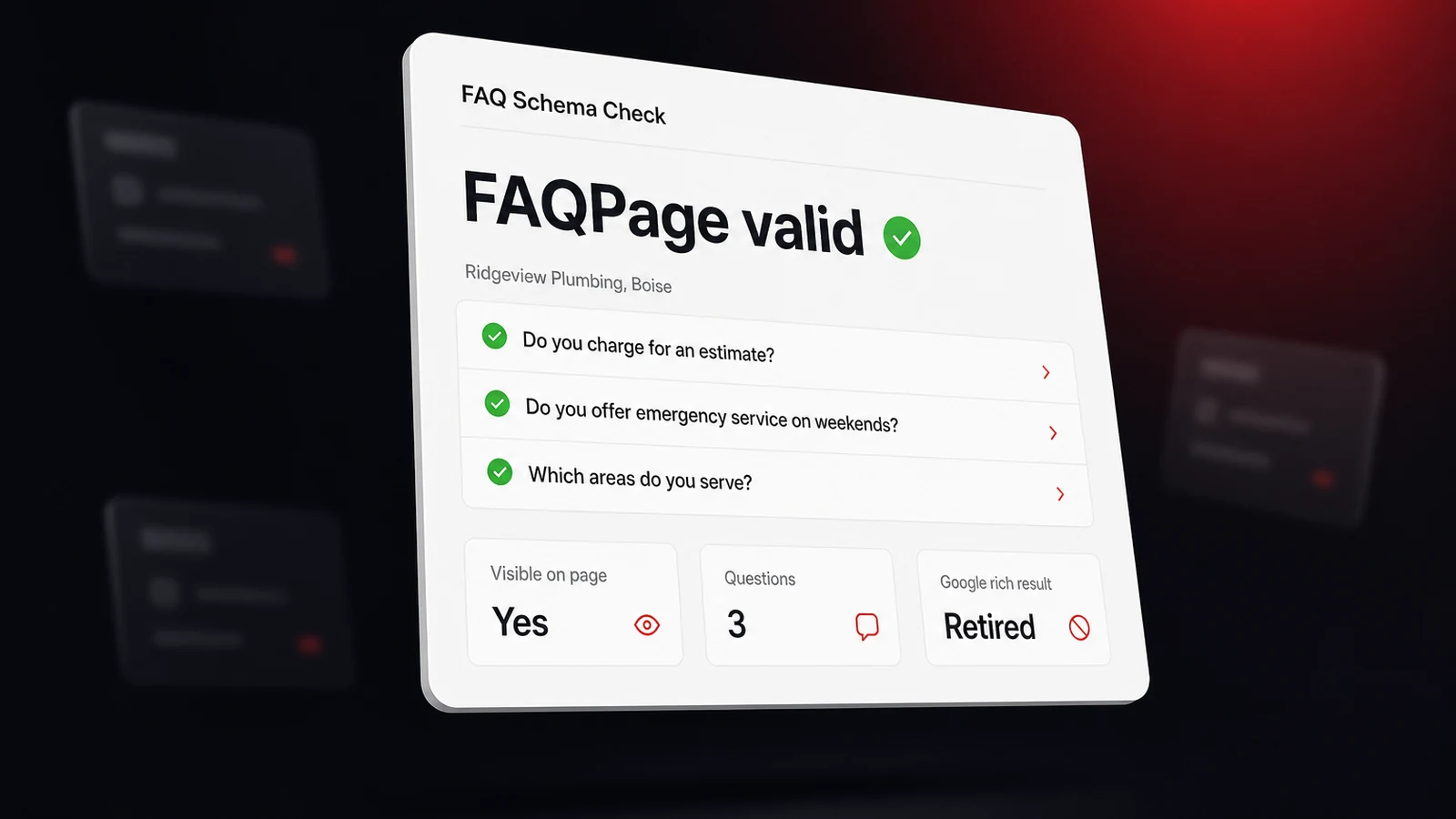
FAQ schema is the FAQPage structured data that labels the questions and answers on a page, and since May 7, 2026, Google no longer shows a rich result for it, so the markup stays valid but earns nothing visible in Google Search. That one sentence settles most of what people mean when they type "faq schema" into a search box or an assistant. The rest of this guide covers what's left, because something is left. The visible FAQ section is the part the evidence says assistants read. The markup is a free label worth keeping where your platform adds it for you, and not something worth paying for on its own.
This is the third guide in our schema series for local businesses. The first covered local schema markup, the LocalBusiness block that labels your name, address, hours, and phone. The second covered AggregateRating schema, the block that labels your star rating. FAQ schema labels something different from either, a conversation. And unlike the other two, its story in 2026 is mostly about a feature Google took away, which is why much of the advice still online is behind.
What FAQPage Markup Says to a Machine
Schema.org, the shared vocabulary the search engines and assistants read from, defines FAQPage as a web page presenting one or more frequently asked questions. The page holds a list of Question items, and each Question carries a name, which is the question as written, and an acceptedAnswer, an Answer whose text field holds the reply. That's the whole structure. Where a LocalBusiness block labels a fact and an AggregateRating block labels a verdict, an FAQPage block labels a question and the answer you stand behind.
Here's a filled-in block for a plumbing company in Boise, the example this guide uses throughout. Three questions customers actually ask, three answers that each stand on their own.
<script type="application/ld+json">
{
  "@context": "https://schema.org",
  "@type": "FAQPage",
  "mainEntity": [
    {
      "@type": "Question",
      "name": "Do you charge for an estimate?",
      "acceptedAnswer": {
        "@type": "Answer",
        "text": "No. Ridgeview Plumbing gives free estimates in Boise and Meridian, and the price we quote is the price you pay unless the job changes."
      }
    },
    {
      "@type": "Question",
      "name": "Do you offer emergency service on weekends?",
      "acceptedAnswer": {
        "@type": "Answer",
        "text": "Yes. A licensed plumber is on call Saturday and Sunday from 7am to 9pm, and the $95 after-hours trip fee is applied to the repair."
      }
    },
    {
      "@type": "Question",
      "name": "Which areas do you serve?",
      "acceptedAnswer": {
        "@type": "Answer",
        "text": "Boise, Meridian, Eagle, Nampa, and Kuna, with a 45 minute response window for emergencies inside Boise city limits."
      }
    }
  ]
}
</script>
Two things to notice. Every answer opens with the answer, a yes, a no, or a place name, before any explanation, because a machine quoting one sentence will quote the first one. And nothing in the block is sales copy. "Why choose Ridgeview?" isn't a question a customer asks, so it isn't in there.
Every post on this blog, this one included, carries a block shaped exactly like that. It's generated from the same list that renders the FAQ accordion at the bottom of the page, so the markup and the visible answers can't drift apart. Open the page source and you'll find it. That's the shape to copy if a developer builds your pages, and the shape the Yoast and Rank Math FAQ blocks produce for you, covered further down.
How Google Wound Down the FAQ Rich Result
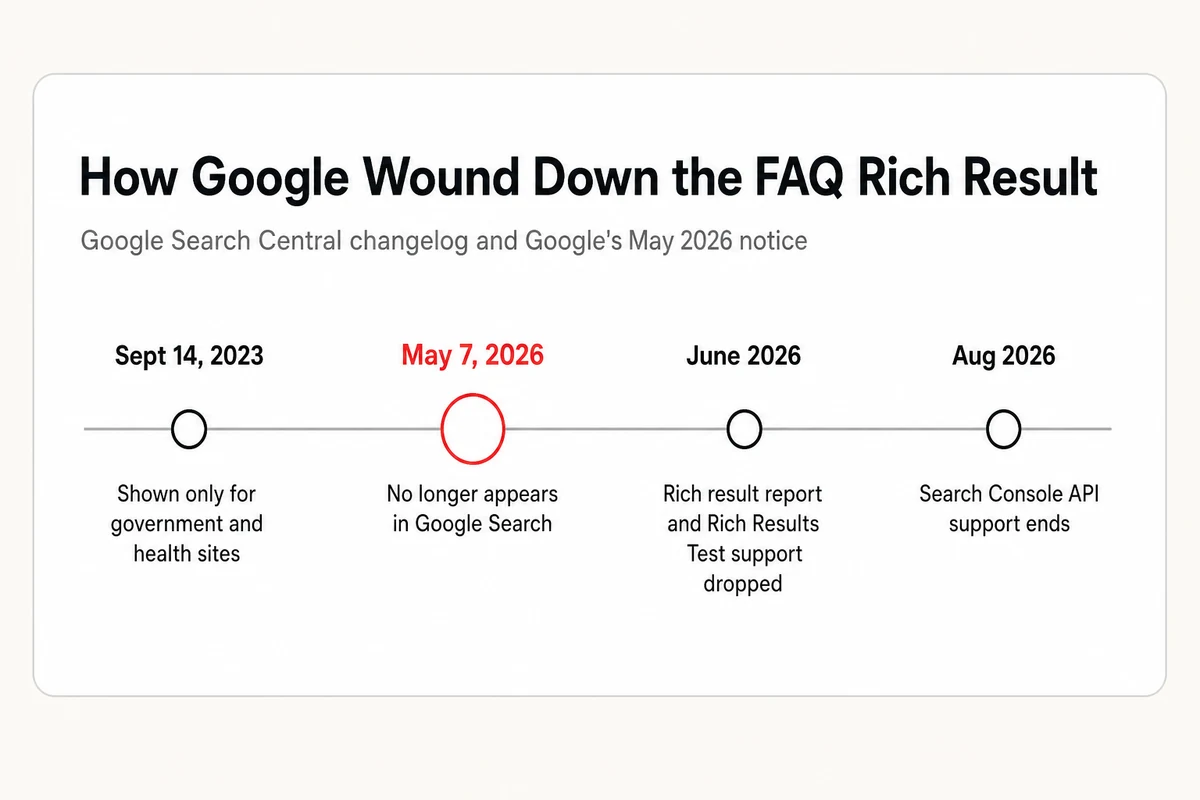
The FAQ rich result was the expandable list of questions that used to sit under a page's blue link in Google. Google's own Search Central changelog records how it ended. On September 14, 2023, the FAQ documentation was updated to say the feature was only shown for well-known, authoritative government and health websites. On May 8, 2026, a new entry announced the feature would no longer appear in Google Search starting May 7, 2026. On June 15, 2026, the documentation itself was removed.
Search Engine Journal reported the notice on May 10, 2026, and quoted Google's plan to drop the FAQ search appearance, the rich result report in Search Console, and support in the Rich Results Test in June 2026, with Search Console API support removed in August 2026. Google's line on pages that still carry the markup was plain. It won't cause problems, and it won't produce visible results in Google Search. No reason was given, and no blog post explained it.
That matters because plenty of the web hasn't caught up. Shopify's FAQ creation guide, updated May 21, 2026, two weeks after the feature ended, still tells merchants FAQ rich results show only for well-known government and health websites. And when Search Engine Journal rounded up the reaction on May 16, 2026, Lily Ray of Amsive had flagged search results showing roughly 168,000 pages using the phrase "FAQ schema is critical for GEO," GEO being generative engine optimization. Google ended the feature the same spring that advice was all over the results.
What the Assistants Read, the Visible Answer or the Hidden Block
With the Google feature gone, the case for FAQ schema rests on whether AI assistants read it. The 2026 evidence is thin and mixed, so here's the evidence at its real weight, the direct tests first and the official statements after.
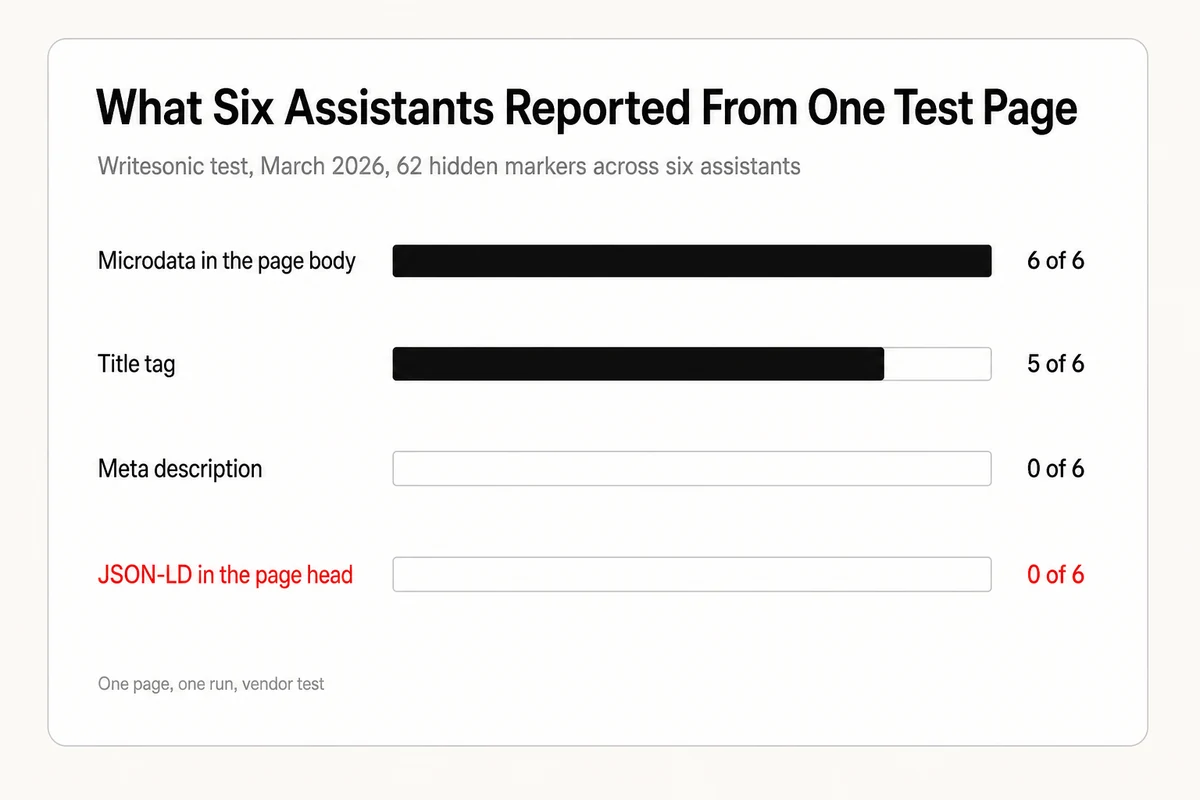
The most direct test is a small one, and it planted generic hidden markers rather than an FAQPage block, so it speaks to FAQ schema by analogy. In March 2026, Writesonic, which sells AI visibility tooling, planted 62 hidden markers across one test page and asked six assistants, three of the five we track plus Copilot, DeepSeek, and Grok, to report what they could see. Schema.org microdata written into the page body was reported by six of six. The title tag by five of six. The meta description by zero of six. And JSON-LD in the page head by zero of six. Writesonic's explanation, that the crawlers convert the page to Markdown and strip the head first, is a guess the test doesn't prove, and it's one page, run once, by a vendor. It lines up with a second experiment the Search Engine Journal roundup cited, by searchVIU, in which five AI systems relied on visible HTML during direct page retrieval and didn't use hidden JSON-LD, microdata, or RDFa. The two tests disagree on microdata, so hold the details loosely. On JSON-LD in the page head they agree, and that's where FAQ plugins usually put it.
The bigger study points the same way. In the same roundup, Ahrefs is reported tracking 1,885 pages that added JSON-LD and matching each against a control page that never did. Over 30 days, citations moved 2.4% up in Google AI Mode, 2.2% up in ChatGPT, and 4.6% down in AI Overviews, and Ahrefs' Ryan Law summed up whether schema helps pages get cited as "Probably not." That's small and mixed, up in two places and down in one, over a 30-day window that can miss slower effects.
The platforms themselves won't settle it. Google's 2026 guide to performing in its AI features, as Search Engine Journal summarized it on May 15, 2026, says no special schema.org markup is needed for generative AI search, while still recommending structured data as part of ordinary SEO for rich result eligibility. John Mueller of Google, answering on Reddit in January 2026 and calling it his own view rather than official guidance, said the short answer to whether schema helps LLMs is "yes, no, and it depends," with shopping details like price and availability as the case he singled out. On the Microsoft side, David Mihm's write-up of Fabrice Canel's SMX Munich talk, as Search Engine Roundtable carried it in March 2025, had Bing's principal product manager confirming that schema markup helps Microsoft's LLMs understand content. That's secondhand, and it's about Microsoft's own models, so it says little about ChatGPT on its own. Our test of whether ChatGPT uses Google or Bing found its citations overlapping Bing's top ten about as rarely as Google's, so a label Bing reads is a Copilot and Bing benefit first.
Put together, the weight lands like this. On the evidence so far, the assistants appear to fetch the visible page at answer time and quote the visible answer. At index time, a label can help Bing, and possibly Google, understand what a page is. So the visible FAQ is the asset, and the markup is a free annotation on it. That's consistent with how AI answer engines source content in general, from pages they can read straight, not from code they have to dig for. One more distinction. Google reads a JSON-LD block in the head or the body, which is why our local schema guide puts it in the head, while the tests above are about what an assistant fetches at answer time, a different reader. And this verdict is about FAQPage only. The LocalBusiness block still labels the facts every search engine and assistant needs, and the rating block still states your score plainly, so leave those in place.
Write the FAQ for the Reader, Then Mark It Up for Free
Everything above reduces to a short order of operations, and the markup comes last.
- Pick the questions a customer would ask an assistant. Not "Why choose us," but "Do you charge for an estimate," "Do you work weekends," "Which towns do you cover." Five to eight is plenty. If you already know which questions get a competitor named instead of you, start there.
- Answer each one in a sentence that stands alone. The first sentence carries the answer, the number, the place, or the name. "Yes, a licensed plumber is on call Saturday and Sunday from 7am to 9pm" survives being lifted out of context. "It depends, give us a call" doesn't.
- Keep it visible. Google's structured data policies, updated July 10, 2026, say don't mark up content that isn't visible to readers of the page. An accordion the reader can open generally counts as visible. A block of questions that exist only in code doesn't.
- Add the markup where your platform does it for free. Yoast's FAQ block, included in the free plugin, still adds valid FAQPage schema and now describes its job as helping search engines and AI tools understand your content. Rank Math's FAQ block adds it too, and its own doc notes Google ended support in 2026. Wix lets you enable FAQ structured data for collapsible lists in Wix Blog posts, though the same page still says the feature shows only for large government and health sites. Squarespace's auto-generated schemas are six, blog post, event, local business, organization, product, and website, with no FAQ among them. Shopify's own guide points merchants at apps for it. Don't buy an app or a plugin tier for FAQ schema alone. The one thing it used to buy, the Google rich result, is gone.
- Generate it from the visible list. If a developer builds your pages, have the markup produced from the same questions that render on screen, the way our own pages do, so an edit to one can't leave the other stale. Once it's live, give it time, since it can take days to weeks for AI to notice website changes depending on the assistant.
You don't have to write the answers or the block by hand. Hand your real questions to an AI assistant with this prompt and it does both, then check every number it kept against what's true.
Here are the questions my customers ask most, with my rough answers. For each one, rewrite the answer so the first sentence fully answers it with the specific number, place, or name, in plain language, under 50 words, and no sales copy.

Then give me a FAQPage JSON-LD block for the final list, wrapped in a script tag, ready to paste into my [website platform] page, and tell me where that platform lets me paste it.

My business is [describe it], my website is [paste your URL], and the questions and answers are [paste them].
One last note on the vocabulary itself. Joost de Valk, who founded Yoast, was quoted in the same Search Engine Journal roundup saying the FAQ deprecation is proof that "the GEO industry is replaying early SEO, just faster," and he's proposed a FAQSection type to schema.org that would separate a page with an FAQ section from a page that's an FAQ. The vocabulary may keep moving. The visible answers won't need to.
The Answer That Gets Quoted Is the One a Customer Asked
An FAQ pays off when it answers the question a customer put to an assistant, in words the assistant can lift whole. The markup rides along for free and asks nothing of you beyond keeping it honest. Which questions to answer is the part you can't guess from your own side of the counter. Lighthouse Local's AI visibility tracker puts your customers' real questions to ChatGPT, Gemini, Claude, Perplexity, and Google AI on a repeating schedule and shows which answers name you and which name a competitor, and every miss is an FAQ entry you haven't written yet. For the page itself, our free AI audit scores the on-site signals an assistant depends on, structured data among them, then hands you a fix list ranked by impact in about a minute, no signup. If you'd rather hand the writing and the markup to someone, Lighthouse Local for Business pairs you with experts who do the on-page work, with your sign-off on every change. Answer the question the customer asked, in plain sight, and let the label come along for free.
Frequently asked questions
Does FAQ schema still work in 2026?
It's still valid markup, and plugins like Yoast and Rank Math still produce it, but Google stopped showing FAQ rich results on May 7, 2026, so it earns nothing visible in Google Search. Its remaining job is helping search engines and assistants understand a page, and the evidence on that point is mixed. The visible FAQ section matters more than the code behind it.
Will FAQ schema hurt my site now that Google dropped it?
No. Google's notice said existing markup won't cause problems, it just won't produce visible results. Leave it in place if your platform already adds it. The only block worth removing is one whose questions don't appear visibly on the page, which breaks Google's structured data policies.
Does FAQ schema help with AI answers and Google AI Overviews?
Not clearly. A study Search Engine Journal reported in May 2026 tracked 1,885 pages that added JSON-LD and found small, mixed changes in AI citations, up in two places and down in one, and a vendor test found assistants reporting schema.org microdata written into the page body but not JSON-LD in the page head. Microsoft's Bing team is reported to say schema helps its own models understand content. Write the questions and answers visibly on the page first, then let the markup label them.
Should I pay for an FAQ schema app or plugin?
No, not for the schema alone. The feature it used to buy, the Google rich result, is gone. Use what your platform includes, like Yoast's free FAQ block, Rank Math's block, or Wix's opt-in for blog collapsible lists. If your platform has no free option, a well-written visible FAQ section with no markup is a fine place to stop.