Five Reasons, Five Different Traces in the Answer
ChatGPT doesn't mention your business for one of five reasons. It answered from memory and its memory predates you. Its search read a copy of you, a directory or a review page, instead of your site, or found no page at all. Your records describe one service while the question asks for another. The place in the question isn't a place your pages are built for. Or the question never asked for a business in the first place, so nobody got named. Each one leaves a different trace in the answer, which is why you can sort a miss in about two minutes once you know what to look for.
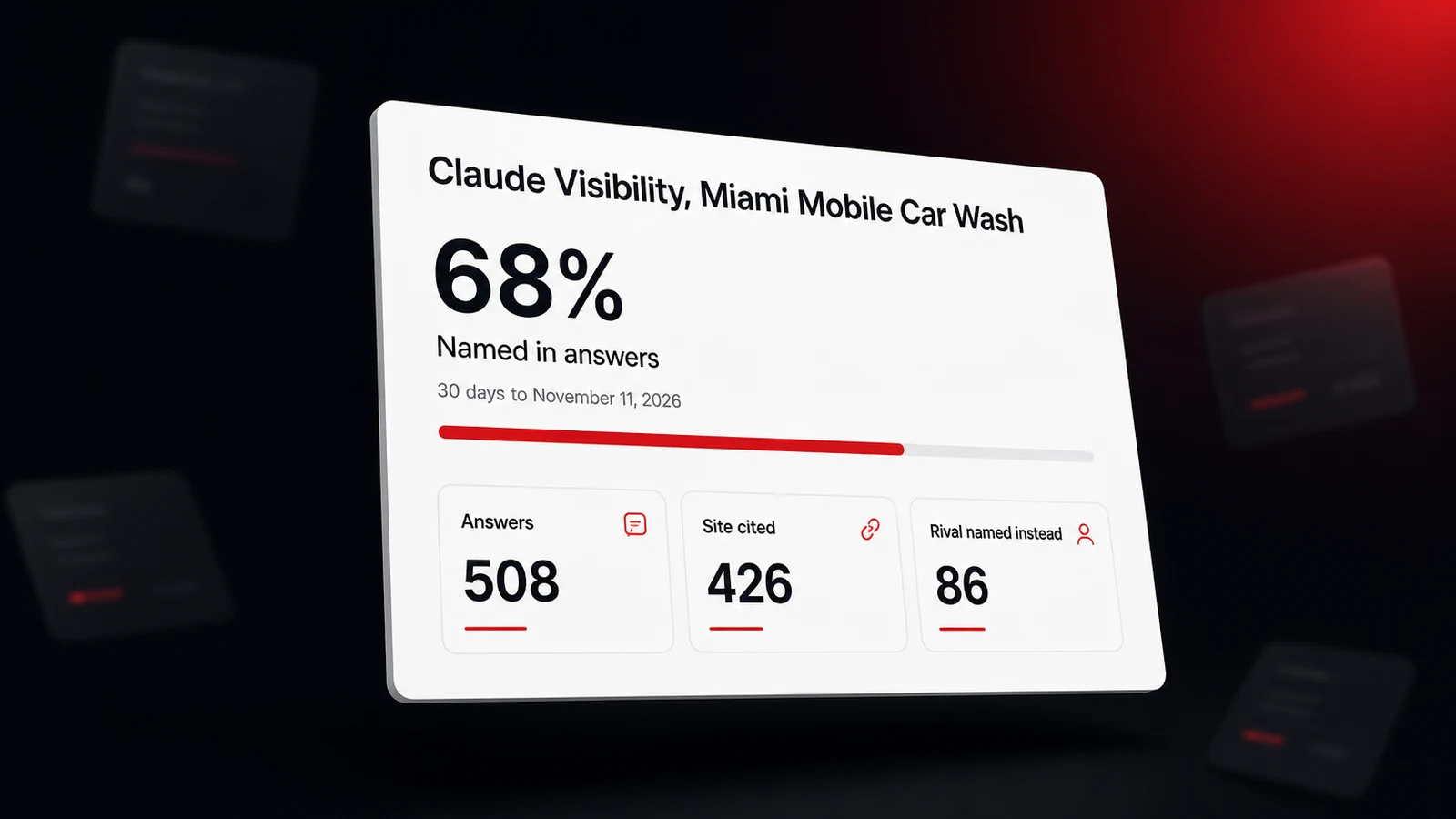
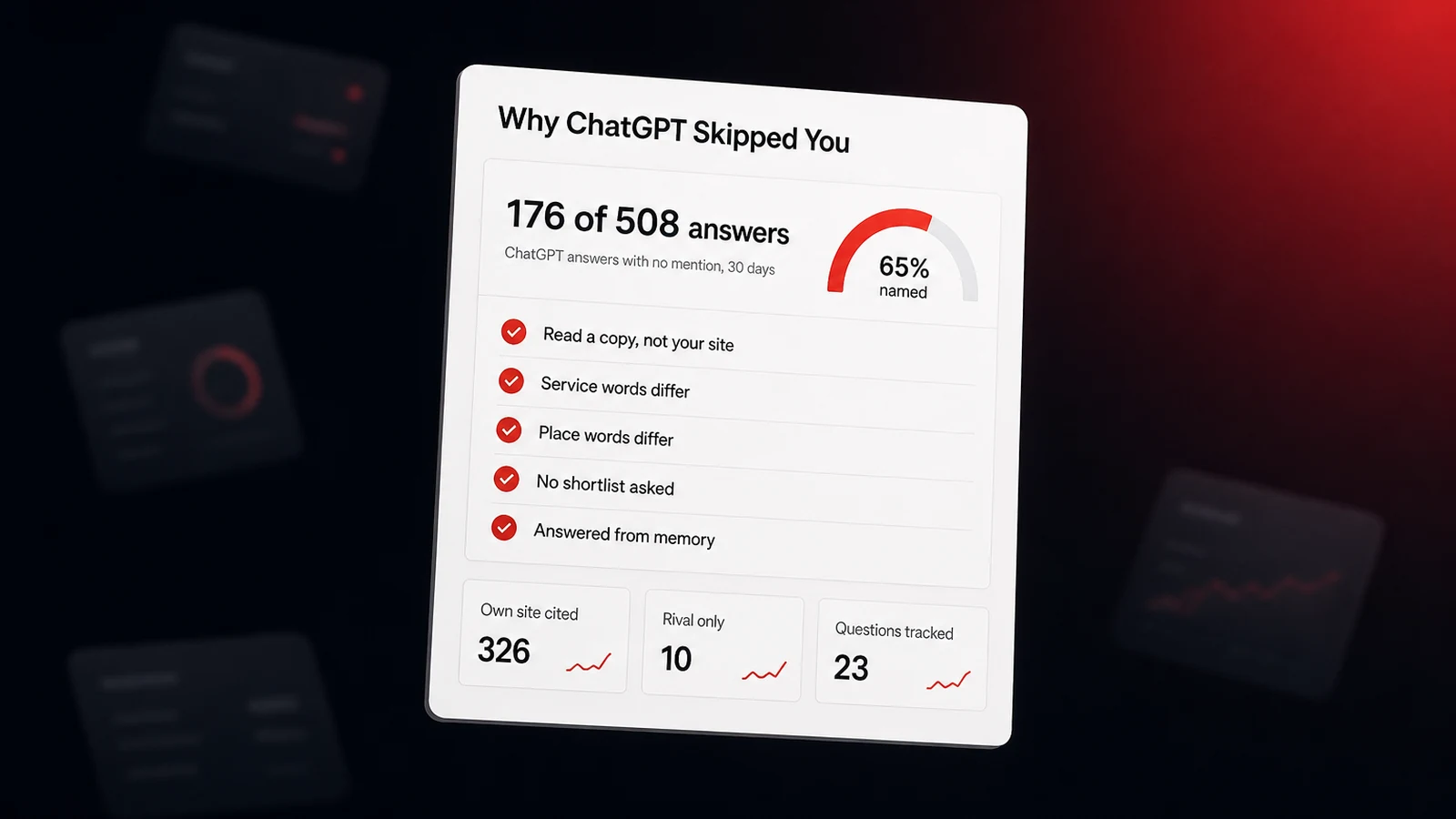
The numbers behind this post come from our AI visibility tracker, which asks ChatGPT the same local questions on a daily or weekly schedule on behalf of a Miami mobile car wash. Between October 13 and November 11, 2026, it captured 508 ChatGPT answers to 23 questions. The car wash was named in 332 of them and its own site was cited in 326. A rival was named while the car wash wasn't in only 10. That leaves 176 answers with no mention, and almost none of them were lost to a competitor. They were lost to the question or to the source ChatGPT happened to read, which is good news, because those are the two things you can change.
The sections below take these five reasons in the order you should test them, most with a real answer from that month, the tell that gives the reason away, and the fix. If you'd rather see the whole method on one screen first, the table near the end puts the reasons side by side.
Reason One, It Answered From Memory, and Its Memory Ends in April
When ChatGPT answers without searching, it's working from a training snapshot with a fixed end date. OpenAI's model page for the Instant model that ChatGPT uses lists a knowledge cutoff of April 20, 2026. A business that opened, renamed, or moved after that date isn't in the snapshot, and a small business that existed before it may have left too faint a mark to be recalled. The model doesn't say so. It names the businesses it does remember, usually the big ones, with the same confidence either way.
The tell is the absence of sources. A searched answer shows citations and a Sources button. A memory answer shows neither, and if you ask the same question twice the names move around. The test takes a minute. Open a temporary chat, ask for a shortlist in your city without searching, and note whether you appear. Then ask again with search on. If you show up only in the second answer, your problem is reason one, and the only fix is to make sure the searched version finds you, since nobody outside OpenAI can edit the snapshot. Our post on why ChatGPT holds outdated facts about a business walks through sorting memory from search in more detail, including the prompt that labels the two halves.
Reason Two, Its Search Read a Copy of You, or Nothing at All
Most local questions trigger a search, and the search is where most misses happen. On November 11, 2026, our tracker asked ChatGPT to find a mobile car wash in Miami. It named six providers, including the car wash we track, so this looks like a win. Open the sources and it's a narrower win than it looks. Five of the six got in through their own sites or booking pages. The car wash got in through a Birdeye review page, a third-party copy of its name and rating, while its own site, cited by three other assistants within two minutes of that capture, wasn't read by ChatGPT at all.
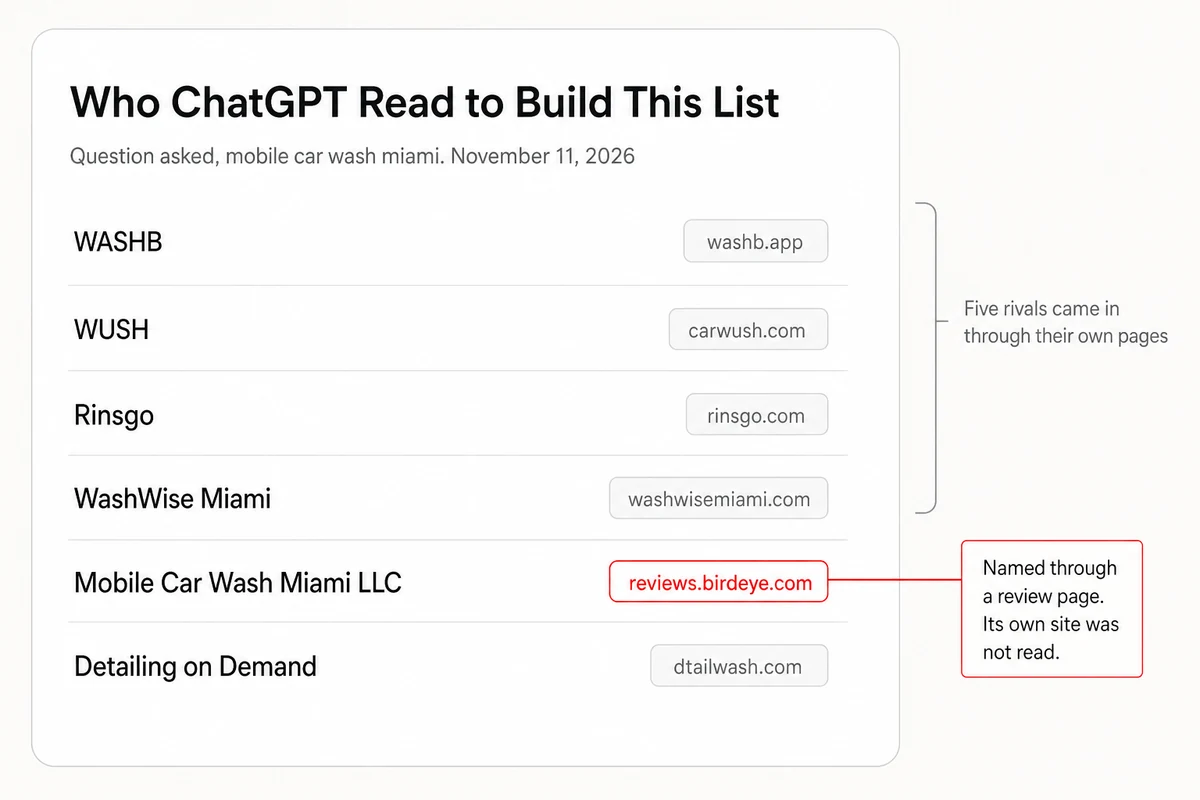
That matters because a copy can go missing or go stale on its own schedule. A review page that drops out of the index takes your name with it, and a review page with last year's rating carries that rating into the answer. ChatGPT searches its own index and outside providers rather than Google, which our explainer on which search engine ChatGPT runs on covers, so a site that blocks OAI-SearchBot, or has no page that plainly says what it does and where, can be invisible to that search even while it ranks fine on Google.
The tell is in the Sources panel. Ask for a shortlist in your city, open Sources, and look for your domain. If your name appears but your domain doesn't, ChatGPT read a copy. If neither appears, it found nothing. The fix is the same in both cases. Allow OAI-SearchBot in robots.txt, put your service and your city in the first lines of a page that exists to answer that question, and claim the copies it does read, Yelp, Bing Places, and the review platforms, so the copy at least says what your site says.
Reason Three, Your Pages Say One Service and the Customer Asked for Another
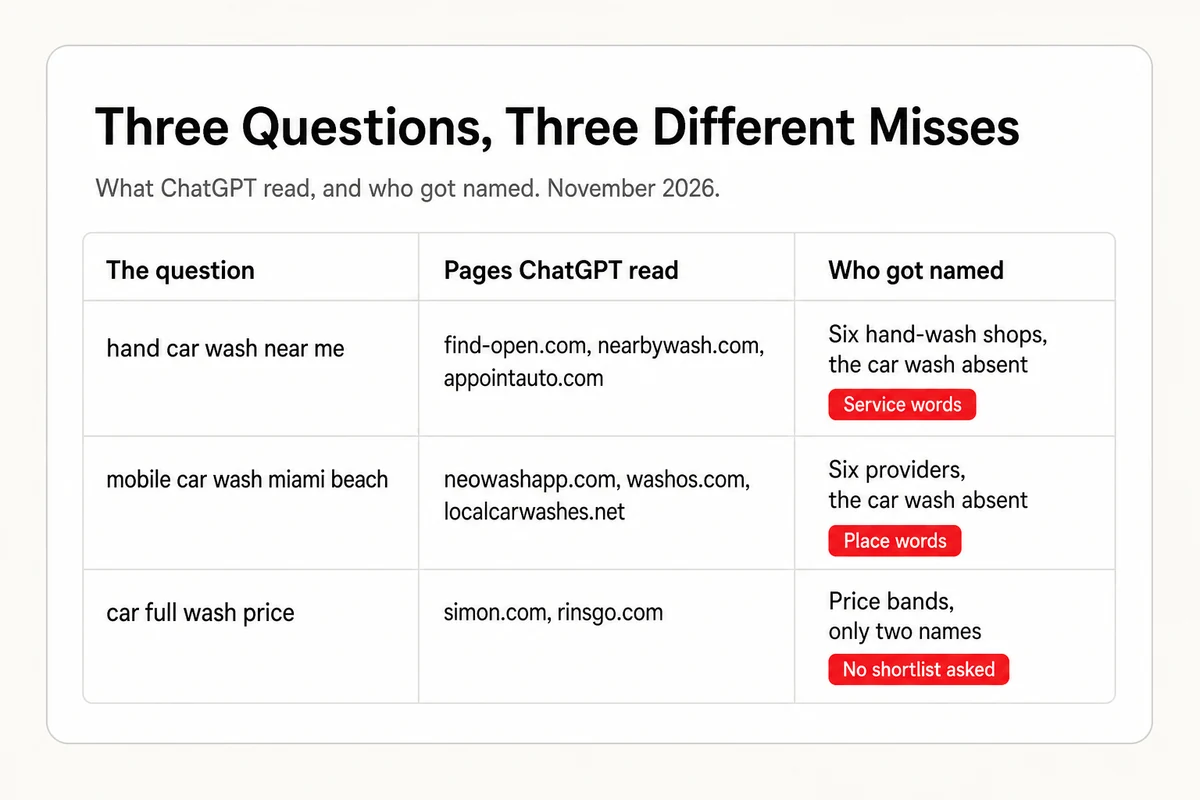
On November 6, 2026, the tracker asked ChatGPT for a hand car wash near me. ChatGPT listed six hand-wash shops, five of them pulled from directory pages, find-open.com, nearbywash.com, appointauto.com, and a mall's store listing, and one from the shop's own site. The car wash we track washes by hand at the customer's home, which is exactly what someone typing that question wants, and it wasn't named. Claude, asked the same thing at the same time, named it last, under a line that began with if you'd rather not drive. Claude had read the car wash's own site. ChatGPT had read directories built around the words hand car wash, and the car wash's pages are built around the words mobile car wash.
This kind of miss isn't about quality. The customer's words and your words describe the same service from different sides. A mobile detailer is a hand wash that comes to you. A plumber who clears drains is a drain cleaning company to the person searching at midnight. If no page of yours uses the customer's phrasing, ChatGPT's search has nothing to match, and the directories that do use it win the answer.
The test is to ask ChatGPT using three phrasings a customer would use, not the one on your sign, and note which ones you're missing from. The fix is a page per phrasing that states the service in those words, with the city, in plain sentences an answer can quote. Then check the category on each listing you've claimed, since a directory that files you under detailing never surfaces you for a wash.
Reason Four, the Place in the Question Isn't a Place on Your Pages
On November 11, the tracker asked ChatGPT to find a mobile car wash in Miami Beach. ChatGPT named six providers. Four came in through pages built for that place, a mobile-car-wash-miami-beach page on one rival's site, a Miami Beach location page on another's, and Miami Beach listings on two directories. The car wash we track has a Miami Beach service-area page of its own. Claude cited it and named the car wash second. Perplexity cited it and named the car wash first. ChatGPT didn't read it, and the car wash wasn't named.
A city name changes which pages ChatGPT's search reads, and a neighborhood name narrows the set again. Our post on tracking AI visibility for a city and its neighborhoods goes through why a ZIP code does nothing and a place name does everything. The short version is that an answer for Miami Beach is assembled from pages about Miami Beach, and a page that lists twelve service areas in a footer isn't one of them.
The tell is that you appear for the city and vanish for the neighborhood, or appear in one assistant's answer and not ChatGPT's for the same place. The test is to ask the question for each area you serve. The fix is one page per area that would stand on its own, with the place in the title, the first paragraph, and the examples, and with something on it a customer from that area would recognize, a parking rule, a condo garage, a landmark.
Reason Five, the Question Never Asked for a Business
On November 6, the tracker asked ChatGPT what a full car wash costs. ChatGPT answered with price bands, cited a mall car wash's price list and a mobile service's FAQ, and named only the two businesses whose prices it quoted. The car wash we track publishes a pricing page, and three other assistants each cited it that day. ChatGPT cited two other pages and went no further. Nobody was recommended, because the question wasn't a request for a recommendation.
Of the 23 questions we track for this business, the two that drew no mention from any assistant all month were both price questions, what to tip on a wash and what a full wash costs. Those answers name a business only when a business published the number ChatGPT needed. That's the tell. A price or how-to answer with one or two citations and no shortlist means the question wasn't a shortlist question, and your absence isn't a judgment. It's an opening. The test is to read your own question list and mark which ones ask who and which ones ask how much or how. The fix for the how-much ones is a public price page with real numbers, because ChatGPT quotes the pages that state prices and skips the ones that say call for a quote.
Run Five Tests in Fifteen Minutes
Open a temporary chat, so saved memories and past chats don't shape the answer. Our explainer on why AI recommendations differ from person to person covers how memory and approximate location bend a result. Then paste the prompt below, with your details filled in, and run it once for each area and phrasing you care about.
Without searching the web, name the top mobile car wash services in [City], [State].
Label that answer FROM MEMORY.

Now search the web and name the top mobile car wash services in [City], [State].
Label that answer FROM SEARCH, and after it list every page you read, one per line.

Finally, tell me whether [Business Name] appears in either answer,
and if it appears in the search answer, which page it came from.
Read the result against this table.
| Reason | The tell | The two-minute test | The fix |
|---|---|---|---|
| Answered from memory | No sources, names shift between runs | Same question, search off then on | Make the searched answer find you, since the snapshot can't be edited |
| Read a copy, or nothing | Your name without your domain, or neither | Open Sources and look for your site | Allow OAI-SearchBot, one plain page per service and city, claim Yelp and Bing Places |
| Service words don't match | Directories fill the list, your site is absent | Ask in three customer phrasings | A page per phrasing, matching listing categories |
| Place words don't match | Named for the city, missing for the neighborhood | Ask per area you serve | A standalone page per area |
| Not a shortlist question | Price bands, one or two citations, no list | Sort your questions into who and how much | A public price page with real numbers |
Two cautions before you act on one run. First, one answer is a coin flip. The car wash in this post was named in 65 percent of its ChatGPT answers over a month, which means a single miss on a single day proves very little, and a single hit proves less. Run each question on three different days before you file it under a reason. In October 2026, a field test of ChatGPT's local picks by Ryan Doser put twelve local questions to four assistants on one day and found ChatGPT matched Google's local top three 31 percent of the time, with about 79 percent of the businesses named coming back on a rerun. It's a small test, two cities and one day, and the author sells a tool, so take the shape rather than the decimals. That looseness is consistent with the 65 percent we saw, stable enough to diagnose and loose enough that one run misleads.
Second, since November 10, 2026, a U.S. business with an existing ChatGPT listing can claim it in Business Hub. Our walkthrough on claiming your business in ChatGPT covers the two approvals and what the profile changes. For this post, two facts matter. OpenAI says claiming doesn't move you up in its recommendations, so a claimed profile fixes none of those five reasons above. And if your business never appears in the Business Hub search at all, that's reason two confirmed from the other side. There's no listing for ChatGPT to find, and the records it builds listings from are the ones to fix first.
Get Named, Then Watch Whether the Name Holds
These five reasons share one habit. Each shows up in the sources ChatGPT read, not in anything ChatGPT says about you, so the diagnosis is always a question of which pages it opened and which it skipped. Fix the page, the phrasing, the place, or the price, and the name follows. Then keep asking, because ChatGPT rewrites its shortlist from fresh searches and a fix that worked in week one can slip in week four when a directory updates or a rival publishes a better page. Our AI visibility tracker runs that check for you every day across ChatGPT, Gemini, Claude, Perplexity, and Google AI, and keeps each answer with its sources, so the page behind each miss is there to read. The 508 answers in this post came from exactly that log, and Lighthouse Local for Business starts the same log for your own questions. A miss you can name is a miss you can fix, and the page ChatGPT read tells you its name.
Frequently asked questions
Why doesn't ChatGPT mention my business?
One of five reasons. It answered from a training snapshot that predates you, its search read a directory or review page instead of your site or found no page, your pages describe the service in different words than the customer used, the place in the question isn't a place your pages are built for, or the question asked for a price or a how-to rather than a business. The sources ChatGPT shows tell you which.
Is my business on ChatGPT?
Two checks answer it. Ask ChatGPT for a shortlist in your city in a temporary chat with search on and open Sources to see whether your site or a copy of it was read. Then search for your business in ChatGPT's Business Hub. If it appears there, ChatGPT has a listing for you. If it doesn't, there's no listing yet, and the outside records ChatGPT builds listings from are where to start.
Will claiming my business in ChatGPT make it mention me more?
No. OpenAI says claiming a business profile doesn't guarantee more visibility or give you control over ChatGPT's independent recommendations. Claiming lets you correct the facts on the profile and see mention and click counts. The reasons in this post still decide whether you're named.
How many times should I ask before deciding ChatGPT doesn't know my business?
At least three, on different days. The Miami car wash we track was named in 332 of 508 ChatGPT answers over a month, so any single day could show a miss on a question it usually wins. A reason only counts when the same miss, with the same kind of sources, repeats.
What's the fastest fix when ChatGPT can't find my website?
Check robots.txt for a rule blocking OAI-SearchBot, since OpenAI's search won't show a site that blocks it. Then make sure one page states your service and your city in its first lines in the words a customer would type. Those two changes are what let ChatGPT's search read you directly instead of through a review page.