An AI Answer Is a Set of Claims About You
Ask ChatGPT what it knows about Bluebird Heating and Air in Raleigh and you don't get a yes or a no. You get a paragraph. It says the company installs heat pumps, closes on Sundays, charges around $12,000 for an install, and had a complaint about a missed appointment. Two of those four claims are wrong or out of date, the complaint is two years old, and the customer reading them has no way to tell. That's the question this guide answers. Not whether AI names you, which our earlier walkthrough on seeing whether AI recommends you at all already covers, but what it says once it does, and how to make the wrong parts go away.
The stakes are ordinary now. In 2026, Yext reported that 47 percent of all US adults used AI to find a local business in the past month. The same report found that more than 93 percent of the people who trust AI still take at least one verification step before acting, and 48 percent cross-check the answer on another platform. So a wrong claim rarely loses you the customer outright. It sends them to your site or your reviews with a question you didn't know they had, and often with a competitor's name already in mind.
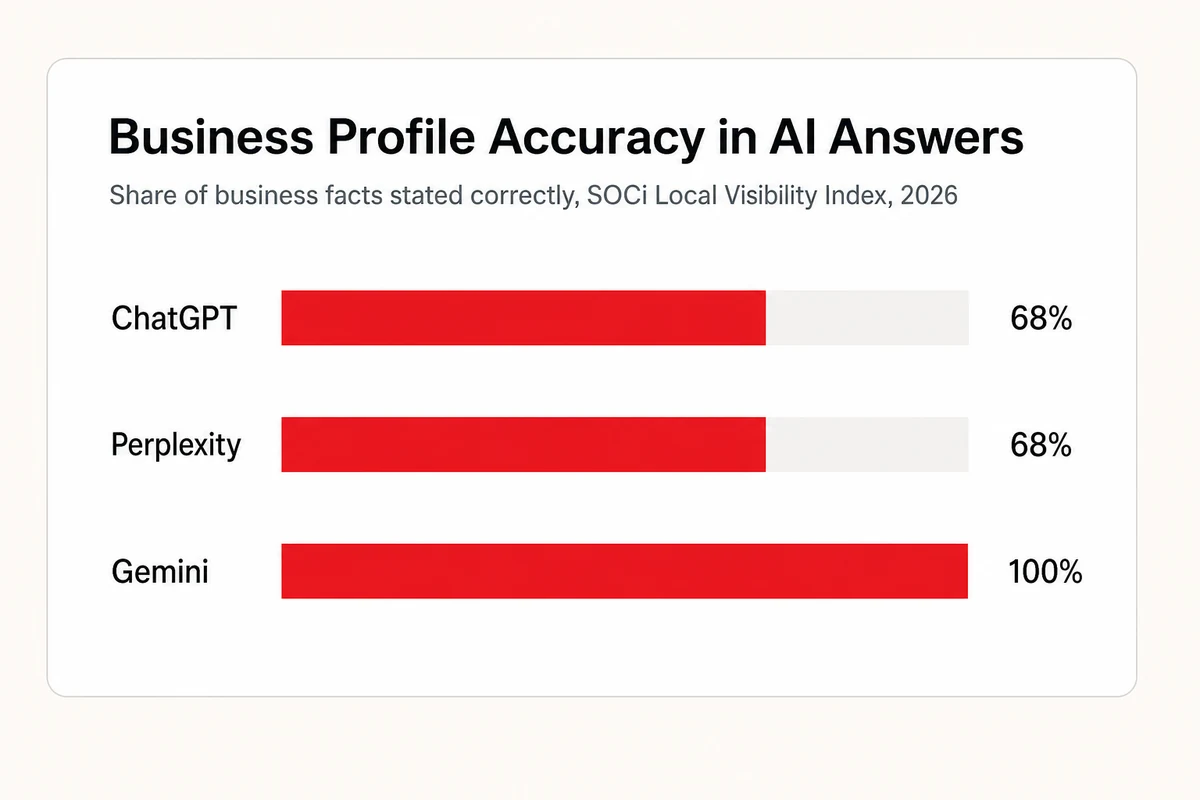
Accuracy is measurably uneven across assistants. In March 2026, SOCi put business profile accuracy at 68 percent on ChatGPT, 68 percent on Perplexity, and 100 percent on Gemini, citing its 2026 Local Visibility Index, and attributed the gap to Gemini reading straight from Google's Maps records. Roughly one claim in three from the two web-search assistants is off. That number is the reason to read every sentence of an answer, not just the line that names you.
Eight Prompts That Pull the Claims Out
Generic questions get generic answers. To surface claims, ask the assistant what a customer asks at each stage, before they know your name, once they've heard it, and when they're deciding between you and someone else. Eight prompts cover it. Replace Bluebird's details with yours and run the set in each assistant you care about. Lighthouse Local tracks ChatGPT, Gemini, Claude, Perplexity, and Google AI, and the questions work the same way in any of them.
1. Who should I call for a heat pump installation in Raleigh, NC? Name specific companies.
2. What do you know about Bluebird Heating and Air in Raleigh?
3. What are Bluebird Heating and Air's hours? Are they open on Sundays?
4. How much does Bluebird Heating and Air charge to install a heat pump?
5. Does Bluebird Heating and Air offer financing?
6. What do customers say about Bluebird Heating and Air? What are the common complaints?
7. Is Bluebird Heating and Air still in business, and where are they located?
8. Compare Bluebird Heating and Air with Capital City Comfort for a heat pump replacement in Cary, NC.
Two habits make the results worth keeping. First, run the prompts that matter most, the unbranded one and the price one, three times each in a fresh chat, since what ChatGPT says about your business shifts from one run to the next. OpenAI's own help page on searching the web with ChatGPT states plainly that "search results and citations can be incomplete, outdated, or incorrect," and a single run can land on any of the three. Second, open the sources. Every assistant that searches shows where it read the claim, and that link is the thing you'll be fixing in a minute. Paste each answer, with its source list, into one document. For Bluebird, eight prompts in each of the five we track produced 40 answers, and that stack is the raw material for the next step.
Sort Every Claim Into Four Faults
Read each answer sentence by sentence and give every factual statement one of four verdicts. It's faster than it sounds, because most sentences are fine and the faults cluster.
- Absent. The assistant answered the question and you weren't in it. On the unbranded Raleigh prompt, two assistants named three competitors each and never mentioned Bluebird.
- Wrong. The claim contradicts a fact that was never true. "Installs start around $12,000" when Bluebird's own pricing page has said from $6,800 since the day it went up.
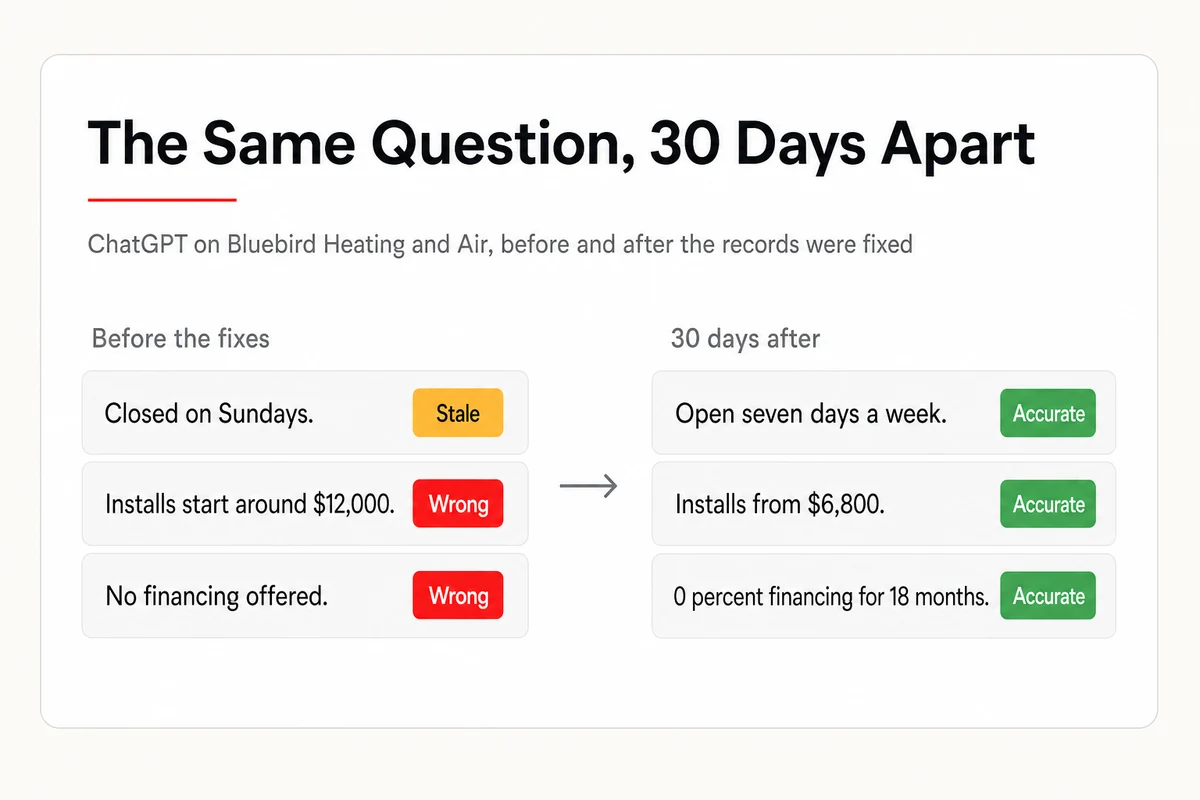
- Stale. The claim was true once. "Closed Sundays" was right until Bluebird moved to seven-day service in the spring of 2026, and four answers still said it.
- Slanted. Every fact checks out, but the framing leads with a two-year-old complaint or puts the competitor first. Two answers opened with a missed-appointment review before mentioning the 4.8-star average.
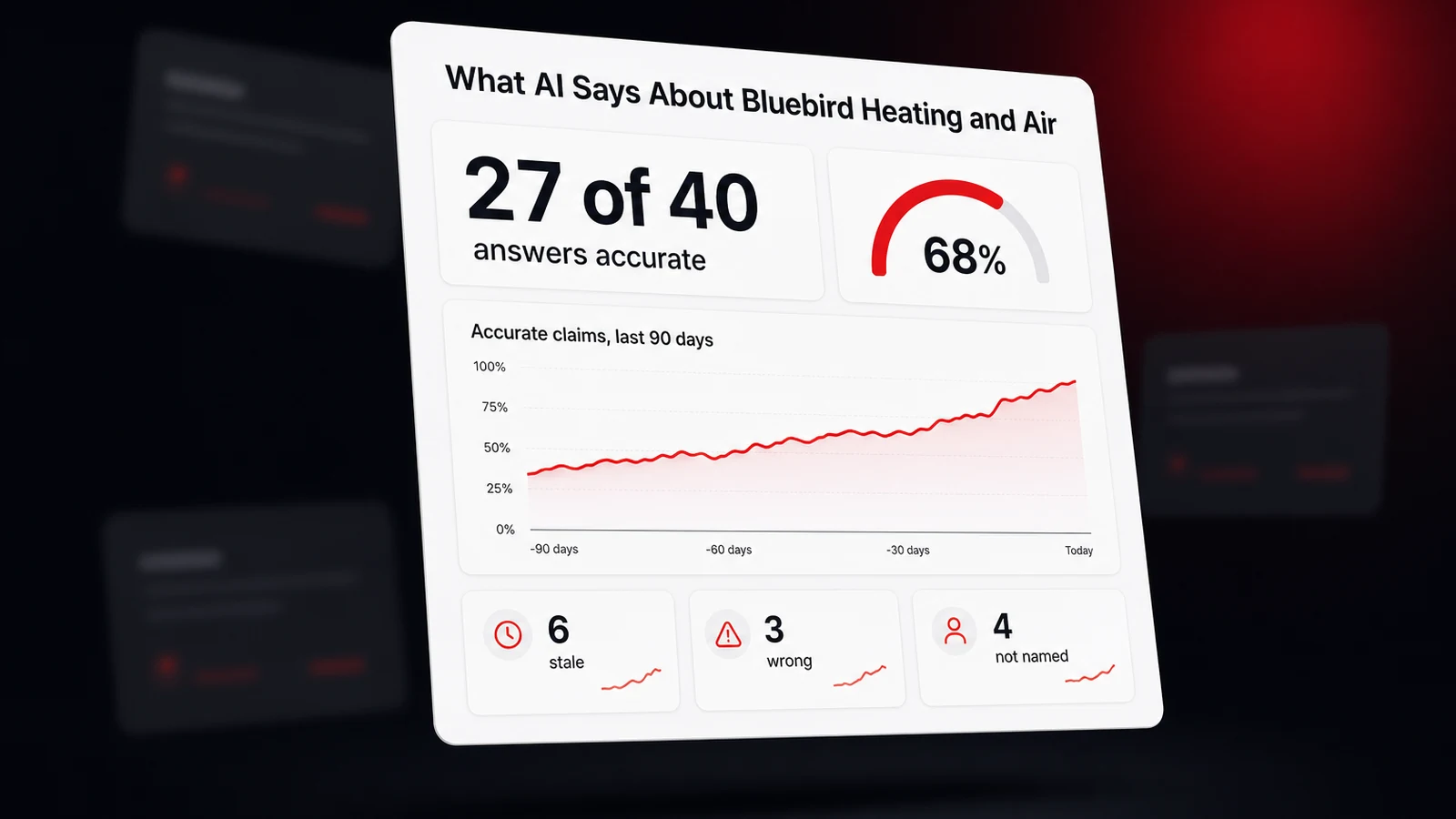
Bluebird's 40 answers sorted into 27 accurate, 6 stale, 3 wrong, and 4 absent, with the slanted flag on 2 of the accurate ones. Log the faults in a sheet with one row per claim. The columns below are the whole method, and the last two are what turn a check into a fix.
| Claim the assistant made | Verdict | Source it cited | Where to fix it | Re-check |
|---|---|---|---|---|
| "Closed on Sundays" | Stale | An old directory listing with the previous hours | Google Business Profile hours, then the directory | Oct 14 |
| "Installs start around $12,000" | Wrong | A forum thread about a different contractor | Publish a pricing page with a from price | Oct 14 |
| "No financing offered" | Wrong | Bluebird's homepage, which never said the word | Add a financing line to the homepage and every service page | Oct 14 |
| "Located on Glenwood Avenue" | Stale | A Yelp listing with the old address | Yelp, Apple Maps, and Google Business Profile | Oct 14 |
| "Customers complain about missed appointments" | Slanted | Three Google reviews from two years ago | Reply to those reviews, ask recent customers to post | Nov 14 |
| Not named for heat pump installation in Raleigh | Absent | None, the competitors were cited from directories | A heat pump installation service page, matching directory categories | Nov 14 |
Follow the Claim Back to the Record That Fed It
The source column is where the work gets specific, because each assistant reads a different set of records, and the fix lives in the record, not in the chat.
ChatGPT searches through outside providers, Microsoft's Bing among them, and rewrites your question before it sends it. Its help page notes that it takes an approximate location from your IP address, so a "near me" answer is only as good as the city it guessed, and it names OAI-SearchBot as the crawler a site has to allow before it's eligible to appear at all. What ChatGPT says about Bluebird is a summary of whatever pages that search returned, so a stale directory listing that outranks the current website turns into a stale claim.
Gemini and the Google AI answers, AI Overviews and AI Mode, read the same Business Profile record that Google Maps shows. That's why SOCi measured Gemini's profile accuracy at 100 percent. If your Business Profile is right, these are usually right, and if it's wrong, they repeat the error with complete confidence.
Claude searches the live web when a question needs current facts. Anthropic's help page on using web search in Claude says "every response includes citations, so you can easily verify sources yourself," so each claim it makes about Bluebird arrives with the page it came from. If that page is two years out of date, so is the claim.
Perplexity works from its own index plus live retrieval and shows its citations inline, so for that assistant the source column fills itself in.
The pattern across all of them is that a claim traces to one of four places. Your Google Business Profile, your own website, a review site, or a directory. Our breakdown of the records each assistant reads for local businesses ranks those four by how often they get cited. For this audit you only need to know which one fed the bad claim.
Correct the Record, Not the Chat
OpenAI's help page offers a fix for a wrong answer. "If a result looks wrong, ask ChatGPT to search again using a specific source, date, or location." That works, and it's worth doing once to watch the assistant correct itself. It also fixes exactly one conversation, yours. The next customer starts a fresh chat and gets the stale claim again. Durable corrections happen in the record the assistant read, and each fault has a home.
- Stale hours, address, or phone. Start with your Google Business Profile, because Gemini and the Google AI answers read it directly and ChatGPT's search often lands on it. Google's guide to editing your Business Profile lists every field you can change, from hours and service area to services and description, and warns that a changed name or address can mean verifying the business again. Then fix the same fields on Yelp, Apple Maps, Bing Places, and any directory the assistant cited, so the records stop disagreeing with each other.
- Wrong price or missing service. The assistant couldn't find the fact, so it filled the gap from somewhere else. Publish it in a plain sentence on your own site. "Heat pump installation in Raleigh starts at $6,800, with 0 percent financing for 18 months" is a sentence an assistant can lift whole.
- Slanted framing. Old complaints stay prominent when nothing newer outweighs them. Reply to the reviews the assistant quoted, and ask this month's customers to post, because reviews shape what AI says about you more than any other single source, and recency counts.
- Absent on the unbranded prompt. Being left out is a visibility problem more than an accuracy one, and our rundown of what gets a business recommended by AI works through it in full. The usual culprit is that the service the customer asked for has no page of its own and no matching category on your listings.
Expect a lag. Google's page on what happens to Business Profile edits says edits usually take up to 10 minutes to review but can take up to 30 days, and it notes that when Google receives reports that your information is inaccurate, it may update the profile itself and leave an alert in the Edit profile section. Check that section while you're in there. A correction Google made on your behalf is a claim you never saw. If you'd rather not run the listing cleanup and the service-page writing yourself, Lighthouse Local for Business has specialists for that, and nothing ships until you've approved it.
Watch It Free, Then Decide If You Need a Tool
The re-check column matters because the fixes take weeks to land and the answers drift on their own. Two free signals come first.
The first is your own re-run. Thirty days after the fixes, run the eight prompts again and re-grade. Bluebird's second pass moved the Sunday claim in every assistant, and the price claim in all but one, which was still reading the forum thread.
The second is Google's new report. As of August 31, 2026, Search Console's Generative AI performance report is live for every site worldwide, showing how many times links to your pages appeared in AI Overviews and AI Mode, broken down by page, country, device, and date. It counts impressions only, with no click data, so it tells you which pages Google's AI is showing, not what it said about them. That's still the earliest free evidence that a new service page is being read.
A paid tracker earns its place when hand-checking stops being sustainable, which for most owners is the third month. Our comparison of AI search visibility tools for small businesses covers current prices and what each one measures. Lighthouse Local's AI visibility tracker takes your prompt set and re-asks it on a schedule in ChatGPT, Gemini, Claude, Perplexity, and Google AI, keeps the full answer text with its sources, and flags when a description changes, so the re-grade happens without the Saturday morning. There's revenue riding on it. In June 2026, Digital Commerce 360 reported Adobe Analytics data showing AI-referred traffic to retail sites up 138 percent year over year in May 2026 and converting 54 percent better than traffic from other sources. That's retail, not HVAC, but it's the clearest 2026 measurement of what a visitor who arrives already convinced is worth.
Make the Assistants Describe You Correctly
What AI says about your business is a set of claims, each one read from a record you can edit. The eight prompts pull the claims out, the four verdicts sort them, the source column tells you which record to fix, and the re-check date makes it a habit instead of a scare. Most of the fixes are unglamorous, a profile field, a sentence on a service page, a reply to an old review. Before you start, our free AI visibility audit will scan your site and hand back a priority list of what's missing, no signup needed. Then fix the record, wait a month, and ask again. The assistants only repeat what they can find, so give them something true to find.
Frequently asked questions
What does AI say about my business, and how do I see it?
Put your customers' own questions to each assistant, branded and unbranded, and read every sentence of the answer as a claim. Eight prompts covering hours, prices, services, reviews, and a comparison with a competitor surface most of what ChatGPT, Gemini, Claude, Perplexity, and Google AI will tell a customer about you.
How often does AI get business information wrong?
In 2026, SOCi measured business profile accuracy at 68 percent on ChatGPT, 68 percent on Perplexity, and 100 percent on Gemini, which reads Google's Business Profile records directly. Roughly one claim in three from a web-search assistant needs checking.
How do I correct what ChatGPT says about my business?
Fix the record it read, not the chat. Asking ChatGPT to search again with a specific source or date corrects one conversation only. Updating your Google Business Profile, your website's service pages, and the directory or review page it cited changes what every future answer is built from.
Why does AI say my business is closed on days I'm open?
Because a listing somewhere still shows the old hours and the assistant read that one. Update hours on your Google Business Profile first, then on Yelp, Apple Maps, Bing Places, and any directory the assistant cited, so every record agrees.
Is there a free way to monitor what AI says about my business?
Yes. Re-run your prompt set monthly in each assistant, and use Google Search Console's Generative AI performance report, live for all sites since August 31, 2026, to see which of your pages appear in AI Overviews and AI Mode. Paid trackers add scheduled runs, stored answers, and change alerts.