Your Customers Ask an Assistant Before They Search
This guide scores ten AI visibility tools for local businesses on a one-location budget, from free snapshots to trackers under $100 a month, so you can see which one answers whether your customers' assistant recommends you. The last few people who found a small business near you probably never scrolled a results page. One asked ChatGPT who to call. One typed the question into Google and read the AI answer sitting above the links. That's what "AI search visibility" means for a small business. It's whether an assistant names you when someone nearby asks the kind of question you answer every day. In March 2026, OpenAI reported that ChatGPT passed 900 million weekly active users, and a share of them are your customers deciding where to spend money this week.
Small businesses have made the same switch as users. In an April 2025 survey of more than 2,200 US businesses with up to 100 employees, Intuit QuickBooks found that 68% now use AI regularly, up from 48% nine months earlier. If you're already asking an assistant to draft an email, assume your customers are asking one where to get their brakes done.
The practice of earning those mentions has a name. Generative engine optimization, or GEO, is the work of making a business more likely to be cited by AI systems that answer a question by summarizing many sources at once. The term comes from a Princeton-led study, the research paper that coined GEO, which found targeted changes can lift a source's visibility in generated answers by up to 40%. You'll also see the same idea called AEO. For this post the label doesn't matter. What matters is that a small business can now measure it, and the tools that do so have finally reached small-business prices. Most of them were built for brands with a marketing team, and AI visibility for local business is a different problem, which is why we scored them on what one location needs.
How We Rated Ten Tools for a One-Location Budget
"Top-rated" needs a rater, so here's ours. Public review sites don't cover this category well yet. Capterra shows Nightwatch at 4.8 out of 5 across 39 reviews and Localo at 5.0 across 20 reviews, while most of the newer AI trackers have a handful of reviews or none. Peec AI's Capterra listing, for one, shows zero. So we rated on fit instead, scoring each tool from 0 to 2 on five things a one-location business actually cares about, for a total out of 10.
- Entry price. Two points for a free tier or a plan under $50 a month, one for $50 to $100, zero above that or when the vendor publishes no price.
- Engine coverage. Two points for tracking ChatGPT plus Google's AI answers plus at least two more assistants, one for two or three engines, zero for a single engine or an unclear list.
- Local awareness. Two points for location-aware prompts or Google Business Profile and Maps data, one for country or city targeting, zero for none.
- Time to a first report. Two points for a free tier or a trial with no card, one for a trial or free preview with strings attached, zero for demo-only.
- Growth trap. Two points for no per-seat fees and at least 50 prompts on the entry plan, one for a small prompt count or credit budgeting, zero for per-seat or per-domain multipliers, or when the vendor says nothing.
Every price and feature below comes from the vendor's own site, opened in September 2026, so treat the numbers as a snapshot and confirm before you pay. We build a tracker too, so Lighthouse Local appears in the table but carries no score. Judge our row on the same five questions, discount it however you think is fair, and run any finalist through a trial scorecard for data quality before paying.
Start Free and Learn What You're Measuring
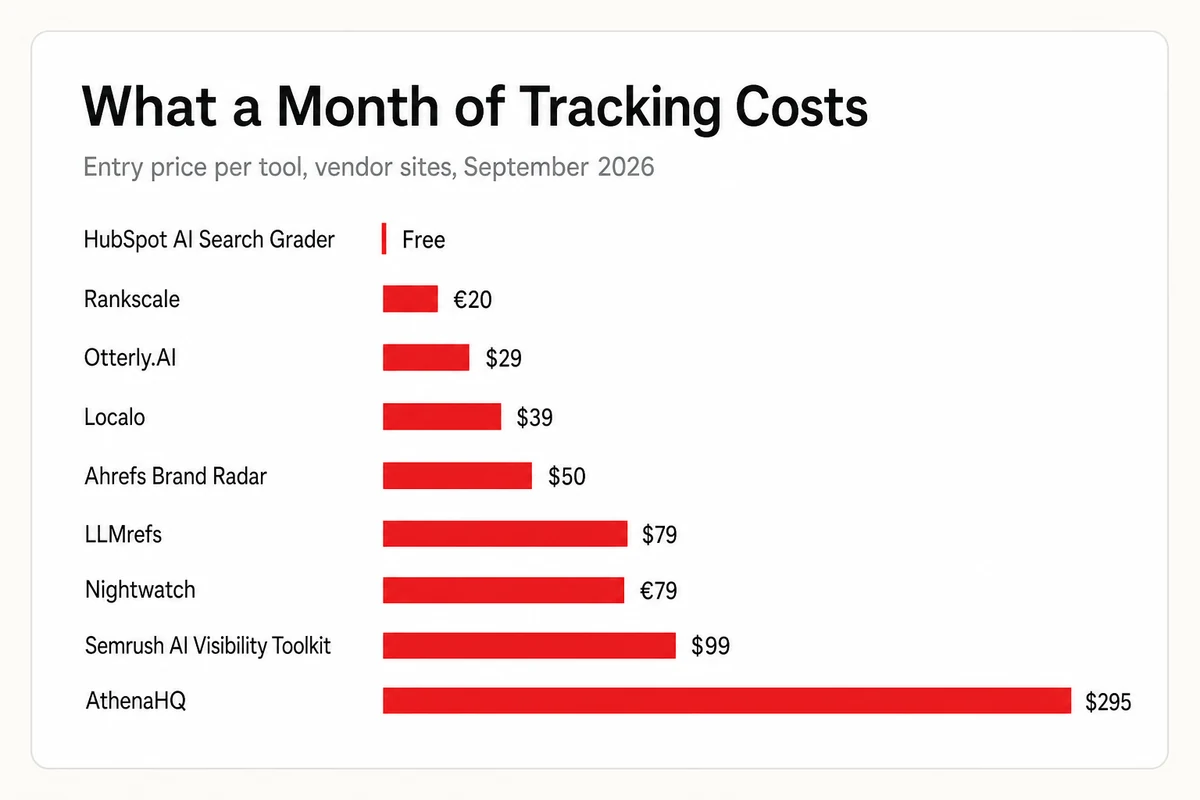
Before you pay anyone, run a free check, because it teaches you what the paid tools are selling. HubSpot's AI Search Grader is a one-time snapshot with no account required, ready in under two minutes, that checks how your brand shows up in OpenAI's GPT-5.4 mini, in Perplexity, and in Gemini. It won't watch you over time, and HubSpot sells ongoing monitoring separately, but as a first look it costs nothing. AthenaHQ's Essential tier starts you with a $25 credit worth 300 checks across five engines, ChatGPT and Copilot among them, and it's the free option that comes closest to a real tracker before its paid Starter plan jumps to $295 a month.
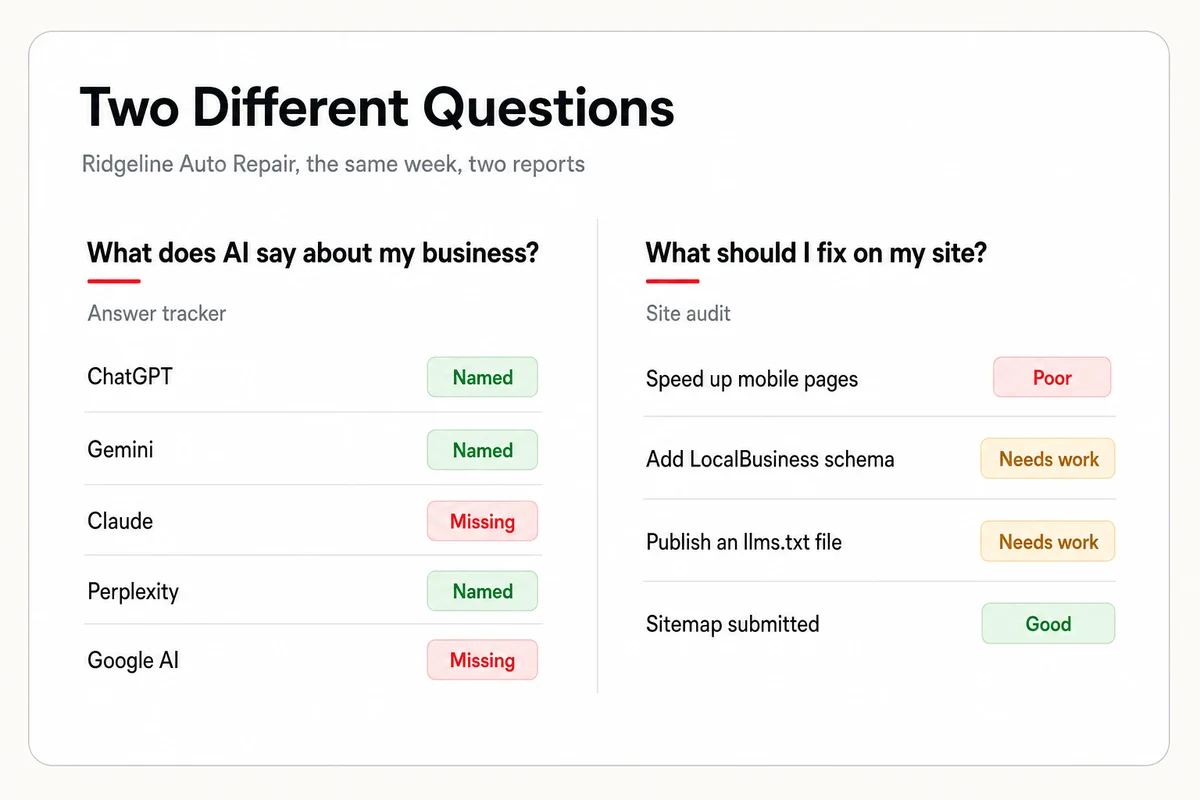
Then be clear about which question each free tool answers, because two different ones hide behind the phrase "AI visibility." One question is what the assistants say about you right now. The other is what on your own site stops them from finding and trusting you. Our free AI audit answers the second one. It scans your site's on-site signals, from schema and page speed to your sitemap and llms.txt, and returns a ranked fix list with no signup. It doesn't read what ChatGPT says about you, and no scan of your own site can. For the first question you either ask the assistants yourself, and checking whether AI recommends your business by hand takes about twenty minutes, or you pay one of the trackers below to ask on a schedule and keep the answers.
Under Fifty Dollars a Month Buys a Real Tracker
Three tools start below $50, and each makes a different trade. Otterly.AI starts at $29 a month with a free trial and tracks the same five engines we do, ChatGPT, Gemini, Claude, Perplexity, and Google AI, plus Microsoft Copilot. The trade is prompt count. Its entry plan tracks 15 prompts, so a shop with several services will feel the ceiling within a month. Rankscale starts from €20 a month on a credit system, which is the cheapest way into multi-engine tracking and also the one that makes you do arithmetic. Credits burn per engine per prompt, so ten prompts across six engines cost six times what they would on one, and you'll want to estimate that before month two.
Localo costs $39 a month on annual billing, $49 monthly, with fourteen days free and no card, and it's the one tool here that isn't an AI answer tracker. It manages your Google Business Profile, tracking your Maps positions, scheduling posts, and pulling reviews into one place. It belongs on this list because your profile is the record most assistants read first when they answer a local question, so a tidy profile sits upstream of every AI answer about you. Just don't buy it expecting to see what ChatGPT says.
The Fifty to Hundred Dollar Band Is Where Coverage Fills Out
Between $50 and $100 a month, prompt counts stop pinching and engine lists get long. LLMrefs charges $79 a month for 500 tracked prompts, unlimited seats and projects, and every engine it monitors, from ChatGPT and Google's AI Overviews through Grok and DeepSeek, with a seven-day trial and no card. For a single business that's more prompts than you'll ever write, which is the point. Nightwatch started life as a Google rank tracker and now checks ChatGPT, Gemini, Claude, Perplexity, and Google AI answers alongside your classic rankings, from €79 a month on annual billing with unlimited seats and a fourteen-day trial. It's the one paid tracker here with a real review history, the Capterra rating above.
Two SEO-suite add-ons sit at the top of the band, and both make sense only if you already pay for the suite. Semrush's AI Visibility Toolkit is $99 a month standalone with no free trial, and extra prompts cost $60 per 50. Ahrefs sells Brand Radar custom prompts from $50 a month standalone, includes them in its paid plans, and offers a free AI Visibility Checker to preview your brand first. Both are strong if your team lives in Semrush or Ahrefs for SEO, and heavy if it doesn't, because you're buying a full suite's interface to read one report. Both sit in our side-by-side AI visibility tool comparisons, row by row against Lighthouse Local, with the date we checked each vendor.
Our own Starter plan sits in this band too. Lighthouse Local for Business tracks one business site across the five we cover, ChatGPT, Gemini, Claude, Perplexity, and Google AI, with 50 tracked prompts swept weekly, three of them checked every day, three competitors, two seats, and a 30-day history, on a fourteen-day free trial. The exact figure lives on our plans and pricing so this post never goes stale. Where it differs from the trackers above is what happens after the report. Lighthouse Local specialists do the fixing, the on-page SEO, local citations, and Google Business Profile work the report points at, if you'd rather approve the work than do it yourself. Two honest limits. Starter covers one site, and we don't track Copilot or Grok.
Local Businesses Need Location in the Prompt
Most trackers were built for brands whose customers are everywhere. A one-location business has the opposite problem. Nobody asks "good dentist." They ask "dentist near me who takes new patients in Boise," and an assistant answers that with local facts, mostly pulled from Google's records and the review sites. A tracker that can't put your city in the prompt, or that runs every check from a data center on another coast, measures a question your customers never ask.
Three tools take location seriously. Yext's Scout measures performance location by location across Google Search, Google Maps, AI Overviews, and the major assistants, but it's aimed at multi-location brands, publishes no price, and routes you to a demo. Localo owns the Google Business Profile side, as above. Lighthouse Local's AI visibility tracker was built for local and service businesses first, so prompts carry your service area, and every answer is stored with whether you were named, missing, or beaten by a competitor.
The Top-Rated AI Visibility Tools for Local Businesses, Scored
Scores follow the rubric above, two points per axis, ten possible. A "not listed" means the vendor's site is silent on it, not that the feature is confirmed absent, and our own row is described, not scored.
| Tool | Entry price | Engines | Local awareness | Free start | Fit score |
|---|---|---|---|---|---|
| LLMrefs | $79/mo, 500 prompts | Ten plus, from ChatGPT and AI Overviews to Grok and Copilot | Country and language targeting | 7 days, no card | 8 |
| Nightwatch | From €79/mo on annual billing | ChatGPT plus Gemini plus Claude plus Perplexity plus AI Overviews | Local rank tracking | 14 days, no card | 8 |
| Otterly.AI | From $29/mo, 15 prompts | The five we track, plus Copilot | Not listed | Free trial | 6 |
| Localo | $39/mo annual, $49 monthly | None, Google Business Profile only | Maps positions, profile posts, reviews | 14 days, no card | 6 |
| HubSpot AI Search Grader | Free, one-time snapshot | GPT-5.4 mini plus Perplexity plus Gemini | None | No account needed | 5 |
| Rankscale | From €20/mo, credits | ChatGPT plus Gemini plus Claude plus Perplexity plus Copilot and more | Not listed | Free trial | 5 |
| Ahrefs Brand Radar | Custom prompts from $50/mo, included in paid Ahrefs plans | AI Overviews plus AI Mode plus Gemini plus Perplexity plus ChatGPT plus Copilot | Not listed | Free AI Visibility Checker | 5 |
| AthenaHQ | Free credit, then Starter $295/mo | Five on the free tier, ten on Starter | Not listed | $25 credit, 300 checks | 5 |
| Yext Scout | Not published | Google Search plus Maps plus AI Overviews plus ChatGPT plus Gemini plus Claude plus Perplexity | Location by location | Free brand check, then a demo | 5 |
| Semrush AI Visibility Toolkit | $99/mo standalone, $60 per 50 extra prompts | ChatGPT plus Google AI Mode, others not detailed | Not listed | No free trial | 3 |
| Lighthouse Local for Business | Starter and Growth plans | ChatGPT, Gemini, Claude, Perplexity, and Google AI | Built for local and service businesses, service-area prompts | 14 days free | Ours, not scored |
Ten Prompts for Ridgeline Auto Repair
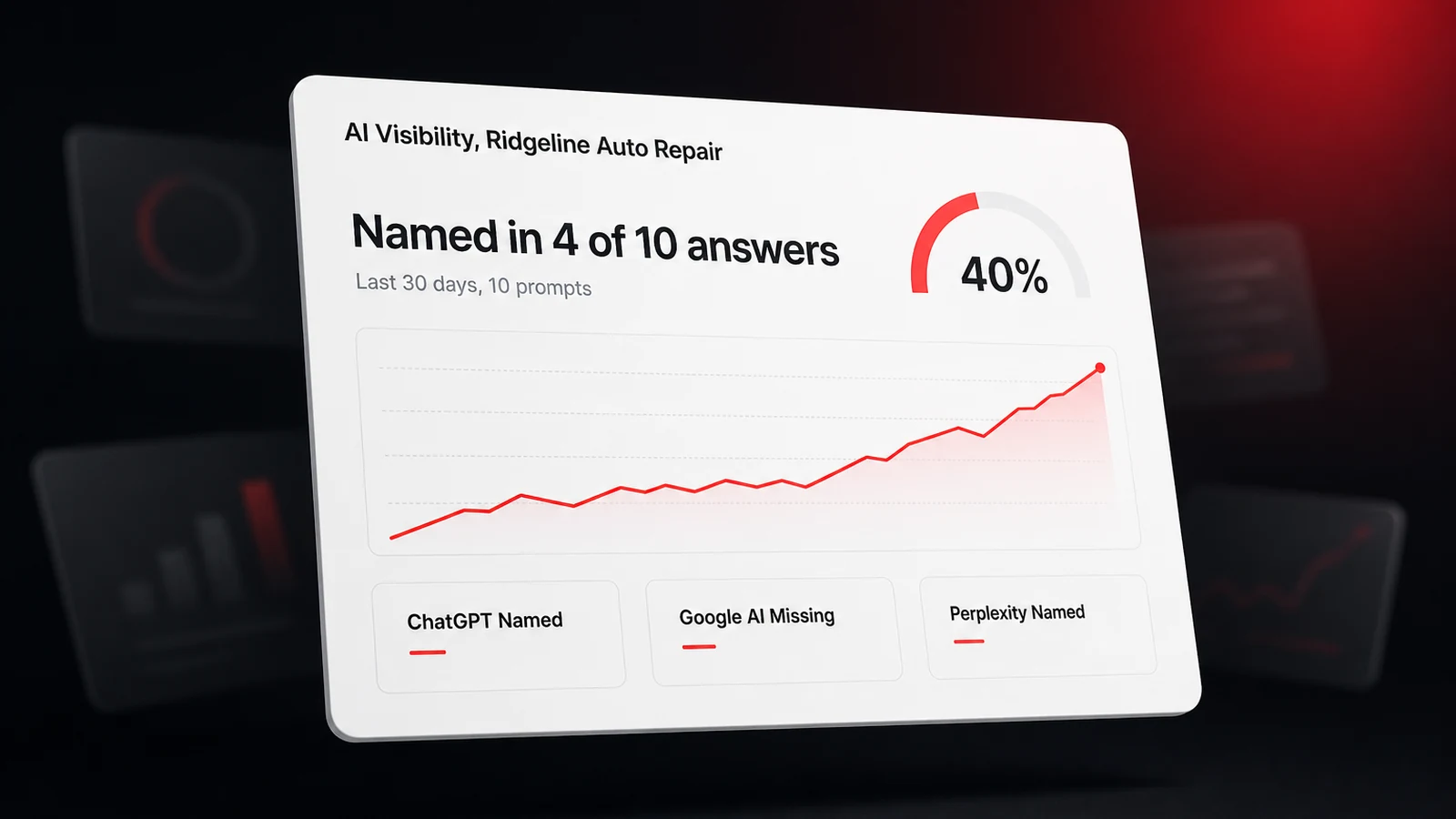
Whatever you pick, the tool only measures what you tell it to ask, and the prompts are the part most owners get wrong. Take a fictional shop, Ridgeline Auto Repair in Boise, Idaho. Three bays, one owner, no marketing hire. Its customers don't type "auto repair Idaho." They ask an assistant a question with a problem, a place, and a constraint in it. Here are ten you could load on day one. Swap the trade and the city for yours.
Who is a reliable auto repair shop in Boise for a check engine light?
Which mechanic near Boise State can do same-day brakes?
Is there an independent shop in Boise that works on Subarus for less than the dealer?
Which highly rated auto repair shops in Boise are open on Saturday?
Where can I get a pre-purchase inspection on a used truck in Boise?
Which Boise mechanics offer a loaner car or a shuttle?
Who does honest transmission diagnostics in Meridian or Boise?
Recommend an auto shop in Boise that gives a written estimate before starting work.
What does a timing belt replacement cost in Boise, and who should I go to?
Is Ridgeline Auto Repair in Boise any good?
Read the answers the way an auditor would. For each prompt on each assistant, record four things. Were you named at all. Who was named instead. Which source the assistant leaned on, a review site, your profile, or your own website. And whether the facts it stated about you were right. Do that weekly for a month and you'll have a real baseline, and a spreadsheet method for tracking AI visibility works fine before a tool does. If prompt ten comes back with the wrong hours or a competitor's phone number, you've found your first fix, and no tool found it. The question did.
Pick the Tool That Answers Your Question
If you run an agency, this list is the wrong one, because your needs are white-label and pooled pricing, and the agency comparison of AI visibility tools covers those. For one business, the decision is simpler than a scorecard makes it look. Start with a free snapshot so you know whether you have a problem. If you're missing from answers, pick a tracker under $100 that lets you write local prompts and keeps every answer, then give it a month. If the answers show you're being found but described wrong, the fix lives on your site and your profile, and the free audit will tell you which fixes come first. Pick the tool that fits your budget, then work through how to get recommended by AI so the number has somewhere to go. If you'd rather hand the tracking and the fixing to one team, Lighthouse Local for Business was built for exactly that shop. Ten tools, three price bands, one question underneath them all. When a customer down the street asks an assistant who to call, does it say your name?
Frequently asked questions
What is an AI search visibility tool?
Software that asks ChatGPT, Gemini, Claude, Perplexity, and Google AI the questions your customers ask, records whether your business is named, and tracks the change over time. It measures answers, not rankings, and it's a different product from a site audit, which finds what to fix on your own pages.
How much does AI search visibility tracking cost for a small business?
In September 2026, a single business can start tracking for somewhere between €20 and $99 a month. Rankscale starts from €20, Otterly.AI at $29, LLMrefs at $79, Nightwatch from €79 on annual billing, and Semrush's toolkit at $99. Free one-time checks exist from HubSpot and Ahrefs, and AthenaHQ starts with a $25 credit.
Is there a free way to check my AI search visibility?
Yes. HubSpot's AI Search Grader is a free one-time snapshot with no account, and Ahrefs offers a free AI Visibility Checker. You can also ask each assistant your customers' questions yourself, which is free and takes about twenty minutes. Our free audit covers the other half, what to fix on your own site.
What is the difference between GEO and SEO?
SEO earns a position on a results page. GEO, generative engine optimization, earns a mention or citation inside an AI-generated answer. The same fundamentals feed both, a fast crawlable site, accurate business facts, and reviews, but GEO is measured by whether the assistant names you, not by where a link ranks.
Do I need a tracker if my Google Business Profile is already complete?
A complete profile is the input, and a tracker is how you see the output. Assistants pull heavily from Google's records, so the profile matters, but it can't tell you whether ChatGPT names you or a competitor. A tracker, or a monthly manual check, is the only way to know.