Copy the Page, Fill It In Once a Month
An AI visibility report for a local business is one page, filled in once a month, that records how often each assistant named the business, who got named instead, what the answers got wrong, which of its pages were cited, and the one fix shipping next. The template below is that page. Copy it into a document or a spreadsheet, keep the same questions every month, and it takes about twenty minutes once your answers are in hand.
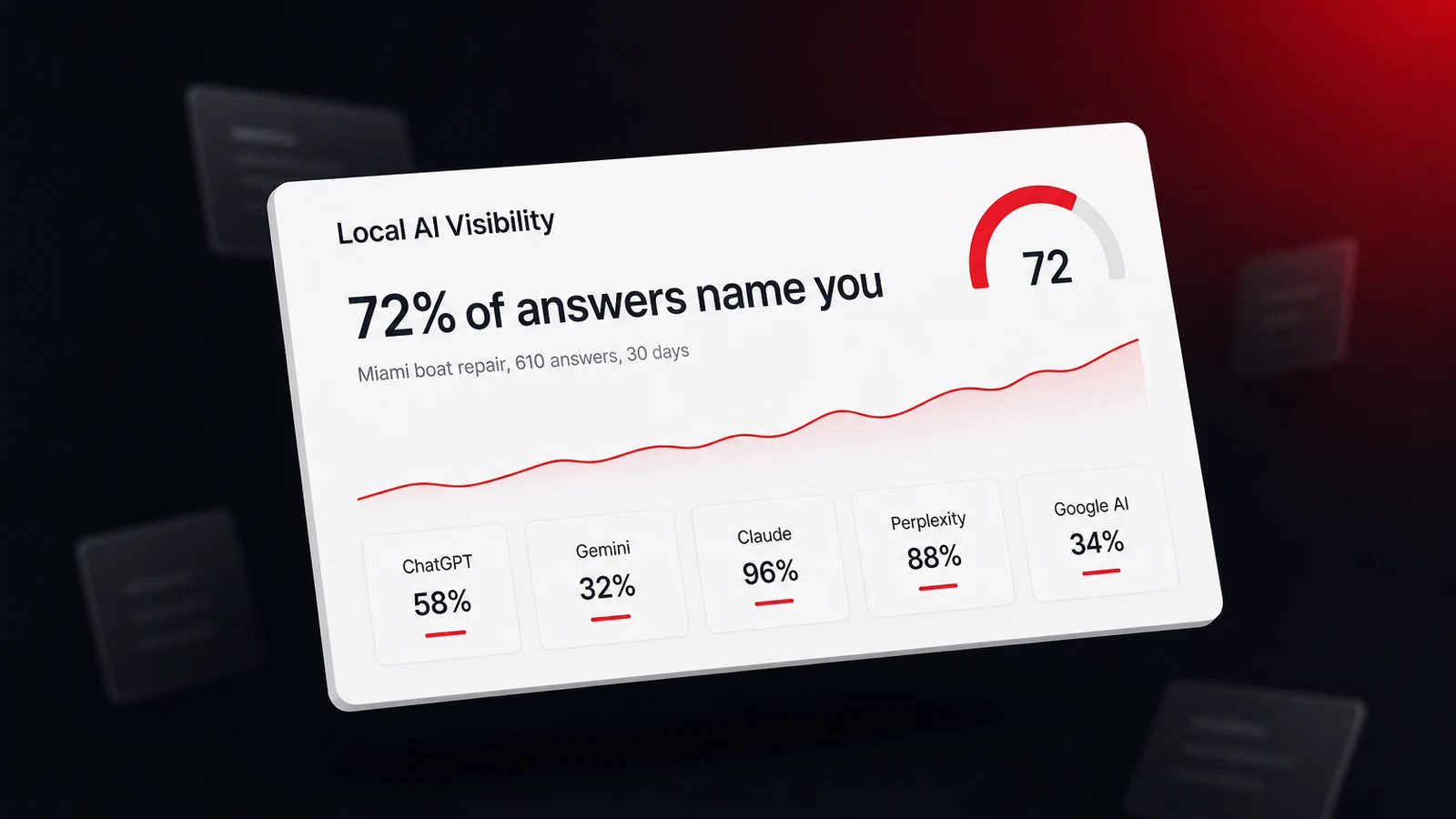
It measures a share, not a position. An AI answer is a short written list of names, with nothing like a page-one slot to hold, so the countable thing is how often you're on that list. Divide the answers that named you by the answers you checked, and that number compares fairly from one month to the next. If you already keep live feeds from Search Console and analytics, an AI search visibility dashboard sits beside this page and covers what it can't, the clicks. This page covers what the feeds can't, whether an assistant names you at all.
Two kinds of reader need the same page, an owner who checks AI once a month and wants a record, and an account manager at an agency who has to show a client where they stand in one glance. The template is written for the owner, and a later section covers the client version.
The Blank Report, Five Tables and a Header
Here's the page with nothing filled in. Every table is explained in the next section, so skim it first and come back.
| Header field | Your entry |
|---|---|
| Business | |
| Location or service area | |
| Month | |
| Prepared by | |
| Questions tracked (count) |
Table A. Named rate by assistant.
| Assistant | Answers checked | Times named | Named rate | Change vs. last month |
|---|---|---|---|---|
| ChatGPT | ||||
| Gemini | ||||
| Claude | ||||
| Perplexity | ||||
| Google AI | ||||
| All combined |
Table B. Who got named instead.
| Competitor | Times named | Which assistants | Which questions |
|---|---|---|---|
Table C. What the answers got wrong.
| Claim in the answer | Correct fact | Assistant | Fixed where (profile, site, directory) |
|---|---|---|---|
Table D. Your own pages the answers cited.
| Page URL | Times cited | Assistants |
|---|---|---|
Table E. Fixes shipped, and the one fix next.
| Type | What changed, or what will change | Where | Date |
|---|---|---|---|
| Fix shipped | |||
| Fix shipped | |||
| Fix next |
Named, Cited, and Fixed Each Mean One Thing
Header. Questions tracked is the count of distinct questions you asked. Keep the set fixed and write them the way a customer who hasn't heard of you would type them, with your real service and your real city. If you change a question, say so on the Month line, because the numbers before and after won't compare.
Table A. Answers checked is how many answers you read from that assistant. Times named is how many of them include your business name in the written answer, even as the last item on a list. A link to your site with no name beside it doesn't count. Named rate is times named divided by answers checked, as a percentage. Change is this month's rate minus last month's. Google AI covers AI Overviews and AI Mode, so ask those questions in a regular Google search. One row per assistant matters because they don't agree with each other. In September 2026, Yext's research team found that four leading AI engines chose the same top local business in 4 percent of shared tests. A combined rate hides which one is skipping you.
Table B. List every business named in an answer where you weren't. Count how many times, and note the assistants and the questions. The top two or three rows are your real AI rivals, and they're often not the competitors you'd list from memory. Every tracked question is unbranded by design, so this table fills from all of them, and it's where the gap between branded and unbranded AI answers shows up in practice, because a rival can only win a question that never named you.
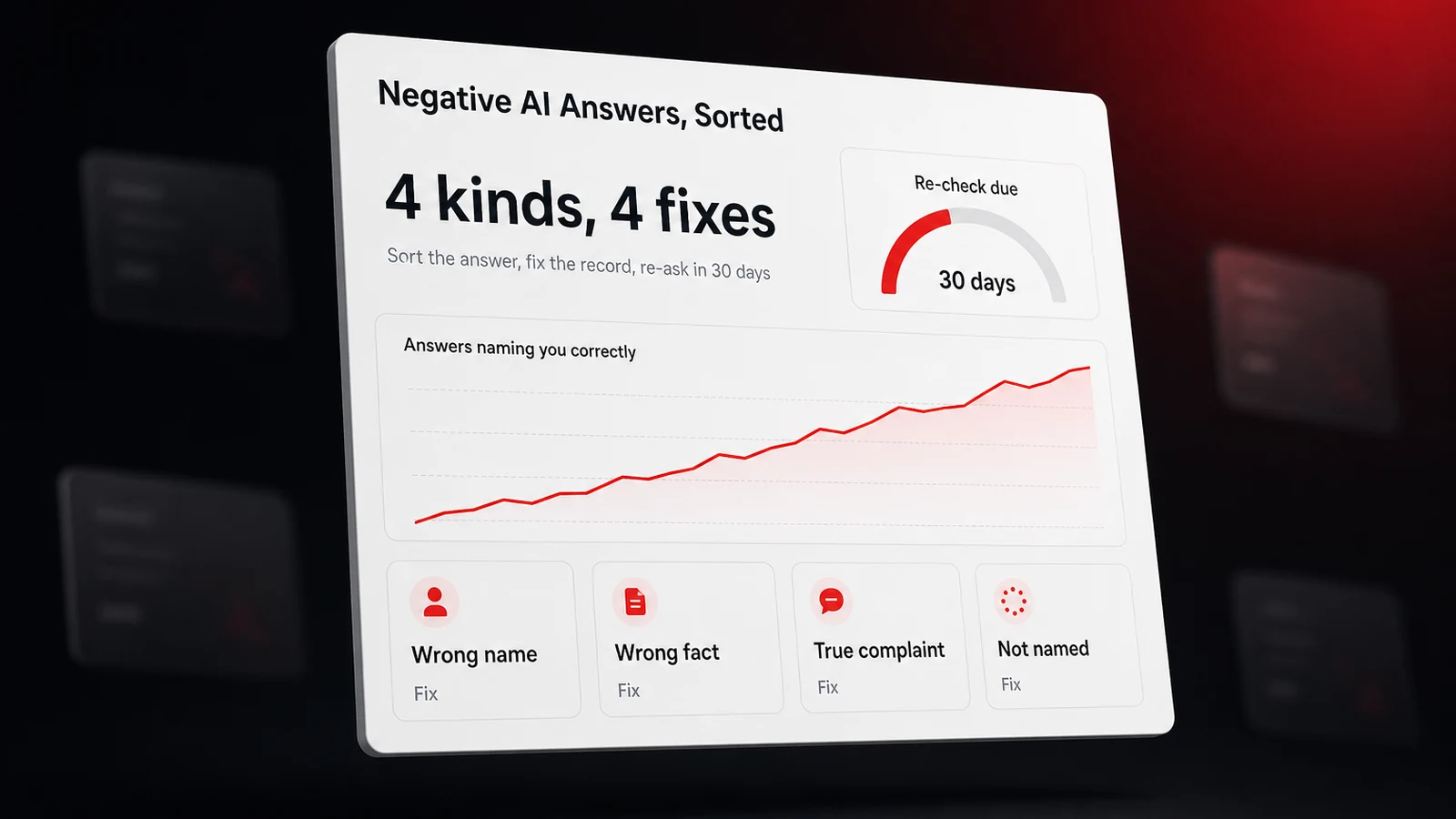
Table C. Read each answer that names you and write down every claim that's wrong or out of date, such as old hours, a former address, or a service you dropped. Put the correct fact beside it. Fixed where stays blank until you've changed the record the assistant likely read, and then you name it. A row still open at month's end moves to next month. If a claim keeps coming back, trace what AI says about your business to the record behind it and fix that record.
Table D. Cited means the assistant used one of your pages as a source, usually shown as a link or a source list beside the answer. Cited and named are separate, and they don't always travel together, but being a source helps. In a 2026 study of about 10,000 AI-cited URLs across seven answer surfaces, Scrunch found that answers citing a brand's own page named the brand about 39 percent of the time, against roughly 19 percent when that page wasn't cited. The pages in this table are the ones doing work for you.
Table E. Fixes shipped is anything you changed this month that an assistant could read, a profile field, a service page, a directory listing, a reply to a review. Fix next is exactly one item. Choose it from the lowest named rate in Table A or the most repeated wrong claim in Table C. One fix at a time is what lets you credit a change next month.
A Miami Car Wash, Filled In
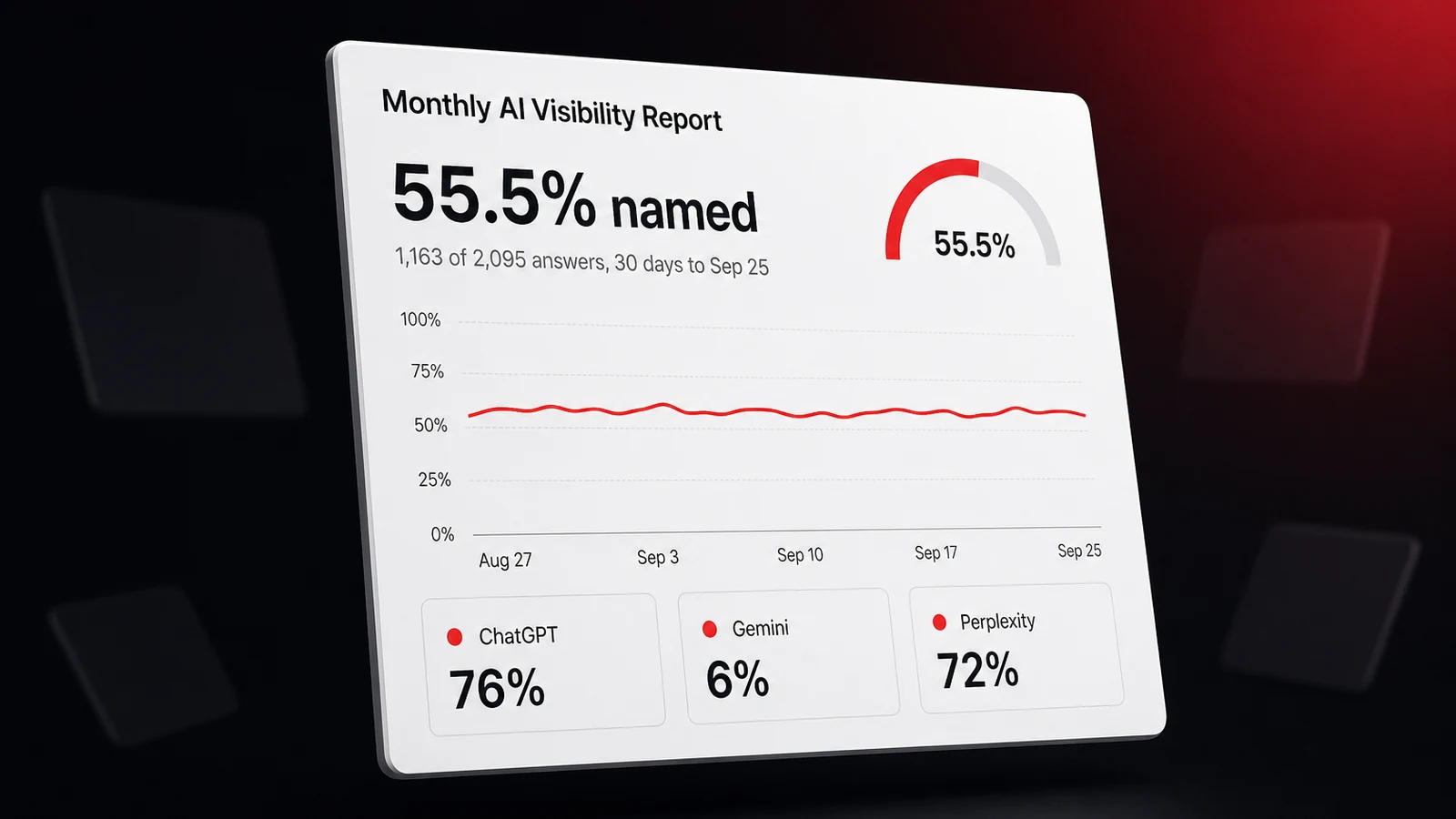
Here's Table A for a mobile car wash in Miami tracked in Lighthouse Local, covering the 30 days to September 25, 2026. The numbers come from our post on AI visibility for a local business, which gave rates for four of the assistants and a count only for Gemini and the total, so four count cells stay blank here.
| Assistant | Answers checked | Times named | Named rate | Change vs. last month |
|---|---|---|---|---|
| ChatGPT | 505 | 76% | first month | |
| Gemini | 468 | 28 | 6% | first month |
| Claude | 502 | 71% | first month | |
| Perplexity | 505 | 72% | first month | |
| Google AI | 115 | 26% | first month | |
| All combined | 2,095 | 1,163 | 55.5% | first month |
The combined 55.5 percent hides the finding. Of Gemini's 468 answers, 224 cited the car wash's own site, yet only 28 named the business. The owner's problem isn't being unfindable. It's being read and then skipped. The likeliest place to start is the record Gemini leans on most for local answers, the Google Business Profile, so that's the single line in Table E, and next month's report will say whether it moved the Gemini row.
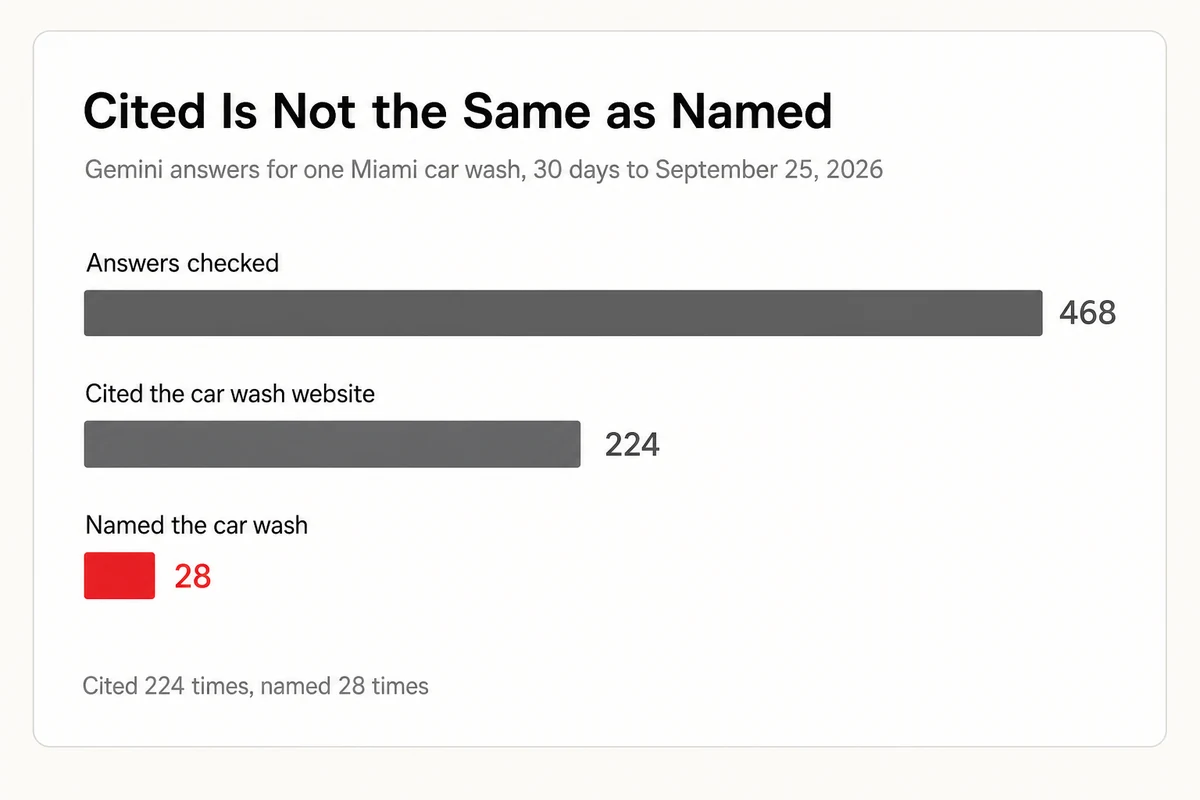
That's the whole point of Tables A and D sitting on one page. A rate on its own says you're losing Gemini. A rate beside a citation count says Gemini already reads your site and still picks someone else, which points at a different fix.
Keep the Question Wording Frozen
Use a month of answers, not a screenshot, and never reword a question between months. Both rules come from the same finding. In a May 2026 arXiv study of about 6,000 paraphrase runs and 6,000 same-prompt reruns on OpenAI and Anthropic models, two runs of the identical prompt shared only 50 to 61 percent of the businesses they listed, and two natural rewordings of the same buying intent shared just 14 to 29 percent. On those models, asking the same thing twice swaps out close to half the list. Asking a slightly different thing swaps out most of it.
For your report that means two things. A single answer on a Tuesday tells you almost nothing, so Answers checked should be as large as you can make it. And a rewritten question is a new question, with its own baseline, so the only way to read a change in Table A is to hold the wording still. By hand, three questions a week on each of the five we track is 60 answers a month, which is enough to see a big move and not enough to trust a small one, since the accuracy of an AI visibility rate depends on how many answers sit behind it. A tracker samples far more. A fixed question set and a sample you can trust are the two rules of tracking brand visibility in AI search. This report inherits both.
Three Pages Side by Side
One page is a reading. Three in a row is a trend. Lay the last three months beside each other and ask five things.
- Is any assistant's named rate moving the same direction three months running, or bouncing around one level?
- Which rival shows up in Table B every month, and on which questions does it win?
- Did a wrong claim in Table C come back after you marked it fixed?
- Which pages in Table D keep getting cited, and which service pages never appear?
- Did the fix you shipped move the assistant it was aimed at, and did the others stay put?
If the last answer is no for two months in a row, the fix probably wasn't in a record that assistant reads, so change a different record next. A Business Profile edit is the likeliest to show up first in Google's own assistants. A new service page is likelier to show up in assistants that pull from the open web. Matching the fix to the row is most of the skill.
The Client Version Is the Same Page
If you run this for clients, don't build a bigger report. Build this one with the client's name in the header. In a 2026 survey of 602 US marketing and PR professionals, Scribewise found that 71 percent of agencies offering AI search work spend more time explaining it than doing it, and 80 percent said clients still read the results through a traditional SEO lens. A page with five rows and a named rate ends that conversation faster than a deck does, because a client can see in one glance that Gemini names them 6 percent of the time and ChatGPT 76.
Fill Table E in the client's language, with the fix you're billing for and the date it shipped, and the next month's page becomes the proof. One page per client, every month, is a recurring service in itself, and Lighthouse Local for Agencies runs the same tracking for every client from one account under your own brand.
Fill the Page, Then Fix One Thing
Copy the tables, ask the same questions on one fixed day every week, and fill in the page at month's end. If you'd rather not tally answers by hand, our AI visibility tracker inside Lighthouse Local for Business captures the answers from each assistant it tracks and keeps the named counts, the rivals, and the cited pages, so the page takes minutes instead of an evening. To seed Table E with a ranked fix list for your own site before the first month is up, run a free AI audit, no signup needed. The report is the habit. The one fix at the bottom is the work.
Frequently asked questions
What should an AI visibility report for a local business include?
Five things on one page. How often each assistant named the business over the month, which competitors were named instead, what the answers got wrong, which of the business's own pages were cited, and the fixes shipped plus the one fix coming next. A header records the business, the month, and the fixed set of questions asked.
How do I calculate an AI visibility named rate?
Count the answers you checked from one assistant, count how many of them include your business name in the written answer, and divide the second by the first. Keep one rate per assistant, because they rarely agree, and keep the same questions every month so the rates compare.
How many AI answers do I need before the report means anything?
As many as you can get. In a 2026 study, the same model asked the same question twice shared only about half the businesses between the two lists, so one answer is noise. Three questions on each of the five we track, once a week, gives about 60 answers a month, enough to see a large move. A tracker samples far more and makes small moves readable.
What's the difference between being cited and being named in an AI answer?
Cited means the assistant used one of your pages as a source for the answer. Named means your business appears by name in the written answer. They often diverge. An assistant can read your site, list it as a source, and still recommend someone else, which is why the report tracks both.
Can an agency use this AI visibility report template for clients?
Yes. Put the client's name in the header, fill Table E with the fix you're billing for and the date it shipped, and hand over the same page every month. Lighthouse Local for Agencies runs the tracking for every client from one account, under the agency's own brand.