A Citation Is a Source Line, a Mention Is the Recommendation
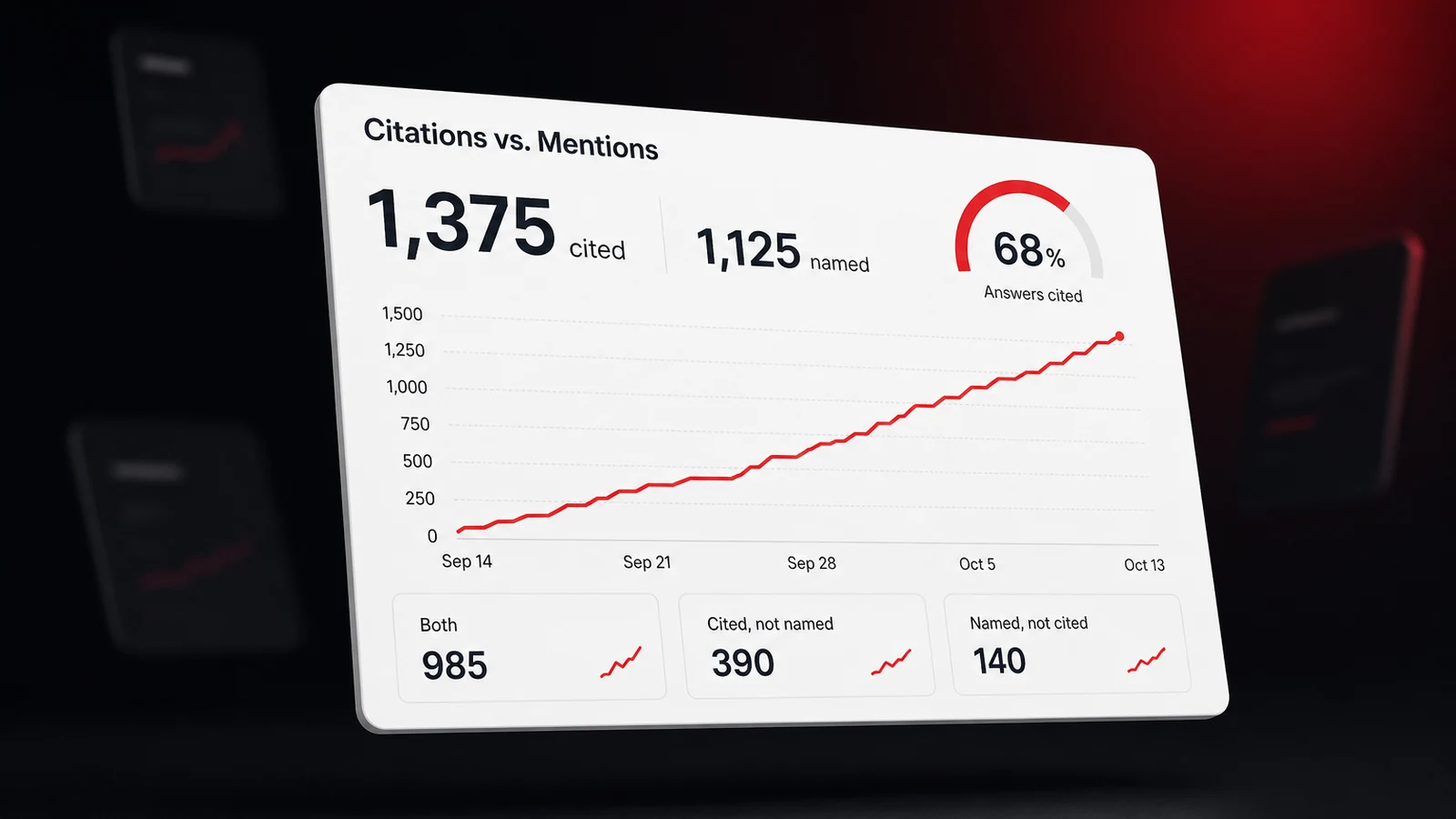
Citations matter in AI search, but as proof the assistant can read you rather than as the prize. A citation is one of your pages listed among the sources an assistant used. A mention is your business's name appearing in the text of the answer, which is the part a customer actually sees. An assistant can cite you without naming you, and it can name you without citing you, and in our tracker both happen every day. Across 2,015 answers captured for one Miami mobile car wash in the thirty days to October 13, 2026, the business was cited in 1,375 answers and named in 1,125. The two overlapped in 985. That leaves 390 answers where an assistant read its pages and never said its name, and 140 where it said the name without listing any of its pages as a source.
Those two leftover piles are the subject of this post, because each one has a different cause and a different fix. Site authority, the backlink score tools like Moz and Ahrefs publish for a domain, gets blamed for both. The recent studies say it decides much less about citations than owners assume, and our own numbers agree on that side. For mentions, the studies find it counts for almost nothing on its own. We'll take citations first, then mentions, then what to do about whichever one you're missing.
Three Assistants Read the Car Wash's Price Guide and None Said Its Name
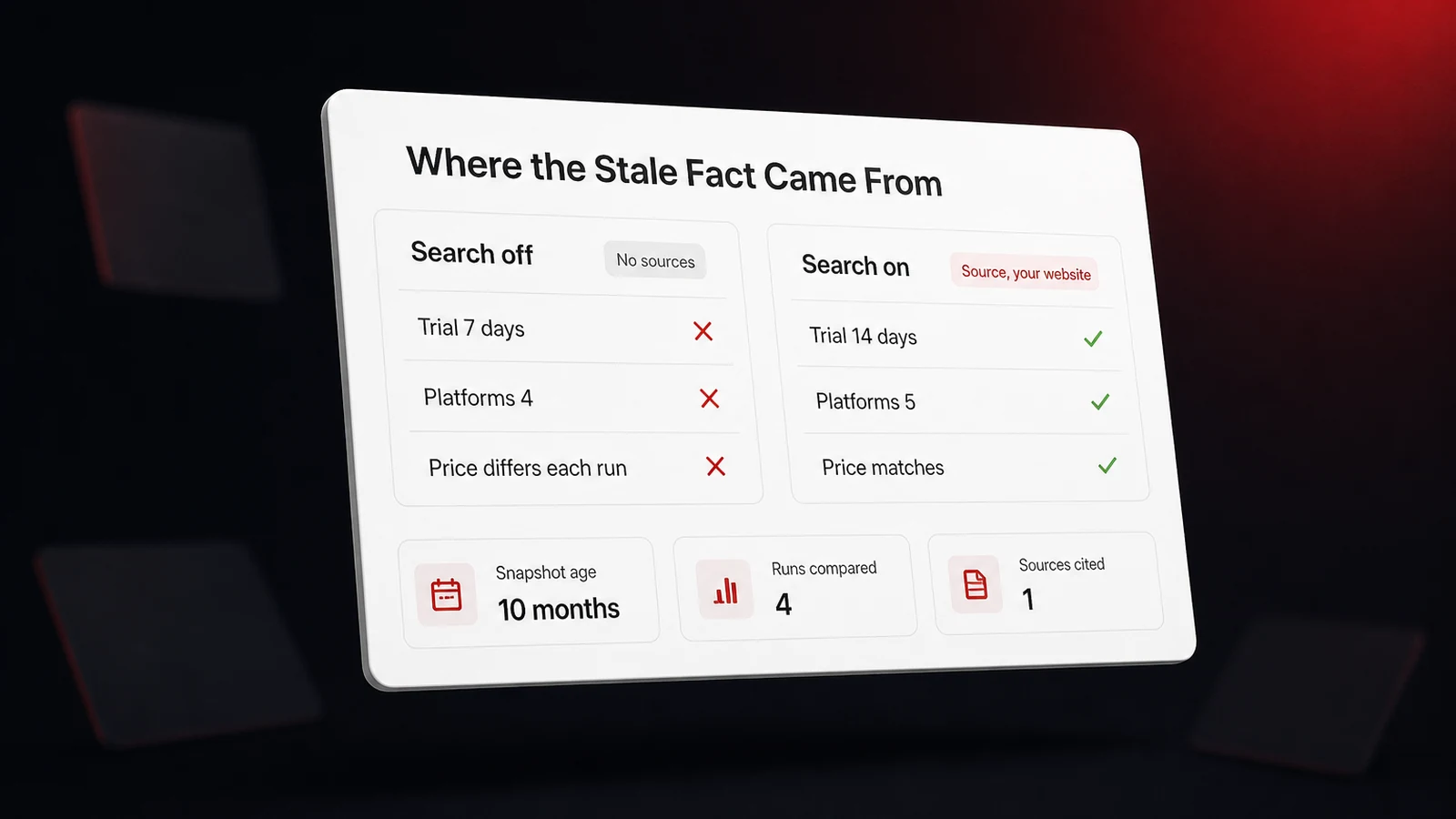
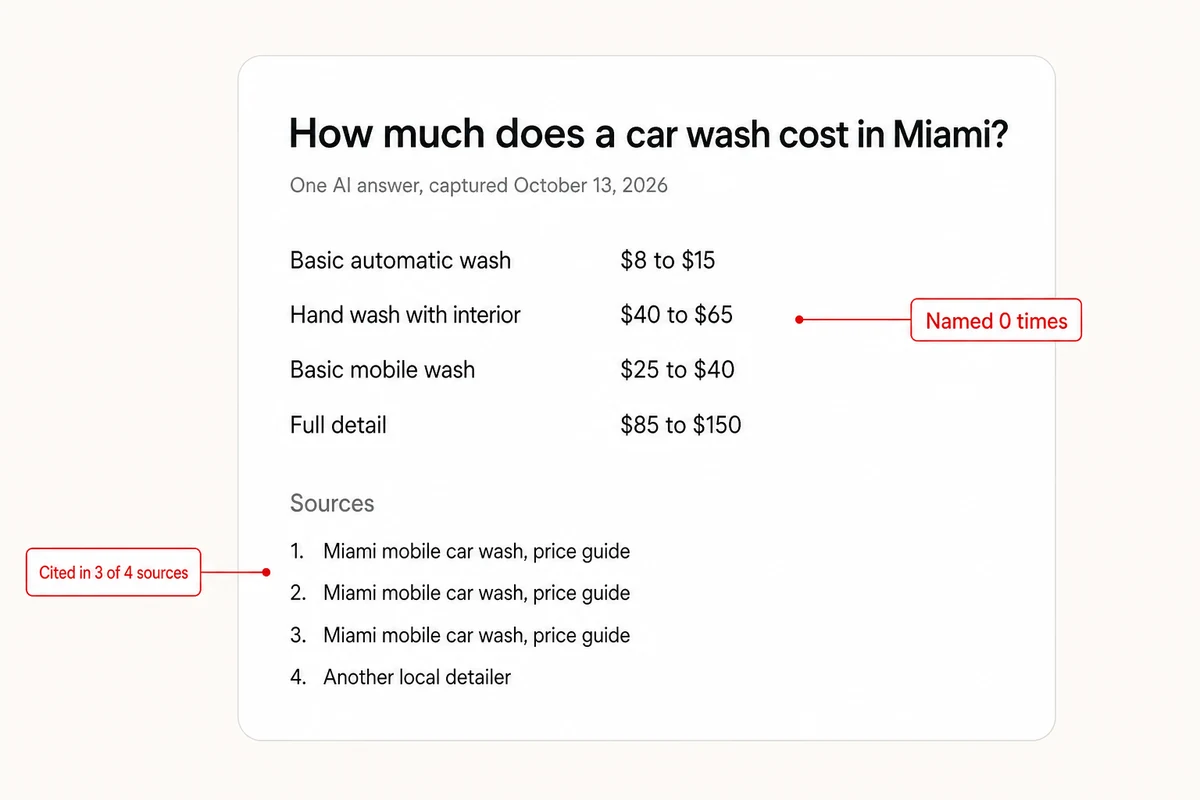
Here's what a price question does to a local business. On October 13, 2026 our tracker asked each of the five we track, "How much does a car wash cost in Miami?" Claude's answer listed price bands for automatic, hand, and mobile washes, from $8 to $15 for a basic drive-through up to $85 to $150 for a full detail. Its first three sources, out of four, were the same page, the car wash's own guide to washing a car in Miami, which is where every one of those numbers came from. The business was named nowhere in the answer. Perplexity put the car wash's price page first and its subscription page second, four of its ten sources, and named no business in its text, the same cited-but-unnamed pattern our study of getting your business recommended by Perplexity traces across forty sources. Gemini used the car wash's pages in seven of its 29 source slots and named three other washes instead. ChatGPT skipped the site and named four competitors with their prices. Google AI Overview skipped it too. Three of the five we track used the business's own pages to write their answer. Zero said who the business was.
Zoom out and the habit shows up as a split by assistant. Over the ninety days to October 13, Gemini cited the car wash in 542 answers and named it in 66. ChatGPT ran the other way, naming it in 1,018 answers and citing it in 442. Same business, same questions, opposite behaviors. ChatGPT tends to say the name and skip the link. Gemini tends to use the page and skip the name. If you only count one of the two, you'll conclude the business is invisible on one assistant and everywhere on the other, and both conclusions are wrong.
The other business we track in the same city tells a different story, and the question mix is the likeliest reason. For a Miami boat repair shop over the same thirty days, 590 answers produced 432 mentions and 398 citations, and 366 of them were both. All nine of its tracked questions ask who does the work, a mobile boat mechanic, boat electrical service, boat repair in Miami, and the assistant that reads the shop's site usually goes on to name the shop. Six of the car wash's 23 questions ask about prices or what to pay, and a price answer tends to quote the numbers and leave the name out, since a price question doesn't ask who does the work. That's a reading of two businesses, not a controlled test, but it's one you can check against your own prompts in an afternoon. A business whose pages are full of useful prices and short on its own name is mostly building citations.
How Often a Mention Carries a Link
The two signals come apart on every assistant, and the gap between them has been measured. In November 2025, Ahrefs went through more than 31,000 mentions of its own brand in AI answers and checked how many of those mentions included a link to its site. The share ran from about one in ten on Google's AI Overviews to about half on Perplexity.
| Assistant | Mentions that included a link |
|---|---|
| Google AI Overviews | 10.7% |
| Gemini | 16.8% |
| ChatGPT | 26.9% |
| Google AI Mode | 36.8% |
| Perplexity | 51.6% |
Seer Interactive measured the same direction at a larger scale and found a wider split. In March 2026, it examined 541,213 AI responses across 20 brands. When a brand was named in an answer, its content was cited in 53.1 percent of answers that mentioned the brand. When the brand wasn't named, that fell to 10.6 percent. A named brand came with a link about five times as often. Seer's data doesn't say how often the reverse holds, how often a link brings a name with it, but one of its cases shows how far the two can drift apart. One client's blog post was cited more than a hundred times over 25 days without the brand being named once. Seer calls those ghost citations, and a page can collect them indefinitely without ever getting its owner into the sentence.
Our own site is a clear example of a ghost citation. In the thirty days to October 13, our tracker captured 1,831 answers to questions about AI visibility tools and checks, and lighthouselocal.ai was cited in 67 of them and named in 15. Perplexity alone cited us 29 times and named us once. Our pages get read when an assistant explains the subject, and our name comes up far less often when it picks a tool. That's a mention problem, and a mention problem has a different fix than a citation problem, as the next two sections show.
What Site Authority Does to a Citation
Site authority is where the recent evidence disagrees with itself, so here's the honest version. In November 2025, SE Ranking analyzed 129,000 domains and 216,524 pages cited by ChatGPT and found domains with a Domain Trust score under 43 averaged 1.6 citations, while domains above 90 earned almost four times as many. Surfer looked at about five million citation URLs across four engines over three months and found the opposite, a correlation between domain score and citation frequency of minus 0.051, which its author called close enough to zero to be noise. Both are vendor studies, and both are measuring something real. One reading fits both, and a third study supplies it.
In March 2026, AirOps traced 15,000 prompts through ChatGPT's search step and found that of 548,534 pages the assistant retrieved, only 15 percent were cited in the final answer. Pages ranking first on Google were cited 43.2 percent of the time. But once a page had been retrieved, authority stopped helping. Retrieved pages from domains with a Domain Authority below 80 went on to be cited 21.5 to 23.6 percent of the time, and pages from domains at 80 to 100 only 15.0 percent. Counted by share of all citations rather than per domain, the 20 to 40 band took 26.0 percent against 25.4 percent for 80 to 100. On that reading, authority gets a page into the search results the assistant reads, and it doesn't earn the citation once the page is on the table. It fits SE Ranking, if its biggest domains collect more citations by ranking for more queries, and it fits Surfer, where a domain's score barely tracks how often it's cited. Featured's audit of 22,881 Perplexity citations from the summer of 2026 found the median cited domain had a Domain Authority of 37, counting each domain once, and that 34.5 percent of citations, counting each citation, went to domains under 40.
For local questions the pattern is flatter still, and we can show it. Next to every domain an answer cites, our Sources page shows a backlink authority score from 0 to 100. For the Miami car wash, 317 outside domains were cited 22,420 times in the thirty days to October 13. Counting citations rather than domains, domains scoring under 16 took 46 percent of them, and domains scoring zero, with no backlink profile to measure, took 26 percent on their own. The top band, 71 and above, took 25 percent, and three quarters of that was five giants, Google, Yelp, Reddit, the Better Business Bureau, and Facebook, so per domain the big names still win by a wide margin. The point is what happens below them. The single most-cited zero-score domain was a rival mobile wash, cited 932 times in a month, more than Reddit and the Better Business Bureau combined. The boat shop's answers ran the same way. Of 5,608 citations to 137 outside domains, 56 percent went to domains scoring under 16, 28 percent to domains scoring zero, and 11 percent to the top band.
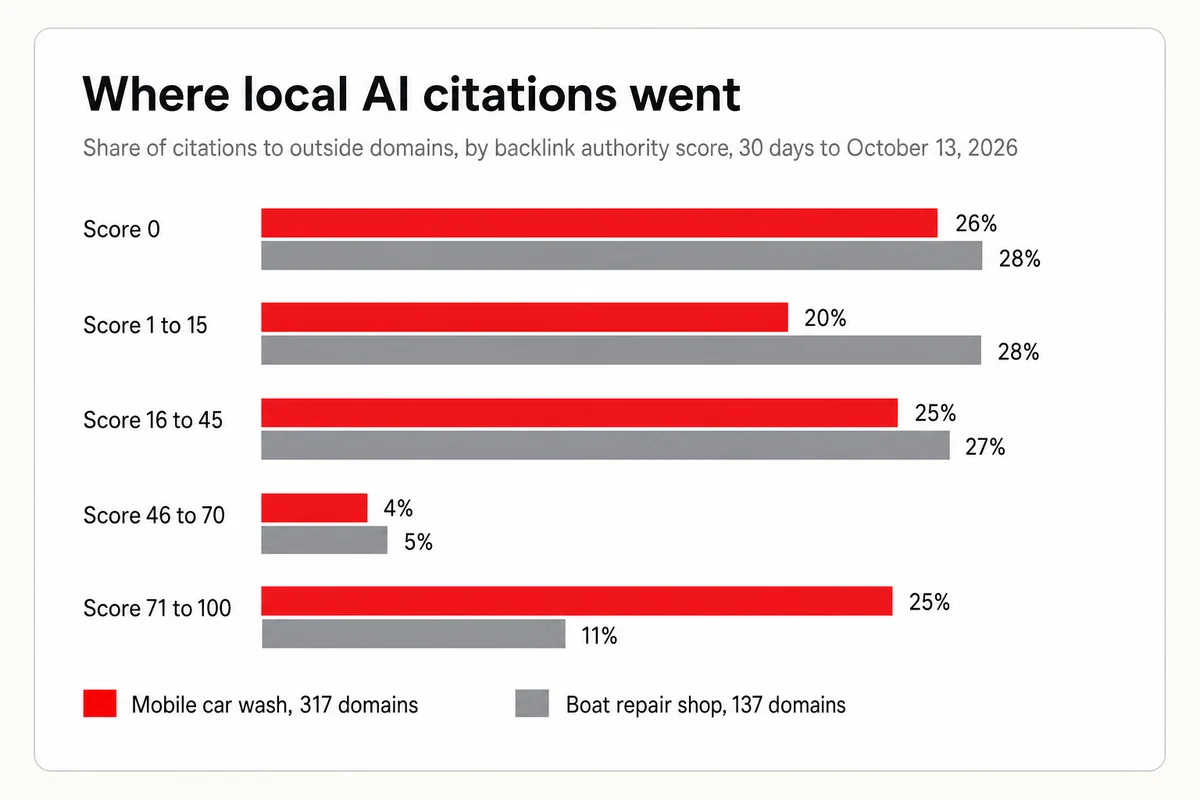
So for a local service question, the assistant will cite a site that has the page answering it whatever its backlink score, and a score of zero doesn't stop it. It's also why buying press release backlinks is the wrong lever for a citation. What the citation data rewards is a page that answers the question and stays current. SE Ranking's same study found pages updated within the last three months averaged 6.0 citations against 3.6 for outdated pages.
What Site Authority Does to a Mention
For mentions, backlinks matter even less, and a different kind of authority takes over. In January 2025, Seer Interactive ran 10,000 questions through GPT-4o and found brands on page one of Google correlated at about 0.65 with being mentioned, while the effect of backlinks was weak or neutral. In July 2026, a Victorious study of 175 brands across eight AI platforms, published as sponsored research in Search Engine Journal, found AI described 96 percent of brands accurately when asked about them directly, yet 89 percent never appeared in answers to category questions. Brands with fewer than 2,000 indexed web pages mentioning them were named 3 percent of the time. Only four of the 150 brands in its mention cohort ever earned a citation to their own site.
The authority that goes with a mention is being written about, by name, on pages the assistant already trusts. SE Ranking's ChatGPT study saw the same force on the citation side. Domains with up to 33 mentions on Quora averaged 1.7 citations, and domains with millions of mentions averaged 7.0, roughly four times the average. It's the same pattern behind why AI picks a competitor over you, where established brands got named from memory without any page being read.
Perplexity's own account of which sites it trusts as sources points the same way. Its help page on source labels explains that Perplexity rates the whole website a source comes from, on whether it corrects mistakes, names who wrote each piece, and separates news from advertising, and that a site with no label isn't a low-quality site, just one that hasn't been rated. Nothing in that description is a backlink count. A one-location business can clear that bar with an about page, named staff, and honest service pages. Getting named is then a matter of showing up, consistently, on the third-party pages that answer the category question, which is the work covered in the branded and unbranded AI visibility gap.
Which Signal to Chase, by What the Answer Shows
Put the two signals side by side for each answer and the first move usually names itself.
| The answer | What probably happened | First move |
|---|---|---|
| Cited, not named | The assistant quoted your numbers or steps and had no reason to say who wrote them. In our car wash data this showed up on price questions. | Add your name and city beside every price or step, lead with a line saying who wrote it and where you work, and include a fact only you can be the answer to, such as your own starting price. |
| Named, not cited | It knows you from reviews, directories, or its own memory and listed none of your pages as a source. | Make the outside records say the same hours, address, and phone, then publish the page that would have earned the citation. |
| Both | Your page was read and your name made it into the answer. | Keep the page current. Pages updated within three months averaged 6.0 citations against 3.6 in SE Ranking's data. |
| Neither | No page of yours matched, and no outside page said your name for this question. | Build the page that answers this exact question, then earn mentions on the review sites and directories the assistant already cites for your trade. |
Two things keep citations in proportion. First, they're still uncommon. Similarweb's July 2026 review of AI search found citations appeared in about 6.8 percent of US ChatGPT prompts in May 2026, up from about 1.6 percent in June 2025, with the share near 23 percent for travel questions and under 4 percent for professional services. Second, they don't send much traffic. SE Ranking's data from 101,574 websites put ChatGPT at 0.32 percent of all referral traffic in May 2026, its highest month on record, with about 60 percent of those visits landing on a homepage. Google said in May 2026 that its AI answers now place links inline next to the relevant text, which should help over time. The same month, its Search team published a resource that sets out to mythbust common AEO and GEO misconceptions and explains why ordinary SEO practices stay foundational to its AI features. So a citation's value is mostly diagnostic. It proves the assistant can find and read you, which is the one route into an answer that every business controls, famous or not.
The on-site half of that route gets covered by a free AI audit, from whether a crawler can reach your service pages to whether your name, address, and services are marked up so a machine can lift them as a unit. The other half is reading the answers themselves, named or cited, assistant by assistant, which is what Lighthouse Local for Business does on a schedule. When the fix list is longer than your week, our specialists can take the page rewrites and listing cleanups off your plate, with each change waiting on your approval.
Count Both, Then Fix the One That's Missing
The mistake that costs owners the most is counting one signal and calling it visibility. A citation count alone would have told the car wash it was everywhere on Gemini. A mention count alone would have told it ChatGPT never reads its site. Neither was true, and the fix for each gap was different. How many answers you need before either number has moved for real is covered in our guide to tracking your brand across AI search. Lighthouse Local's AI visibility tracker records both for every captured answer, named or not, cited or not, with the source list and its authority score beside each one, so the two piles from the top of this post are a filter, not a research project. Being read is the route you control. Being named is the sale. Keep score on both, and you'll always know which one to work on next.
Frequently asked questions
Do citations matter in AI search?
Yes, as proof the assistant can find and read your pages, which is the one route into an answer that every business controls. Established brands also get named from memory without a citation, so a citation isn't required for a mention, but it's the door that's open to everyone. Citations send little traffic on their own. In May 2026, ChatGPT accounted for about 0.32 percent of referral traffic across 101,574 sites, so treat a citation as a diagnostic, not a payoff.
Can an AI answer cite my website without mentioning my business?
Yes, and in our tracker it showed up most on price questions. In our tracker, a Miami car wash was cited in 390 answers over thirty days where its name never appeared, and Seer Interactive found one brand's blog post cited more than a hundred times in 25 days without a single brand mention.
Does domain authority affect AI citations?
Less than owners expect once a page has been found. AirOps found that pages ChatGPT retrieved from domains with a Domain Authority below 80 were cited 21.5 to 23.6 percent of the time, against 15.0 percent for domains at 80 to 100, and in our local data about half of all citations went to domains with a backlink score under 16 of 100. On that data, authority helps a page get retrieved and stops helping after that.
Does domain authority affect whether AI mentions my business?
Backlinks barely track it. What does is being written about by name on pages the assistants already read, like reviews, directories, forums, and local press. A 2026 study of 175 brands found those with fewer than 2,000 web pages mentioning them were named in AI answers 3 percent of the time.
How do I get AI to name my business when it already cites my site?
Put your name in the text it's lifting. Open the page with a sentence that says who you are and where, keep the name next to the prices or steps the assistant quotes, and add facts only you can be the answer to. Then earn the same name on the third-party pages the assistant cites for your trade.