Buy It This Year If Customers Already Ask an Assistant About You
AI visibility software is a must-have in 2026 for a business whose customers find it by asking a question, and a purchase you can defer, on a date you set, if a free check shows the assistants already name you or your customers haven't started asking them yet. That's the whole answer. The rest of this post is how to tell which of those two businesses you run, using two real tracker histories, five questions you can answer in an afternoon, and a way to wait that doesn't cost you the year.
The decision feels like a software purchase, and it isn't one. It's a question about where your next customer's first question goes, and the 2026 measurements say it goes to an AI answer more often every quarter. Comscore's panel data shows the share of Google desktop searches with an AI Overview grew from 25.8% in July 2025 to 39.4% by June 2026, and the same report found ChatGPT's share of prompt volume fell from 70% to 50% over the first half of 2026 while Gemini rose from 17% to 30% and Claude from 2% to 11%. The answers about your business are now spread across several assistants, not one. SparkToro's read of Similarweb clickstream data found 68.01% of US Google searches ended without a click in the first four months of 2026, up from 60.45% two years earlier. And in June 2026, Pew Research Center reported that 44% of US adults use ChatGPT, from a survey of 5,119 adults. None of those numbers says a customer used AI to pick a plumber. They say the answer, not the link, is where attention lands, and the businesses named inside that answer are being chosen now.
For a local business the gap between search rank and AI recommendation runs deeper than a traffic chart shows. Localogy's write-up of SOCi's 2026 Local Visibility Index drew on a sample spanning 2,751 brands and topping 350,000 locations, and found Google's local three-pack surfaces a brand 35.9% of the time on average, while ChatGPT only recommends 1.2% of brand locations, and only 45% of the retail brands that rank in local search also turn up as an AI recommendation. Read that the way a COO reads a report. A page-one Google presence tells you almost nothing about whether an assistant names you, so you have to ask to find out, and keep asking to see whether that's changing.
A Year of Waiting Costs Answers, Not Dollars
The cost of deferring isn't the subscription you didn't pay. It's a year of answers about your category that named someone else while nobody on your side was reading them. Two 2026 studies size how fast those answers are being handed out. Yext Research parsed 155.5 million AI citations across 1,623 brands in the first quarter of 2026, and in a fixed cohort of 770 brands it had tracked since the third quarter of 2025, citations grew 2.77 times in three quarters, with citations per scan up 28% quarter over quarter. The assistants are pointing at more sources per answer, not fewer, and each new slot goes to whoever is already findable. Birdeye's State of AI Search 2026 looked at local-intent prompts and found 80% of brands cited at least once, though only 15% hold the top citation with their own domain, and one brand in five is never cited from its own site at all. Both publishers sell tracking software, as we do, so weigh the framing accordingly. The counts themselves are the useful part.
What the studies can't tell you is whether a citation, once earned, stays earned. Nobody has a clean 2026 answer to that, and we won't pretend to. What a year of not looking does cost, with certainty, is the baseline. When you finally check, you'll have one snapshot and no way to know whether it's better or worse than last spring, whether a competitor took a question you used to hold, or whether the fix you paid for moved anything. A tracker's first job isn't to make the number go up. It's to make the number exist.
There's a cheaper cost of waiting hiding underneath, too. Otterly.ai analyzed more than a million AI citations from early 2026 and found 73% of sites carry crawler-blocking barriers, whether that's a robots rule, a blocked bot, or a page that only renders in JavaScript, and it means an assistant can't read the site even when it wants to. You don't need software to find that. Our free AI visibility audit checks any site's on-site signals and returns a prioritized fix list, no signup required, and a blocked crawler is exactly the kind of thing it flags first. Whatever you decide about the tracker, that fix shouldn't wait a year.
Our Own Site Is Named in 23 of 2,908 Answers
Here's what a tracker showed us about our own site, because a decision post should carry its own receipts. We added lighthouselocal.ai to the Lighthouse Local AI visibility tracker on August 13, 2026, with prompts a business owner might ask about AI visibility tools and services. Through September 25 it captured 2,908 answers across ChatGPT, Gemini, Claude, Perplexity, and Google AI. Lighthouse Local was named in 23 of them. One of our pages was cited in 58. A competitor was named instead in 1,036. The first ten days returned zero mentions anywhere, and the first one arrived on August 23, from Gemini, which went on to produce 19 of the 23.
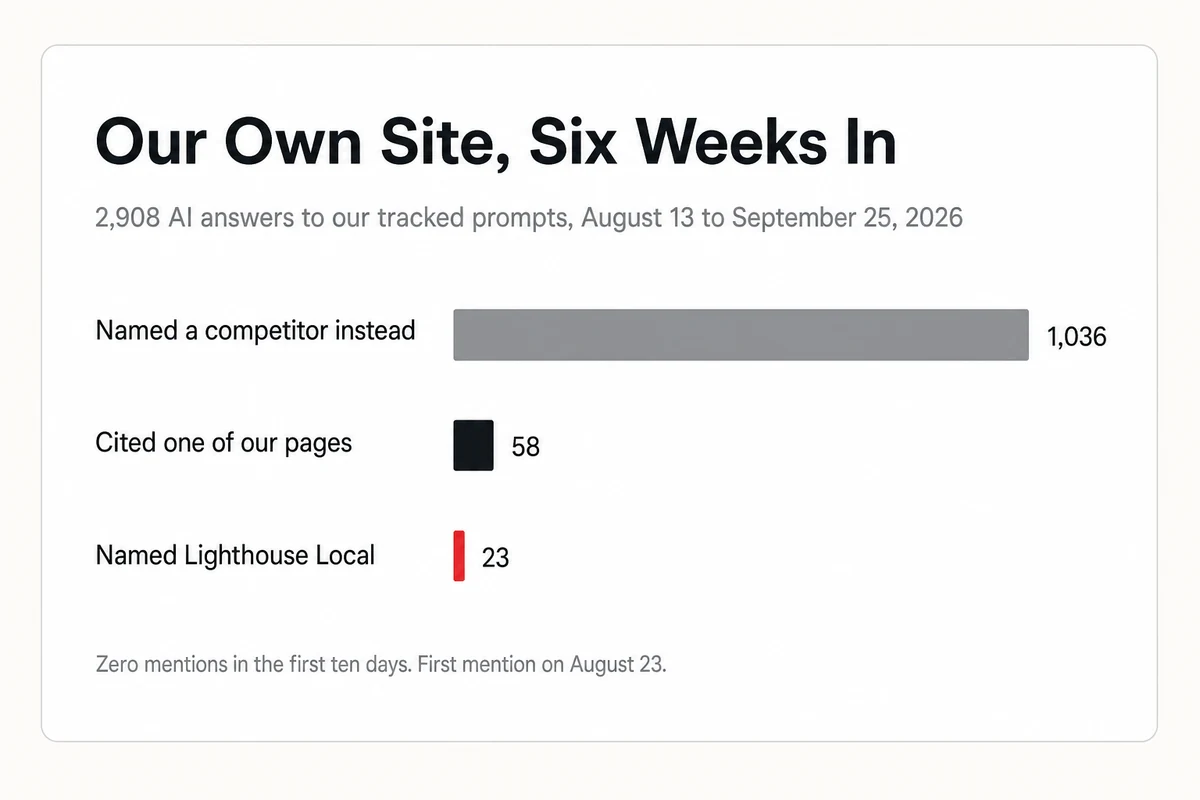
That's a new brand competing against tools that have been on the web for years, and the number is exactly as humbling as it looks. But look at what it bought us in six weeks. We know the gap is roughly 45 competitor answers for every one of ours, so nobody in the building can talk themselves into "we're probably fine." We know ChatGPT named us zero times and Gemini did most of the naming, which points the work at the sources ChatGPT reads rather than at a general content push. And we know the date the first mention appeared, so the next fix has a before. Without the tracker we'd have a hunch and a screenshot. With it we have a baseline, and a baseline is the one thing you can't buy retroactively.
A Boat Repair Shop Winning Everywhere but Gemini
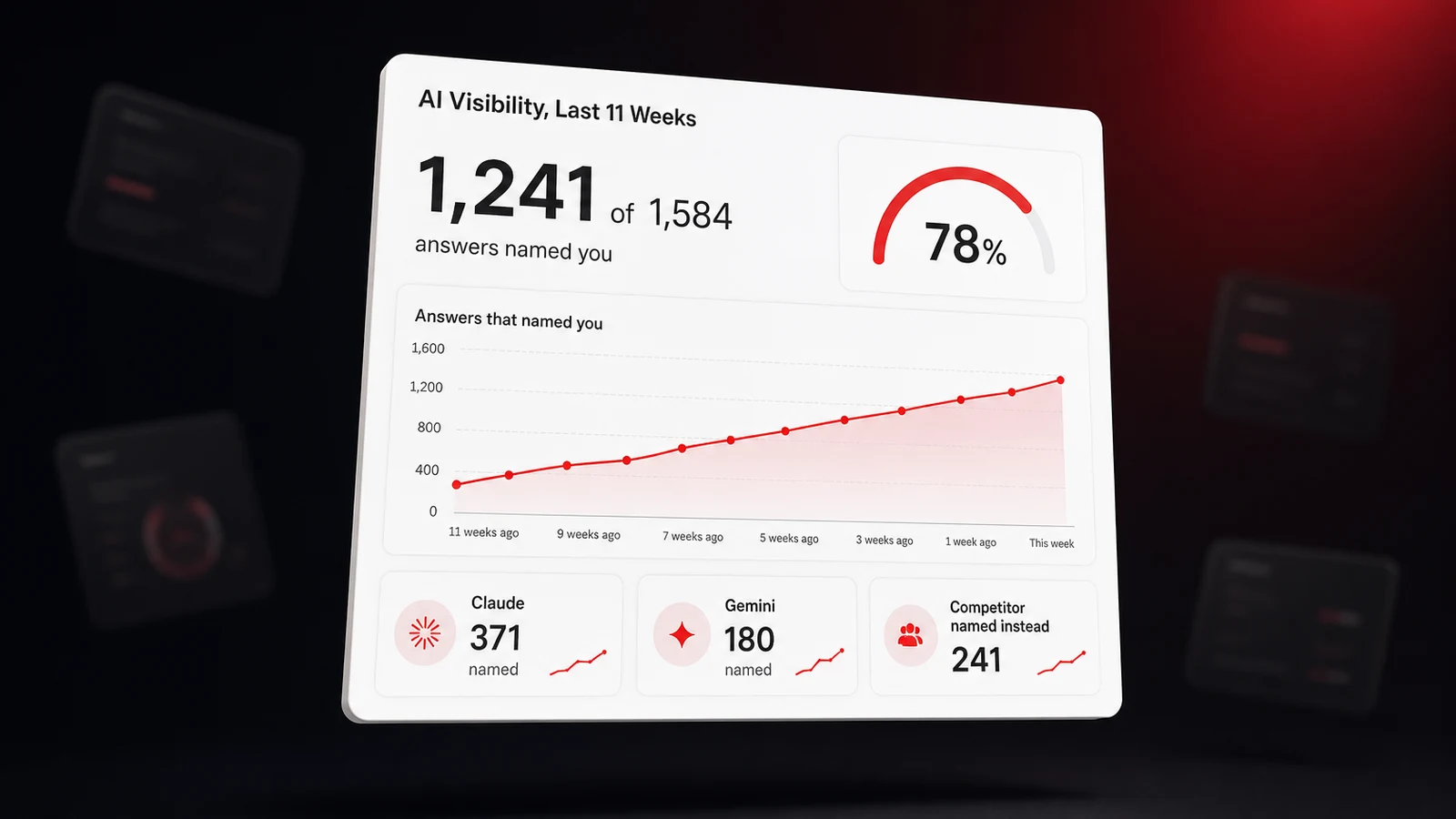
The second history belongs to a boat repair shop in Miami we track, described here without its name. From the day it was added, July 10, 2026, through September 25, the tracker captured 1,584 answers to its customers' questions, and the business was named in 1,241 of them, about 78%. On that top-line number the owner could reasonably wait a year. The per-assistant split says otherwise.
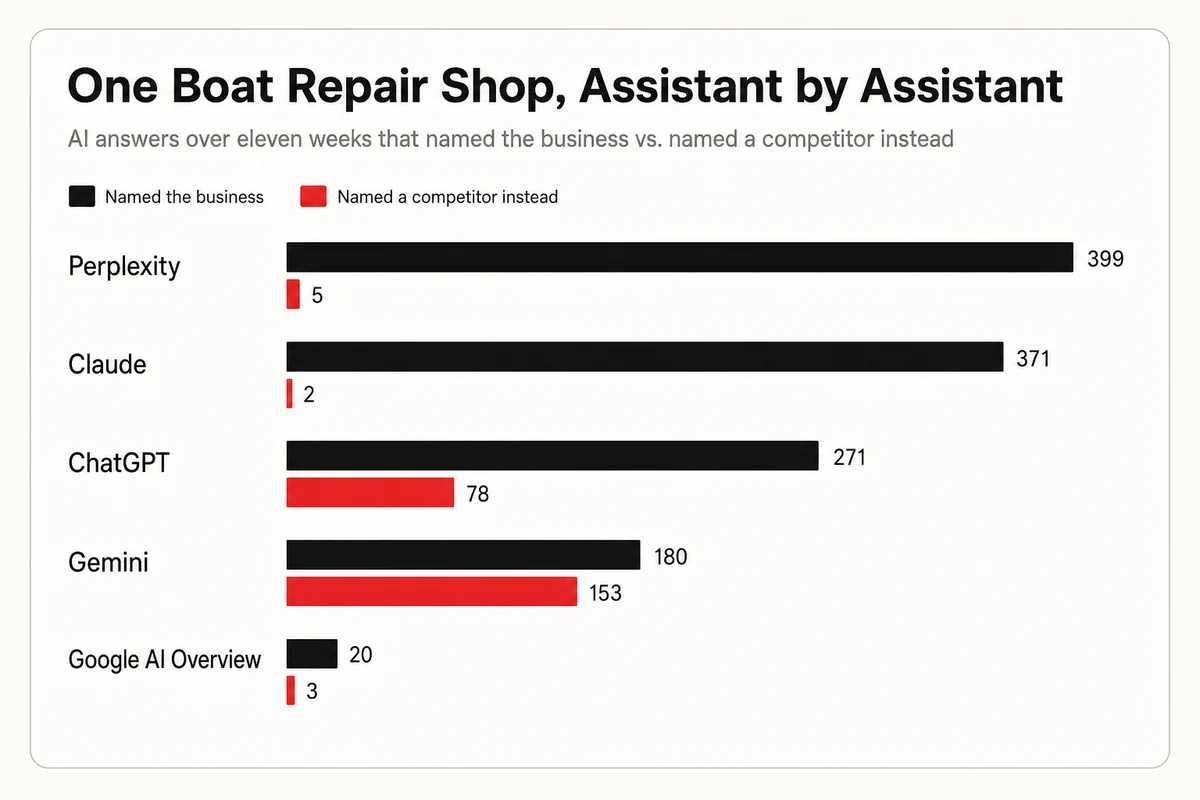
Claude named the business 371 times and named a competitor instead twice. Perplexity, 399 against 5. Gemini named it 180 times and named a competitor instead 153 times, and ChatGPT sent 78 answers to a rival against 271 that named the shop. Same business, same questions, same eleven weeks. A one-time manual check would have produced whichever of those verdicts the checker's favorite app happened to give, and why AI recommendations differ by user is a whole post of its own. The decision the split forces is specific. Gemini answers local questions largely from Google's own records, so the work is the profile, the categories, and the reviews, not the website copy the other assistants are already quoting. We saw the same Gemini gap, neighborhood by neighborhood, in a Miami car wash's AI visibility numbers, and it's the pattern we'd check first for any local business. On one assistant, 153 answers went to a rival, and without per-assistant counts nobody would have known which assistant to fix for.
The Free Baseline You Can Run Before Spending a Dollar
If the honest answer to "do our customers ask an assistant" is "we don't know," don't buy software to find out. Run the free instruments first, and let them tell you whether the paid question is worth asking. Since May 2026, Google Analytics 4 has started grouping visits from the major assistants under an AI Assistant channel by default, at no cost and with no setup, though visits that arrive without a referrer still land in Direct, so treat the count as a floor. Semrush's free AI Visibility Checker runs three brand checks a day with no account, as of September 2026. And the manual method still works. A hand check of whether AI recommends you takes twenty minutes or so across the major assistants, and if you write the results down, a spreadsheet baseline for AI visibility turns that afternoon into history you own.
Do that for one month and you'll know three things a sales page can't tell you. Whether any AI-referred visits exist. Whether any assistant names you for your core question. And how much of your team's time the manual version eats, which is the real price you're comparing the software against. If the answer to the first two is no and no, the tracker can wait, and you've spent nothing finding out. If assistants name you but nobody arrives, the fix is on your site, not in a tracker. If a competitor gets named where you don't, you've found the reason to buy.
Five Questions That Settle Must-Have or Defer
Score yourself on five questions. Each one is answerable this week with the free instruments above, and three or more answers in the "buy now" column make the software a must-have for you this year. Fewer than three, defer it, with a date.
| Question | Buy now if | Defer if |
|---|---|---|
| Do customers find you by asking a question with a place and a problem in it? | Yes, most new customers arrive that way | Referrals, contracts, or walk-ins bring nearly everyone |
| Did a free check name a competitor instead of you for your core question? | Yes, on at least two assistants | You were named, or nobody was |
| Can you name what you'd change if the answer were bad? | Yes, and someone owns the profile, the pages, and the reviews | Nobody would act on the report for six months |
| Is the subscription small next to what you already spend to be found? | Yes, it's a rounding error on the marketing line | It would be your entire marketing budget |
| Will someone read it every month? | Yes, it has an owner and a meeting | It would join the dashboards nobody opens |
The two questions that swing most decisions are the second and the third. A competitor named where you aren't is the clearest buy signal there is, because every one of those answers was a customer who asked and got sent elsewhere. And a report nobody will act on is waste at any price, which is why the honest defer case is usually "we can't fix anything yet," not "it's too expensive." On the first two questions alone, the boat repair shop above is a buy, since two assistants handed a combined 231 answers to rivals. Our own site is the same on the second question and a miss on the first, since our customers don't put a city in the question. And a third site we track, a web design agency in North Miami Beach, shows what the defer column looks like in practice. Over the 90 days ending September 25 it was named in 119 of 1,222 answers, but a competitor was named instead in only 19. The assistants mostly named nobody at all for its questions, so there's no rival in its slot yet, and no reason to pay to watch an empty one.
The Software Is the Cheap Half of the Decision
Most owners frame this as a software cost and then discover the software was the small part. A single-business tracker in September 2026 lands well under $100 a month, and ten AI visibility tools scored for a one-location budget walks through the price bands if you want the list. The expensive half is acting on what it shows. If the report says Gemini sends your customers to a rival, someone has to rebuild the profile, write the service pages, answer the reviews, and earn the directory listings, and that's hours or an agency invoice, not a subscription.
Put the subscription against the budgets it lives in. Gartner's 2026 CMO Spend Survey, as reported by Sword and the Script, found marketing budgets flat at 7.8% of company revenue, with CMOs already putting 15.3% of that budget into AI. Small businesses are moving the same way. Thryv's April 2026 survey of 561 small and medium businesses found AI adoption at 66%, up from 55% a year earlier, with 53% of the adopters spending at least $100 a month on AI tools, and U.S. Bank's survey of 1,000 owners found 75% of owners now use generative AI, most often for marketing and sales. In the trades specifically, Housecall Pro's May 2026 survey of 248 home service pros found 48% actively use AI, mostly for marketing and customer service. A business already paying for AI to write its emails isn't going to feel a tracker in the budget. It'll feel it in the calendar.
The counter-case is real, and it's the smallest businesses. The U.S. Chamber of Commerce Foundation's Main Street AI Monitor found 43% of businesses with two to nine employees use AI for work tasks, against 59% at businesses with 100 to 249, and when Ueni asked 7,413 people starting a business what they'd spend on marketing each month in 2026, 26.1% said zero. If that's you, the tracker isn't a must-have this year, and neither is any other subscription. Run the free baseline, fix the crawler barriers, and come back when there's a marketing line for it to sit on. If you're past that point and what you're short of is hands, not data, Lighthouse Local for Business hands the fixing to specialists who handle the profile, the pages, and the citations, with you approving the work rather than doing it.
If You Wait, Wait on Purpose
Deferring is a fine decision when it's a decision. It's an expensive one when it's a drift. The difference is four lines in a calendar.
- Take the free baseline this month. Ten customer questions, each assistant, results in a sheet with the date on it. That sheet is the "before" you'd otherwise have to buy.
- Clear the barriers that cost nothing. Run the audit, unblock the crawlers it flags, and fill the profile fields it finds empty. An assistant that can't read you can't name you, whatever you decide about tracking.
- Write down the trigger that ends the wait. A good one is "a competitor named instead of us on two assistants for a core question." Yours might be the first AI-referred lead, or a rival's name in a customer's mouth.
- Put the re-check on the calendar. Ninety days, same ten questions, same sheet. If the answers moved against you, the wait is over. If they didn't, you bought another quarter for the price of an afternoon.
A deferral with those four lines costs you almost nothing. A deferral without them is the year of unread answers this post opened with.
Decide Now, Even If the Decision Is Wait
So, must-have or wait a year? Must-have if customers find you by asking, if a free check already shows a rival in your slot, and if someone will act on the report. Defer, on a date, if the free baseline comes back quiet or there's no one to do the fixing yet. What you can't do in 2026 is skip deciding, because the assistants are answering either way, and the answers you didn't read still sent your customers somewhere. When the decision is buy, our plans and pricing put the subscription next to the budget you just sized it against, and the first week of captured answers will tell you more than this post could. When the decision is wait, run the baseline anyway. Either way, make the number exist, because a year from now the only thing worse than a bad score is never knowing what last year's was.
Frequently asked questions
Is AI visibility software necessary for a small business in 2026?
It's necessary when customers find you by asking an assistant a question and a free check shows a competitor named where you aren't. It's deferrable when the baseline comes back quiet or nobody can act on the report yet. Either way, take the free baseline now so the paid decision has a before.
Can I wait a year before buying an AI visibility tool?
Yes, if you wait on purpose. Record ten customer questions across the major assistants this month, fix the crawler barriers an audit finds, write down the trigger that would end the wait, and re-check in 90 days. What you lose by waiting isn't a subscription, it's a year of history you can't buy later.
What does AI visibility software do?
It asks the assistants the questions your customers ask, on a schedule, and records whether your business was named, whether your site was cited, and whether a competitor was named instead, per assistant. The value is the history and the per-assistant split. Our own six weeks of data showed a gap of about 45 competitor answers to one of ours that no single manual check would have sized.
How much does AI visibility software cost?
Single-business trackers in September 2026 mostly land under $100 a month, and Lighthouse Local's own plans are listed on our pricing page. The larger cost is acting on what the report shows, which is hours from your team or an invoice from whoever does the fixing.
What is a free way to check AI visibility before buying software?
Four things cost nothing. Google Analytics 4 now sorts visits from the major assistants into an AI Assistant channel. Semrush's free checker runs three brand checks a day with no account. Putting the questions your customers ask to every assistant by hand takes about twenty minutes. And a free Lighthouse Local audit finds the on-site barriers that stop an assistant reading you at all.