Five Questions Stand Between a Prompt and Your Name
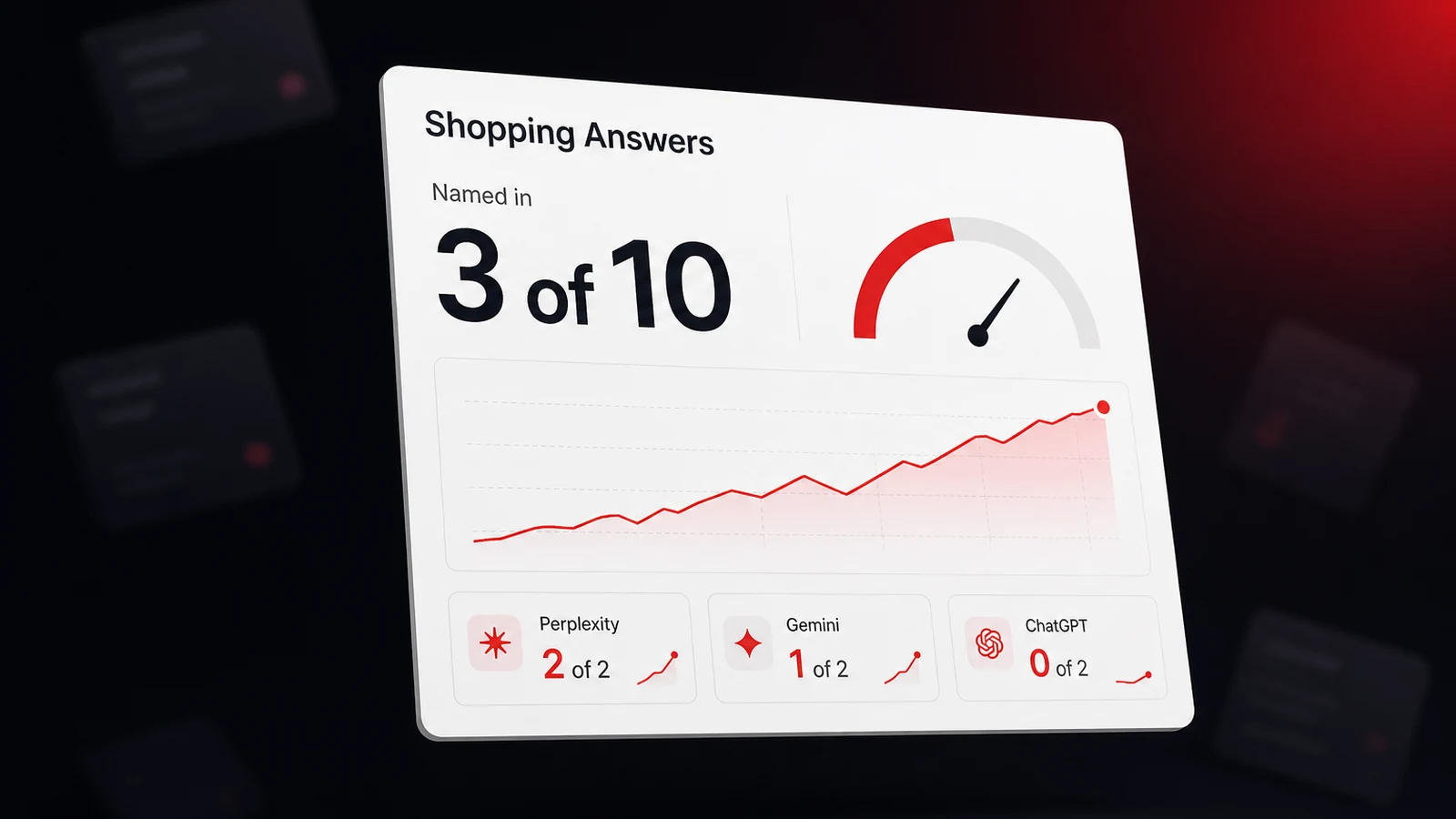
An AI shopping assistant asks five things about a business before it recommends one. Is there a listing it can show? What exactly is the product, and what does it cost right now? Who besides the seller says it's good? If it sends a customer, will the purchase go smoothly? And can the customer reach the business today? Those five questions aren't a theory. They come from what OpenAI, Google, and Amazon publish about how their shopping features choose products and merchants, and from ten answers we captured this week for one manufacturer we track. It was named in three of the ten. Each of the three rested on a document someone else had published about its product. Each of the seven misses traces to one of those five questions it had left unanswered.
The stakes moved fast. Salesforce reported that during the 2025 holiday season, AI and agents drove 20% of all retail sales, about $262 billion, across the 1.5 billion shoppers it measures. Bain's November 2025 consumer research put the share of US adults who use generative AI for product research at 30% to 45%, while about half still said they'd be uncomfortable letting an AI complete a purchase on its own. So most of the money still flows through a recommendation and a click, which is exactly the moment those five questions decide.
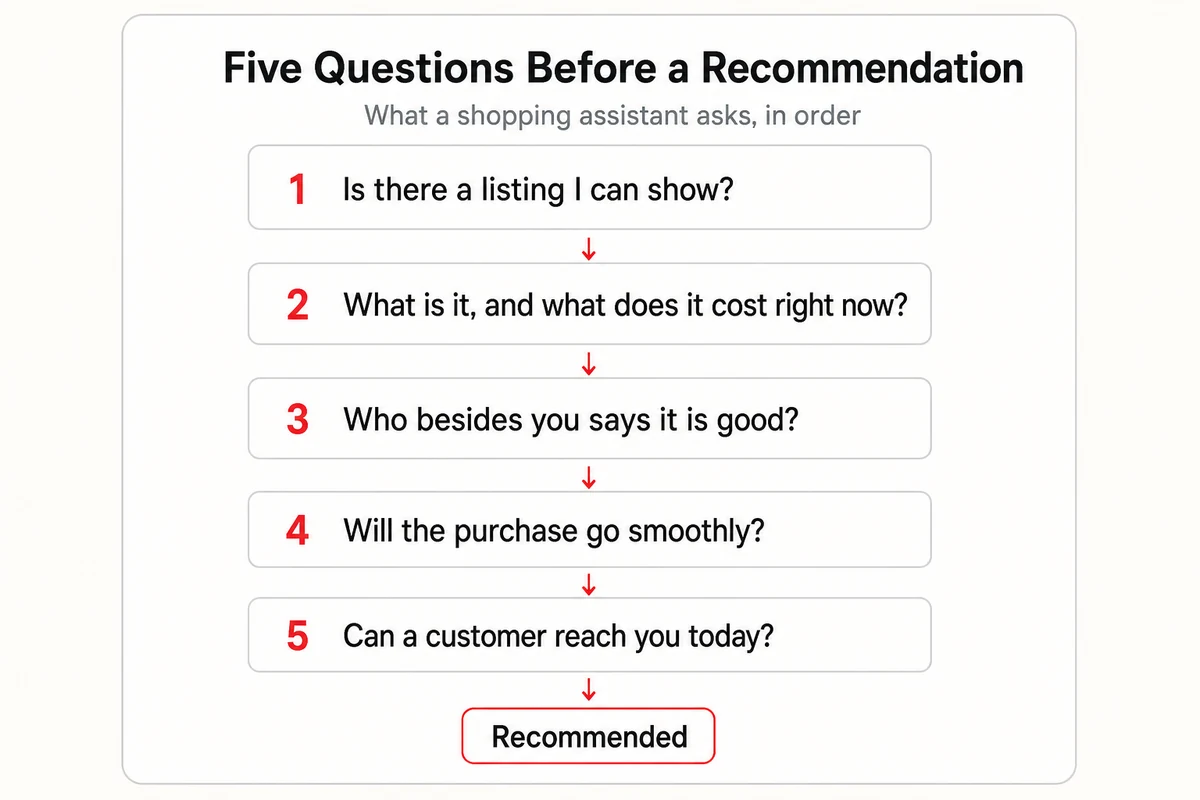
The rest of this post takes the questions in the order the assistants ask them, shows what each platform's own documentation requires to answer yes, and then walks through the ten captured answers so you can see the questions doing their work on a real product.
Is There a Listing I Can Show?
The first question is the one most local businesses have never thought about, and it now decides the most. OpenAI's help article on shopping with ChatGPT search, updated in August 2026, says product results are built from "structured metadata from first-party and third-party providers," and that when a shopper clicks a product, the merchants shown are "ranked based on factors like availability, price, quality," and whether they're the maker or primary seller of the item. The same page notes that merchants on Shopify are already integrated through Shopify Catalog with no extra work, and that everyone else can apply to send a direct product feed.
How much that feed matters changed on one day this summer. Profound, which tracks ChatGPT shopping results for thousands of merchants, found that after the GPT 5.6 release, feed-based retrieval overtook web search on July 10, 2026, jumping from about 8% of product recommendations to about 62% in a single day, across roughly 1.75 million shopping prompts. The number of unique merchants ChatGPT referenced fell by more than a fifth in the same window, from 13,524 to 10,607, and the top ten merchants' share nearly doubled. Shopify stores accounted for about 35% of all feed-based retrieval, which Profound calls the remaining wedge for smaller sellers. A business with no feed and no Shopify store isn't considered for roughly two thirds of ChatGPT's product recommendations.
Google answers the same question from its Shopping Graph, which its November 2025 agentic checkout announcement describes as more than 50 billion product listings, two billion of them refreshed every hour. In January 2026 Google published the Universal Commerce Protocol with Shopify, Etsy, Wayfair, Target, and Walmart as co-developers, an open standard for letting an agent discover, compare, and buy. Microsoft launched Copilot Checkout the same week, enrolling Shopify merchants automatically after an opt-out window. And Amazon's shopping assistant, which it says was renamed Alexa for Shopping on May 13, 2026, grew its Buy for Me pool from 65,000 products at launch to more than half a million, including selection found off Amazon.
In our ten captured answers, this question explained ChatGPT's two misses on its own. Across both prompts it returned ten product cards, and every one of the ten was anchored on a retailer's product page with a price and a stock status. The manufacturer we track sells through a distributor, so its product has no store page of its own. ChatGPT had nothing to show, so it showed something else.
What Is It, and What Does It Cost Right Now?
Once an assistant knows a listing exists, it needs the facts in a form it can trust without reading a paragraph. OpenAI's product feed specification requires exactly nine fields per item, and says an omitted, empty, or unrecognized availability value rejects the whole row. This is the minimal record, one line per product, with the values swapped for your own.
{
  "item_id": "YOUR-SKU-001",
  "title": "Product name, including the variant",
  "description": "Plain factual description of this item.",
  "url": "https://yourdomain.com/products/your-product",
  "brand": "Your brand as shown on the product page",
  "seller_name": "Your business name",
  "image_url": "https://yourdomain.com/images/your-product.jpg",
  "price": "49.00 USD",
  "availability": "in_stock"
}
Notice what's in there and what isn't. Price and availability are required. Reviews, shipping, and returns aren't, but OpenAI's commerce key concepts guide says the recommended attributes, rich media, reviews, and performance signals among them, "improve ranking, relevance, and user trust." Google's Merchant Center product data specification makes the same two fields, price and availability, required for every listing. Amazon's page lists its own ranking signals for its shopping assistant as reviews, price, availability, delivery speed, return rates, and browsing history.
If you don't run a feed, the same facts can live on the page itself as structured data. Google's merchant listing documentation requires a Product with a name, an image, and an Offer carrying a price and a currency code. Its product snippet documentation, updated September 8, 2026, needs a name plus at least one of a review, an aggregate rating, or an offer. That's the product cousin of the local business schema markup a service business adds, and it does the same job. It turns a sentence a model has to interpret into a label it can read.
The cost of getting this wrong is a stale number in front of a buyer. OpenAI's shopping article admits that when merchants change pricing or shipping terms, "there may be some delay" before it's reflected. Profound's June 2026 study of about a million ChatGPT shopping offers found the Best Price tag on every feed-based offer it sampled, but on only 21% of offers scraped from product pages. The shopper sees one price and one stock status. Whether they're yours or a reseller's from last month depends on who answered this question first.
Who Besides You Says It Is Good?
The third question is the one the manufacturer we track answered best, and it's why it got named at all. An assistant treats the seller's own description as a claim and goes looking for corroboration. OpenAI's shopping article says ChatGPT's review summaries "are based on reviews from public websites" and that it doesn't verify them, and its feature labels such as Budget-friendly are generated from whatever third-party data the model has. Reviews are a content source, not a score, which is the same thing we found when we looked at how reviews shape AI recommendations for local businesses.
What counts as corroboration differs by assistant. BrightEdge's December 2025 analysis of who Google and ChatGPT cite on shopping questions found Google AI Overviews cite retailers only about 4% of the time, leaning on YouTube, Reddit, and Quora instead, while ChatGPT cites retailers about 36% of the time, favoring Amazon, Target, and Walmart. That's two different ideas of proof. One wants a listing. The other wants a person who has used the thing.
Our captured answers matched that split closely. On the antibacterial connector prompt, Gemini named the tracked product as its one recommended option, and its citations were a directions-for-use PDF, a news story about the product's FDA clearance, a press release about a clinical study, and the maker's own technology page. Perplexity named it first on both prompts, citing the same FDA clearance coverage, the same study release, and a distribution-agreement announcement. Google AI never named it, and its citations in both answers were store pages, Amazon listings, and YouTube videos. Claude never named it either, and leaned on a larger incumbent's product pages and a distributor's catalog. The product was the same on every screen. What differed was which kind of evidence each assistant went looking for, and the maker had only published one kind.
If I Send Someone, Will the Purchase Go Smoothly?
An assistant that recommends a merchant is putting its own name on the outcome, so the fourth question is about what happens after the click. This is where the optional fields stop being optional. Google's merchant listing documentation lists return policy and shipping details as recommended additions to an Offer, through the MerchantReturnPolicy and OfferShippingDetails types, and OpenAI's feed spec carries its own shipping and returns section. Amazon's ranking signals include delivery speed and return rates outright. A business that can't state its shipping cost, its delivery window, and its return terms in a machine-readable place has left this question blank.
The gap is real and measurable. In Profound's June 2026 offer study, delivery information appeared on 75% of offers ChatGPT built from product pages but on only 4% of feed-based offers, because most merchants sending feeds hadn't filled in the shipping fields. Feeds win on price and stock. Pages win on delivery detail. The merchants that answer this question fully have both.
Checkout eligibility is the strict version of the same test. OpenAI's shopping article says Instant Checkout appears only "for some eligible products and merchants," and Google's agentic checkout launched with a named set of retailers and select Shopify stores. Neither platform publishes a checklist, but both gate the feature on the same data the recommendation already needed, current price, current stock, and stated fulfillment terms. Bain's finding that about half of consumers won't yet let an AI buy on its own means most shoppers still land on your site. They arrive expecting the price and the delivery promise the assistant just quoted, so the smoothest purchase is the one where those numbers match.
Can a Customer Reach You Today?
For a local business the fifth question replaces the feed. An assistant recommending a store, a clinic, or a repair shop needs to know it's open, where it is, and how to reach it, and it gets those facts from the same records that feed Google Maps. Google's Business Profile help explains that services listed on a profile can be highlighted directly when a customer's query matches one, and that products added through the product editor must follow shopping ads policy or the whole set gets removed. A store with physical inventory can go further. Google's local inventory feed specification ties each product to a store code that matches the Business Profile and an in-store availability value, and says a missing required attribute keeps that product out of local results.
Google is now asking this question by telephone. Its agentic calling feature, updated in July 2026, has the AI call local businesses in categories like toys, electronics, and health and beauty to gather "what's available near you, if there are any discounts and more," then reports back to the shopper. A business whose phone rings out, or whose staff can't quote a price and a stock status, has just answered the fifth question out loud.
We saw the local version of those five questions in a second capture this week, for an industrial equipment manufacturer in a small Midwestern town, on a prompt that named both its specialty and its town. Four assistants had answered by the time we read it, and all four named the company. ChatGPT led with a Google Maps card and the phone number. Claude quoted the founding year from the company's own About page. Gemini cited a supplier directory and a trade association's member listing. Perplexity cited the same association, the LinkedIn company page, the local newspaper, and a map listing. Where is it, what does it do, is it real, and how do I call. Every source they reached for answers one of those, which is the same pattern we mapped when we looked at how AI sources local business data. A complete Google Business Profile answers the first and last of them for every assistant at once.
Ten Answers, One Product, Three Mentions
Here's the full tally for the manufacturer we track, a medical device maker whose product is a needle-free IV connector sold through a distributor. Our AI visibility tracker asked two product questions on September 25, 2026, "Recommend a good neutral IV connector?" and "Can you recommend an antibacterial needleless connector?", and captured the answer from each of the five we track. Names are withheld because it's a customer, and the pattern is the point.
| Assistant | Neutral connector | Antibacterial connector | What the answer rested on |
|---|---|---|---|
| ChatGPT | Not named | Not named | Ten product cards, each anchored on a retailer's store page |
| Gemini | Not named | Named, as the one recommended option | FDA clearance news, a study press release, the directions-for-use PDF |
| Claude | Not named | Not named | A large incumbent's product pages and a distributor catalog |
| Perplexity | Named first | Named first | FDA clearance coverage, the study release, a distribution deal announcement |
| Google AI | Not named | Not named | Store pages, Amazon listings, YouTube videos |
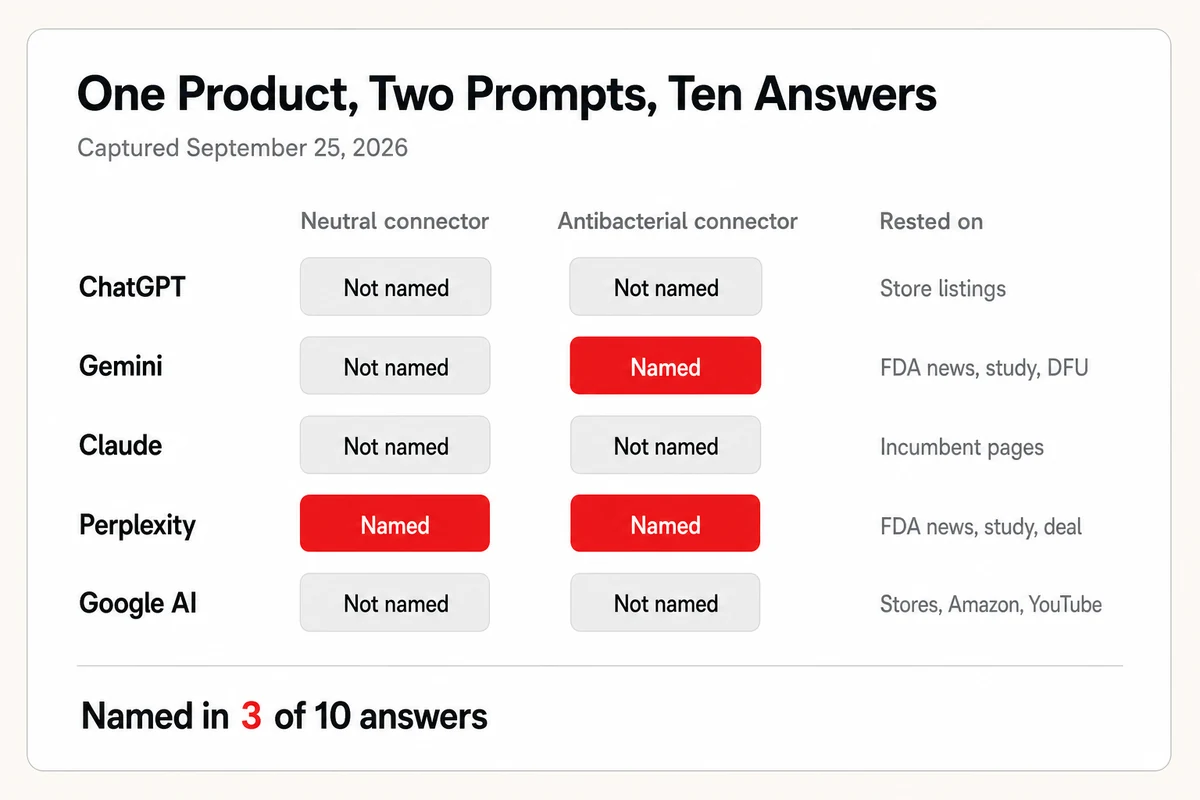
Read the last column against those five questions. The three mentions all came from question three, corroboration, and the maker had answered it well. It has an FDA clearance with news coverage, a published clinical study, and a directions-for-use document online. The seven misses all came from question one, a listing to show. The product isn't on any store page the assistants could find, and its distributor's catalog doesn't carry a feed. Two of the assistants also ended their answer by asking the shopper a question back, hospital or home use, central or peripheral line, which is the assistant admitting it didn't have enough to decide.
One honest caveat. Ten answers is one day, and the same prompt asked again next week will cite differently. We read these as a snapshot of which questions the product could answer, not as a score, and a weekly capture is what turns the snapshot into a trend.
Answer the Questions in the Order They Get Asked
The order matters because each question gates the next. A perfect return policy on a product no assistant can find changes nothing. So work down the list the way the assistant does.
- Give them a listing. If you sell online, put your products on Shopify or send a direct feed to OpenAI and Google Merchant Center. If you sell in person, list your services and products on your Business Profile and, if you hold stock, send a local inventory feed with the store code filled in.
- Label the facts. Price, currency, and availability on every product, in the feed and in Product and Offer markup on the page, and keep them current. A stale price is worse than none, because the assistant will quote it.
- Publish the proof somewhere that isn't your site. A customer review on Google, a listing on a trade directory, a piece of local news coverage, a case study a partner hosts. The manufacturer above was named only where that kind of document existed.
- State the terms. Shipping cost, delivery window, and return policy in the feed's shipping and returns fields and in MerchantReturnPolicy and OfferShippingDetails on the page.
- Answer the phone with a price and a stock status. Google may be the one calling. If your hours on the profile are wrong, this is the question you'll fail first.
The first two and the fourth are on-site work, and they're what a free Lighthouse Local audit checks, with a ranked list of what's missing on your pages. The third is slow, steady work that our specialists at Lighthouse Local for Business can carry for you, from reviews to citations, with your approval on each piece, if you'd rather not run it alone. And whether any of it changed what the assistants say is a question only repeated capture answers, and Lighthouse Local's AI visibility tracker runs that capture each week, for the same prompts, across the five we track.
A Careful Buyer Asks the Same Five Things
Strip the technology away and those five questions are what a careful customer has always asked before handing over money. Can I buy it here, what does it cost, does anyone vouch for it, what if it goes wrong, and are you open. The assistants didn't invent the list. They made it mandatory, and they ask it in a form a human never did, as fields in a feed, labels on a page, and documents on someone else's site. The manufacturer in our capture had answered one of them well and was named three times for it. Answer all of them, and the assistant runs out of reasons to name someone else.
Frequently asked questions
What do AI shopping assistants check before recommending a product?
Five things, in order. Whether a listing exists they can show, what the product is and what it costs right now, whether anyone besides the seller vouches for it, whether shipping and returns are stated, and for local businesses, whether the customer can reach it today. OpenAI's own help page says merchants are ranked on availability, price, quality, and whether they're the maker or primary seller.
Does a small business need a product feed to show up in ChatGPT shopping?
Increasingly, yes. Profound measured feed-based retrieval overtaking web search in ChatGPT shopping on July 10, 2026, rising to about 62% of product recommendations in one day. Shopify stores are integrated automatically through Shopify Catalog, and other merchants can apply for a direct feed. Without either, you're only considered for the shrinking share that still comes from web search.
Do reviews affect whether an AI recommends my business?
Yes, as evidence rather than as a score. ChatGPT builds review summaries from public review sites and doesn't verify them. Google AI Overviews lean on YouTube, Reddit, and Quora far more than on retailer pages. In our capture, the tracked manufacturer was named only where a third party had published something about its product.
Which structured data do shopping assistants read on a product page?
Google's merchant listing documentation requires a Product with a name, an image, and an Offer carrying price and priceCurrency, and recommends MerchantReturnPolicy and OfferShippingDetails. Product snippets need a name plus a review, an aggregate rating, or an offer. Those labels give an assistant the same facts a feed would, read straight from the page.
How do I know which of those five questions my business is failing?
Ask the assistants a product or service question a customer would ask, then read what each cited. Store pages and Amazon listings mean it wanted a listing you don't have. Third-party articles and reviews mean it wanted corroboration. A clarifying question back means it didn't have enough to decide. A tracker that captures the same prompts weekly turns that one reading into a trend.