The Model Has Heard of You. It Isn't Thinking of You.
AI knows your business but doesn't recommend it because knowing a name and reaching for it are two different things. An assistant can hold plenty of facts about you and still leave you off the shortlist, because the question a customer typed never touched the things you're known for. That's the clearest finding in a September 2026 study from researchers at Northwestern and Boston University, who asked six AI models from OpenAI, Google, and Anthropic for product recommendations 1,200 times with a plain request and another 1,200 times with detailed shopper scenarios.
The plain request was as simple as it gets, one sentence saying the shopper was looking for a hiking jacket, a cordless drill, a coffee maker, cat food, or a cruise. Asked that way, the models never once suggested L.L.Bean for a hiking jacket or Craftsman for a cordless drill, across 240 answers apiece. Then the researchers rewrote the prompts in the language those brands use to describe themselves. L.L.Bean showed up in nearly nine answers out of ten. Craftsman showed up in about eight out of ten. The models could produce both brands the whole time. A plain question just didn't bring them to mind.
Before you apply this to a shop with one location, know the study's limits. The models answered from memory with web search turned off, so the study measures what a model knows, not what a live assistant finds when it searches. Every brand tested was a national name. And the rewritten prompts were built by hand for two brands, so the authors call that part illustrative. What carries over is the shape of the problem, and we found the same shape in our own tracking data for a local business, which is further down.
Three Rungs Between a Plain Question and Your Own Words
For an owner, the part worth keeping is that a recommendation prompt comes in three strengths, and a business can be missing at one and present at the next. Think of them as rungs on a ladder.
- The plain question. Just the category. A hiking jacket, a plumber, a car wash. No budget, no situation, no detail.
- The real need. The category plus a person and a purpose. One of the study's prompts described a teacher who takes students on outdoor field trips and wants a waterproof jacket that's tough, affordable, and practical, not trendy.
- Your own words. The category described the way your marketing describes you. The researchers built these prompts from the brands' own marketing materials, and they say plainly that an ordinary shopper wouldn't phrase a request that way.
Here's how the two brands fared on each rung. On the plain question, neither was named at all. On real-need prompts, Craftsman appeared in about a third of answers and L.L.Bean in about one in twenty. On prompts in their own words, Craftsman reached about eight in ten and L.L.Bean nearly nine in ten.
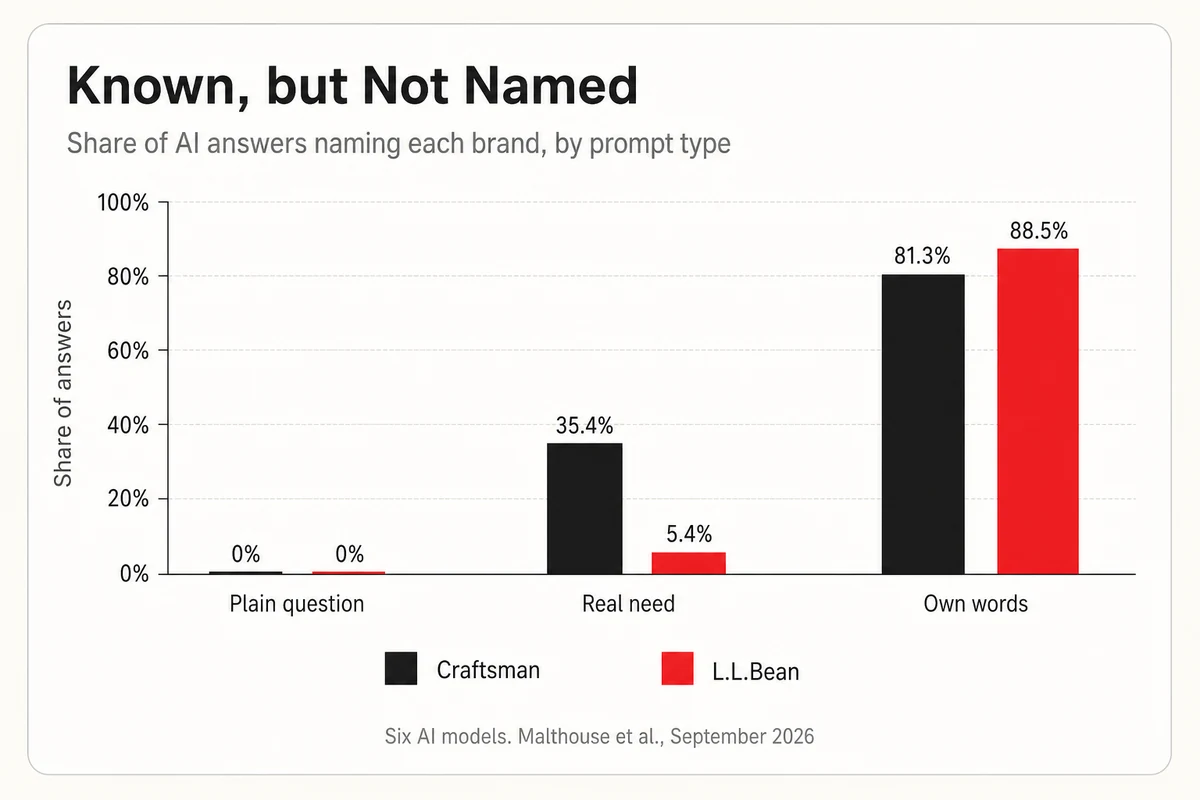
The authors read this carefully, and their reading is worth repeating. The low rates on the first two rungs can't be put down to the models not knowing the brand. The brand can be retrieved. What's missing is the link between the brand and the way people ask. They write that visibility alone is unlikely to be enough, and that what a brand is associated with matters too. It's a different failure from the one in our post on why a competitor gets named instead of you, which is about whether a live assistant reads your pages. In the study, this one showed up with search switched off.
A Mobile Car Wash Went 0 for 31 on the Plain Question
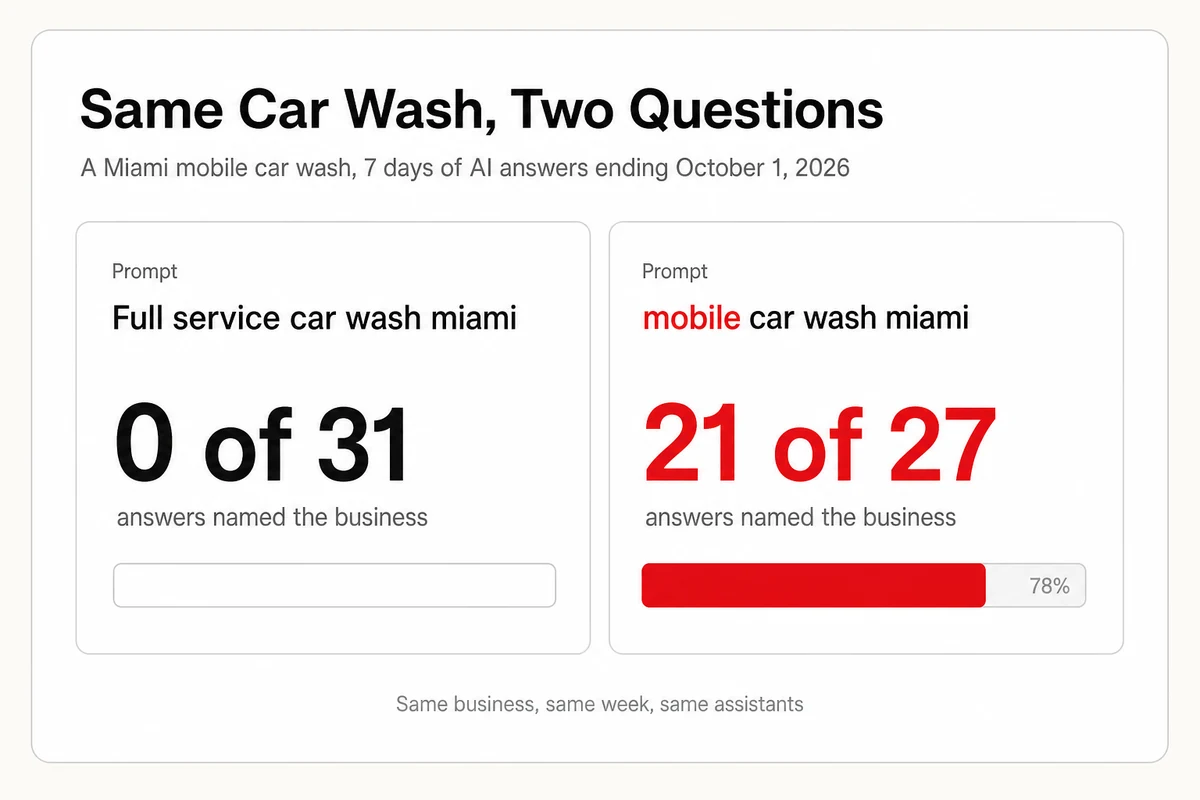
That study tested national brands with search switched off. Here's the same pattern in a local business, on live assistants with search on. A mobile car wash in Miami follows its prompts in the Lighthouse Local AI visibility tracker, the same business we profiled in our guide to AI visibility for a local business. Two of its prompts make a natural ladder. One is the closest thing it tracks to a plain category question, a full-service car wash in Miami. The other trades full service for the word the business is built around, mobile.
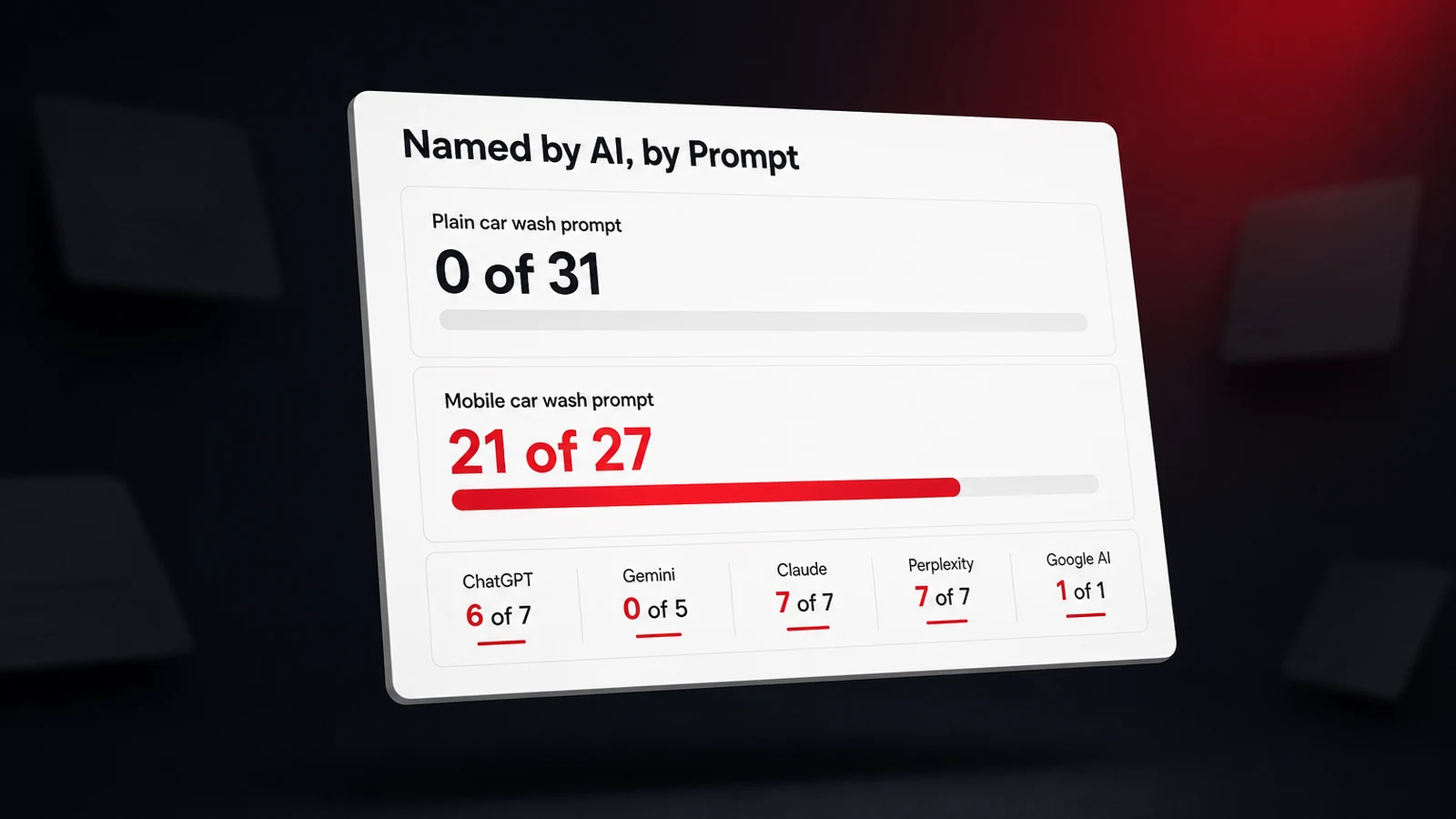
Over the seven days ending October 1, 2026, the tracker captured 31 answers to the plain prompt across ChatGPT, Gemini, Claude, Perplexity, and Google AI, and none of them named the car wash. Over the same seven days it captured 27 answers to the mobile prompt, and the car wash was named in 21.
| Assistant | Plain prompt, answers naming it | Mobile prompt, answers naming it |
|---|---|---|
| ChatGPT | 0 of 7 | 6 of 7 |
| Gemini | 0 of 5 | 0 of 5 |
| Claude | 0 of 7 | 7 of 7 |
| Perplexity | 0 of 7 | 7 of 7 |
| Google AI | 0 of 5 | 1 of 1 |
Two things stand out. First, the business didn't change between the two prompts. Same business, same week, same assistants. The wording of the question decided whether four of the assistants named it at all, and Gemini passed over it both times. Second, on the plain prompt Perplexity used the car wash's own website as a source in five of its seven answers and still didn't name it. The assistant had the business open in front of it and picked other names, most likely because a company known for coming to your driveway isn't what a full-service car wash question calls for.
The wider 30-day view agrees. Of the fifteen prompts the car wash follows that include the word mobile, twelve were answered with its name at least once by four or more of the five we track. Its two plain shortlist prompts, one for a full-service car wash and one for a hand car wash, were each named by two or fewer. And one prompt sits on the middle rung. It asks for a car washing service at home, never says mobile, and four assistants named the business for it. One business and one week isn't a study. It's a pattern worth checking in your own answers.
Where You First Appear Tells You What to Fix
Run your own business up the ladder and the rung where your name first shows up is a diagnosis. Each one points at different work.
| Where your name first appears | What the model is telling you | Where to start |
|---|---|---|
| The plain question | You're a default pick for the category | Protect it. Keep the facts behind it current and watch for a rival taking the slot |
| The real need | It knows who you're right for, but doesn't file you under the category | Say the category in plain words everywhere a machine reads you, starting with your profile category, page titles, and homepage |
| Your own words only | It knows your pitch, and your pitch isn't how customers ask | Rewrite service pages and listings in the customer's phrasing, and ask reviewers to describe the job you did for them |
| Nowhere | It isn't connecting you to any of these questions yet | Start with the record. Listings, reviews, and a site a machine can read |
The second and third rows are where the study's two brands sat, and they're the rows owners overlook, because the business feels known. The paper's advice for them is the oldest idea in positioning. Make sure you have the basics that qualify you for the category, then own a small number of differences that matter to the customer, and say both the same way everywhere. For a local business, everywhere means your site, your Google Business Profile, your directory listings, and the words customers use when they write about you, since reviews shape which businesses AI recommends. The car wash is a useful warning in the other direction. It owns its difference so completely that the plain category question passes it by.
The last row is a different problem with a more mechanical fix. If no prompt brings up your name, start with what a machine can read on your own site. A free Lighthouse Local audit scans it and hands back a ranked list of fixes, covering things like whether crawlers can get to your pages and whether your name, services, and area are labeled so software can pick them out.
Being Searched For Beat Being Advertised
The same study checked which outside signals moved together with how prominently a brand got recommended. The researchers gathered five for each brand, covering Google search interest, online conversation, news coverage, Wikipedia page views, and advertising spend. Search interest was the strongest of the set by a clear margin, with online conversation second. News, Wikipedia views, and ad spend added little once the others were counted. Conventional brand popularity scores showed little consistent relationship with who got recommended.
The authors are firm that this is a correlation and that nobody should go chase a search-trend number. The honest reading is narrower and still useful. The brands the models reach for are the ones people are looking up and talking about now, not simply the ones with the biggest ad budgets. It likely runs both ways. A separate June 2026 preprint from researchers at an AI visibility company, which linked people's AI conversations to their browsing, found that when an assistant recommended a brand to someone who hadn't engaged with it lately, that person's Google searches for the brand's name rose by about four percentage points. Getting named creates the searches that go along with getting named.
For a local business the nearest equivalent is review volume. A September 2026 audit of AI recommendations in local service markets compared the restaurants AI recommended against the wider market. Recommended restaurants had three to five times the review count of a typical one, and ratings higher by a tenth of a star at most. The recommended places stood out for how much people had said about them, far more than for how highly they were rated.
Climb It Yourself in Twenty Minutes
Write three prompts for your main service, one per rung, and fill in the brackets.
Rung 1, the plain question
Who should I call for [service] in [town]?

Rung 2, the real need
I'm a [type of customer] in [town] and I need [service] because [situation]. I care most about [one priority]. Who should I call?

Rung 3, your own words
I'm looking for a [service] company in [town] that [your main selling point, worded the way your website words it]. Who should I call?
Leave your business name out of every one. Ask each prompt several times in a new chat, signed out where the assistant allows it, because your own history tilts the answer, which is the reason AI recommendations differ by user. Then repeat on each assistant your customers use, and count how many answers name you on each rung. The study's authors ran every plain prompt 40 times per model before they trusted a rate, and an April 2026 paper on measuring visibility in AI search recommends at least seven runs per prompt per day, because a single daily answer can't give a reliable estimate.
That's a lot of asking by hand, and it's the part worth handing off. The three rungs are just three prompts, so add them to your Lighthouse Local tracker and it asks each assistant on a schedule, keeps every answer, and marks the ones that name you, which is how the car wash numbers above were counted. When the ladder shows a gap you'd prefer not to close alone, the specialists behind Lighthouse Local for Business do the page, listing, and profile work, and you approve each change.
Known Is Where It Starts, Named Is the Work
The uncomfortable part of this research is that reputation doesn't transfer on its own. A household name got passed over by six models on the simplest question in its category, and a car wash with strong answers on its specialty vanished when the word mobile left the prompt. Neither can be written off as unknown. Both look like an association problem, and associations are built from what you say about yourself, what customers say about you, and whether the two match the way people ask.
So find your rung, fix the link it points to, and measure again in a month, since tracking your visibility in AI search only means something as a trend. Being known gets you into the model. Getting named takes being tied to the question.
Frequently asked questions
Why doesn't ChatGPT recommend my business when it clearly knows about it?
Because knowing a business and connecting it to a question are separate steps. In a 2026 study run with web search off, six AI models never suggested L.L.Bean for a plain hiking jacket request, then named it in nearly nine answers out of ten when researchers rewrote the prompt in the brand's own marketing language. If you're known but skipped, the gap may be between what you're known for and how customers phrase the question.
How do I test whether AI recommends my business?
Write three prompts without your business name. One names only your service and town, one adds a customer and a situation, and one describes the service the way your own website does. Ask each several times in a fresh chat on every assistant your customers use, and count how often you're named. The first prompt where your name appears shows what to work on.
Does advertising make AI more likely to recommend a business?
Not by itself. In the 2026 study, advertising spend moved in step with how prominently a brand was recommended, but added little once search interest and online conversation were counted. Google search interest in the brand was the strongest signal. The authors stress this is a correlation, so treat it as a sign that current customer attention matters more than budget alone.
Do well-known brands always get recommended by AI?
No. In the study, established brands including L.L.Bean, Eddie Bauer, Craftsman, and Freshpet received no recommendations at all on plain category questions, while the models kept returning to a small set of other names. Fame measured the traditional way had little consistent relationship with which brands the models suggested.
How many times should I run a prompt before trusting the result?
More than once, and ideally several times a day. The study ran each plain prompt 40 times per model, and separate 2026 research on AI search recommends at least seven runs per prompt per day for brand monitoring. A single answer tells you what one run said, not how often you're named.